
Todd Hido
American, b. 19682653, 2000
Archival pigment print mounted on aluminium Dibond.
61 x 50.8 cm / 24 x 20 in
96.5 x 76.2 cm / 38 x 30 in
121.9 x 96.5 cm / 48 x 38 in
187.3 x 149.9 cm / 73 3/4 x 59 in
Signed, titled, numbered, and dated on a label affixed to the verso of the mount
Edition of 10 + 3 AP — 61 x 50.8 cm / 24 x 20 in
Edition of 5 + 1AP — 96.5 x 76.2 cm / 38 x 30 in (Sold out)
Edition of 3 + 1AP — 121.9 x 96.5 cm / 48 x 38 in
Edition of 1 + 1 AP NFS — 187.3 x 149.9 cm / 73 3/4 x 59 in (Sold out)
© The Artist
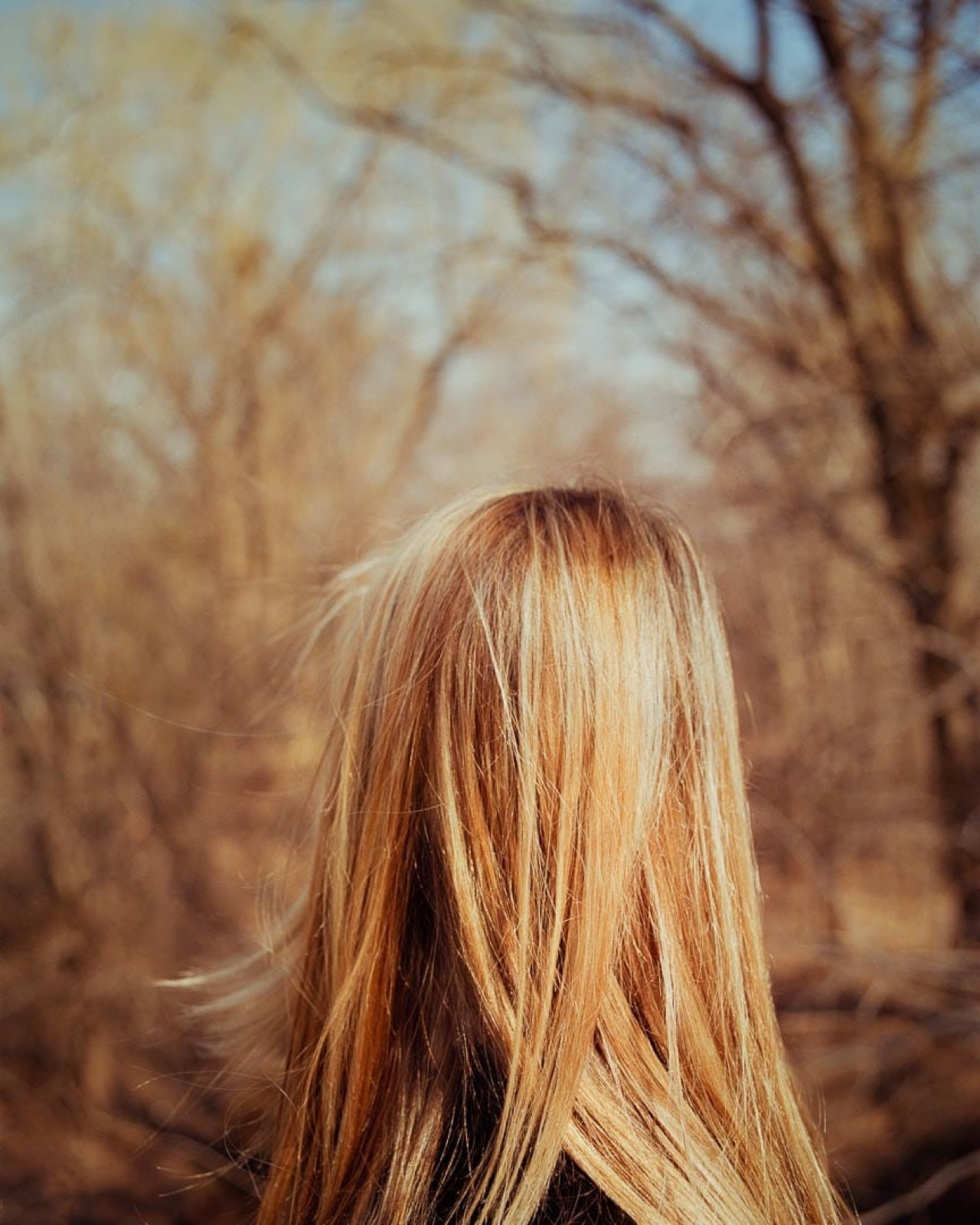
A head, turned away, with no face to offer. The blonde hair falls forward and across, a single sheet of it, so that what should be a portrait becomes its refusal: the woman has rotated out of the genre even as she stays inside the frame. We are left to read a person by the back of the head, by the catch of low winter light along strands that the camera renders sharp while the bare branches behind dissolve into a soft brown weather. That shallow depth is the whole argument. One plane is described; the rest is atmosphere.
This belongs to Hido's Roaming, the body of work in which he moved his attention from the lit suburban house to figures set loose in semi-rural land. The procedure stays the same — overcast light, the colourist's print, a stillness borrowed from cinema's between-frames. What changes is the object. A house photographed at night is already a kind of face, a front with windows for eyes. Here the human face is present and withheld at once, and the picture turns on that withholding. It is less a likeness than a study of how little a photograph needs in order to imply a life.
The image does its work by subtraction. No expression, no eyeline, no narrative supplied — only the fact of hair, light and the cold field beyond, and the viewer's reflex to complete what is missing. Hido's standing rests on pictures exactly this economical; held in major collections and across the monographs that have made Roaming a touchstone, the series is now firmly inside the photographic canon. Offered here at scale, the frame keeps its restraint and gains presence: a portrait that declines to be one, and is stronger for the decline.