Amber has soaked into everything here — the road, the curb, the fog itself — until colour stops describing objects and becomes the weather of the picture. Out of that saturation one sharp incident survives: across the rear window of a parked car, frost or condensation has spread in fine ferning branches, a crystalline filigree holding focus where the rest of the frame surrenders to dissolution. It is the kind of detail a moving eye would miss and only a long exposure can hold: the lamp above is not a flash but a slow accumulation of light, and the fog around it is time made visible, gathering on glass while the camera waited.
What Hido is photographing here is less a street than a condition. The sodium lamp does not illuminate so much as saturate, so that depth collapses and the road, the curb, the low shape of the car all hang at roughly the same distance from us — flattened, frontal, almost a screen. The picture withholds the cut to the next shot that cinema would supply. We are left inside a single frame that refuses to advance, which is precisely the still photograph's privilege and its melancholy: it can stop a car forever under a light, but it cannot tell us who left it there.
This is the register Hido has worked since the mid-1990s — the nocturnal American suburb shot from the sidewalk or the car, on film, with the patience that color negative at night demands. The pictures are known by number rather than name, "1738" among them, a deliberate refusal of anecdote that pushes everything back onto looking. Held now as large archival pigment prints, their grain and amber bloom survive the change of medium intact, which is its own quiet argument: the mood was never an accident of process but the subject itself.
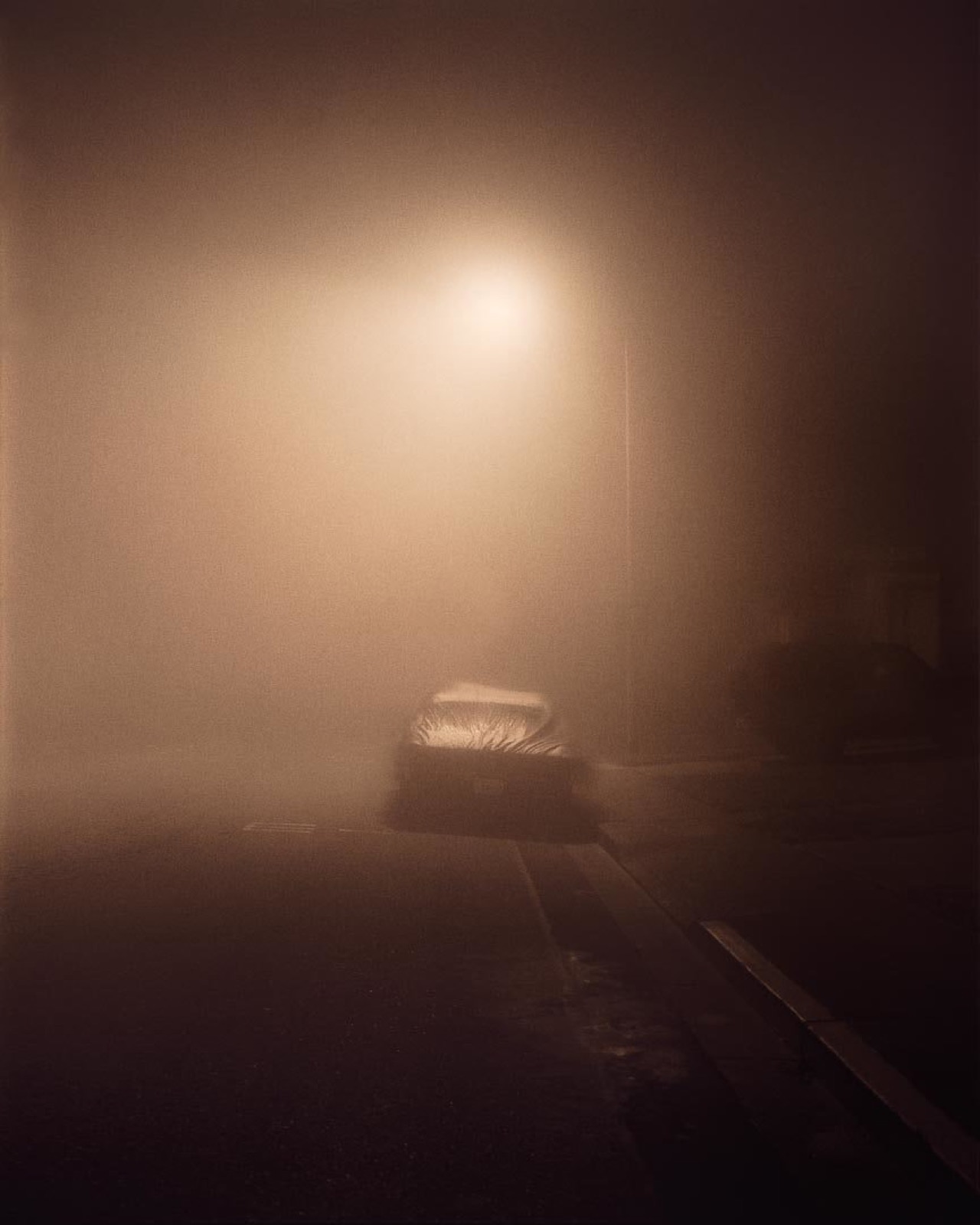

Amber has soaked into everything here — the road, the curb, the fog itself — until colour stops describing objects and becomes the weather of the picture. Out of that saturation one sharp incident survives: across the rear window of a parked car, frost or condensation has spread in fine ferning branches, a crystalline filigree holding focus where the rest of the frame surrenders to dissolution. It is the kind of detail a moving eye would miss and only a long exposure can hold: the lamp above is not a flash but a slow accumulation of light, and the fog around it is time made visible, gathering on glass while the camera waited.
What Hido is photographing here is less a street than a condition. The sodium lamp does not illuminate so much as saturate, so that depth collapses and the road, the curb, the low shape of the car all hang at roughly the same distance from us — flattened, frontal, almost a screen. The picture withholds the cut to the next shot that cinema would supply. We are left inside a single frame that refuses to advance, which is precisely the still photograph's privilege and its melancholy: it can stop a car forever under a light, but it cannot tell us who left it there.
This is the register Hido has worked since the mid-1990s — the nocturnal American suburb shot from the sidewalk or the car, on film, with the patience that color negative at night demands. The pictures are known by number rather than name, "1738" among them, a deliberate refusal of anecdote that pushes everything back onto looking. Held now as large archival pigment prints, their grain and amber bloom survive the change of medium intact, which is its own quiet argument: the mood was never an accident of process but the subject itself.