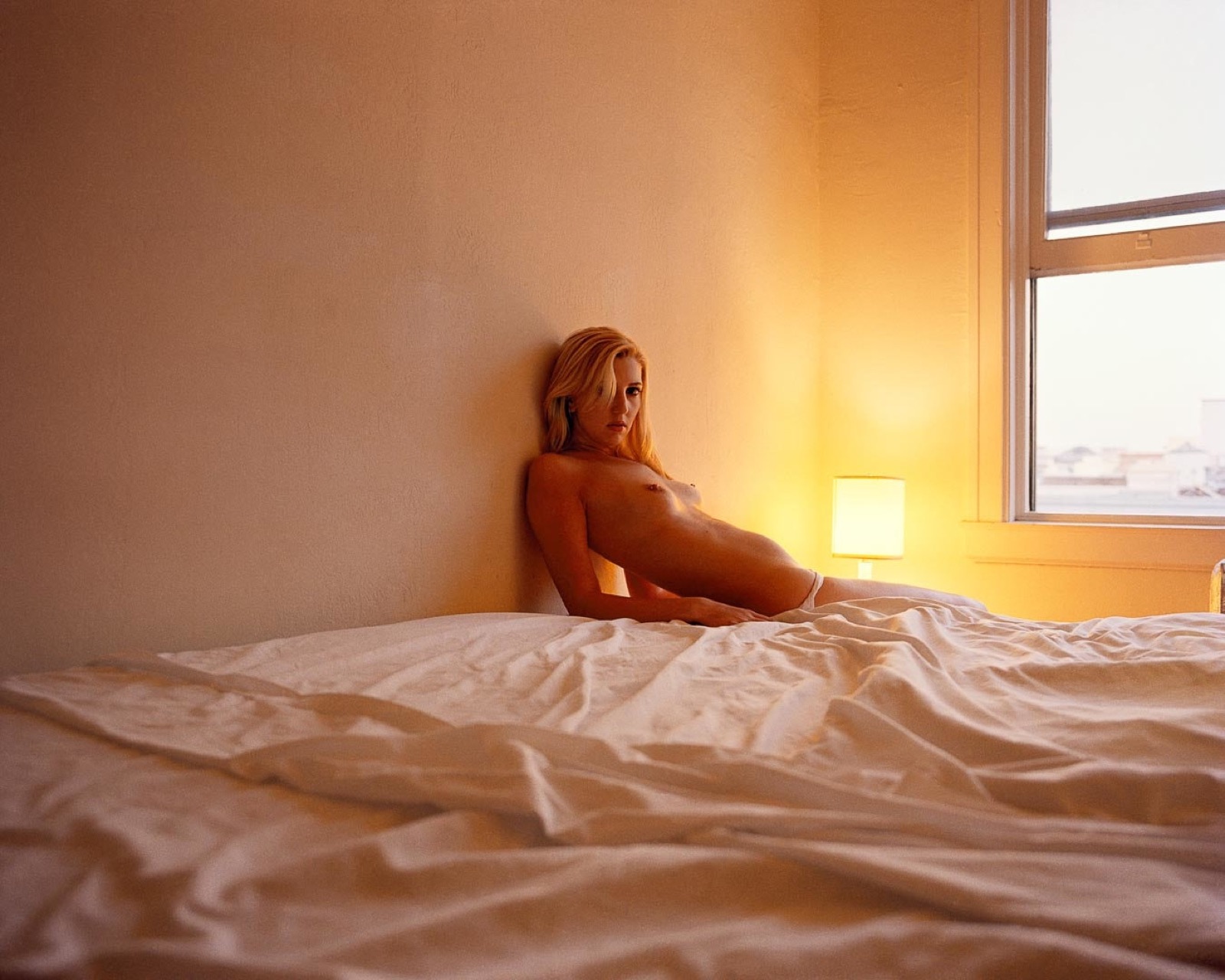
Todd Hido came to the figure from the outside in. For years he photographed suburban houses at night, their curtained windows glowing with lives he never showed; 3680, made in 2005, reads like the reverse shot those pictures withheld. Here, at last, is an interior: a room steeped in tungsten amber, a lamp burning beside a window of blank white daylight, rooftops beyond the glass, and a woman installed where the light used to be.
Nothing in the scene is casual, and that is its subject. She reclines, undressed but for white underwear, against the wall as though the bed were a raked stage; hair falls across one eye, and her gaze meets the lens without surrendering anything. Two light sources argue over her — the lamp's domestic heat, the window's cold vacancy — while the rumpled sheets rise in the foreground like terrain, carrying more narrative weather than the body does. Hido works in the tableau register of diCorcia or a Hopper canvas, but strips out incident until atmosphere alone is left holding the plot.
The title is a number, not a name: the archival address of an image that solicits story while refusing anecdote. That refusal is its contemporary intelligence. The eroticism is a decoy; the real charge is narrative, suspended indefinitely between the lamp and the window.
Todd Hido came to the figure from the outside in. For years he photographed suburban houses at night, their curtained windows glowing with lives he never showed; 3680, made in 2005, reads like the reverse shot those pictures withheld. Here, at last, is an interior: a room steeped in tungsten amber, a lamp burning beside a window of blank white daylight, rooftops beyond the glass, and a woman installed where the light used to be.
Nothing in the scene is casual, and that is its subject. She reclines, undressed but for white underwear, against the wall as though the bed were a raked stage; hair falls across one eye, and her gaze meets the lens without surrendering anything. Two light sources argue over her — the lamp's domestic heat, the window's cold vacancy — while the rumpled sheets rise in the foreground like terrain, carrying more narrative weather than the body does. Hido works in the tableau register of diCorcia or a Hopper canvas, but strips out incident until atmosphere alone is left holding the plot.
The title is a number, not a name: the archival address of an image that solicits story while refusing anecdote. That refusal is its contemporary intelligence. The eroticism is a decoy; the real charge is narrative, suspended indefinitely between the lamp and the window.