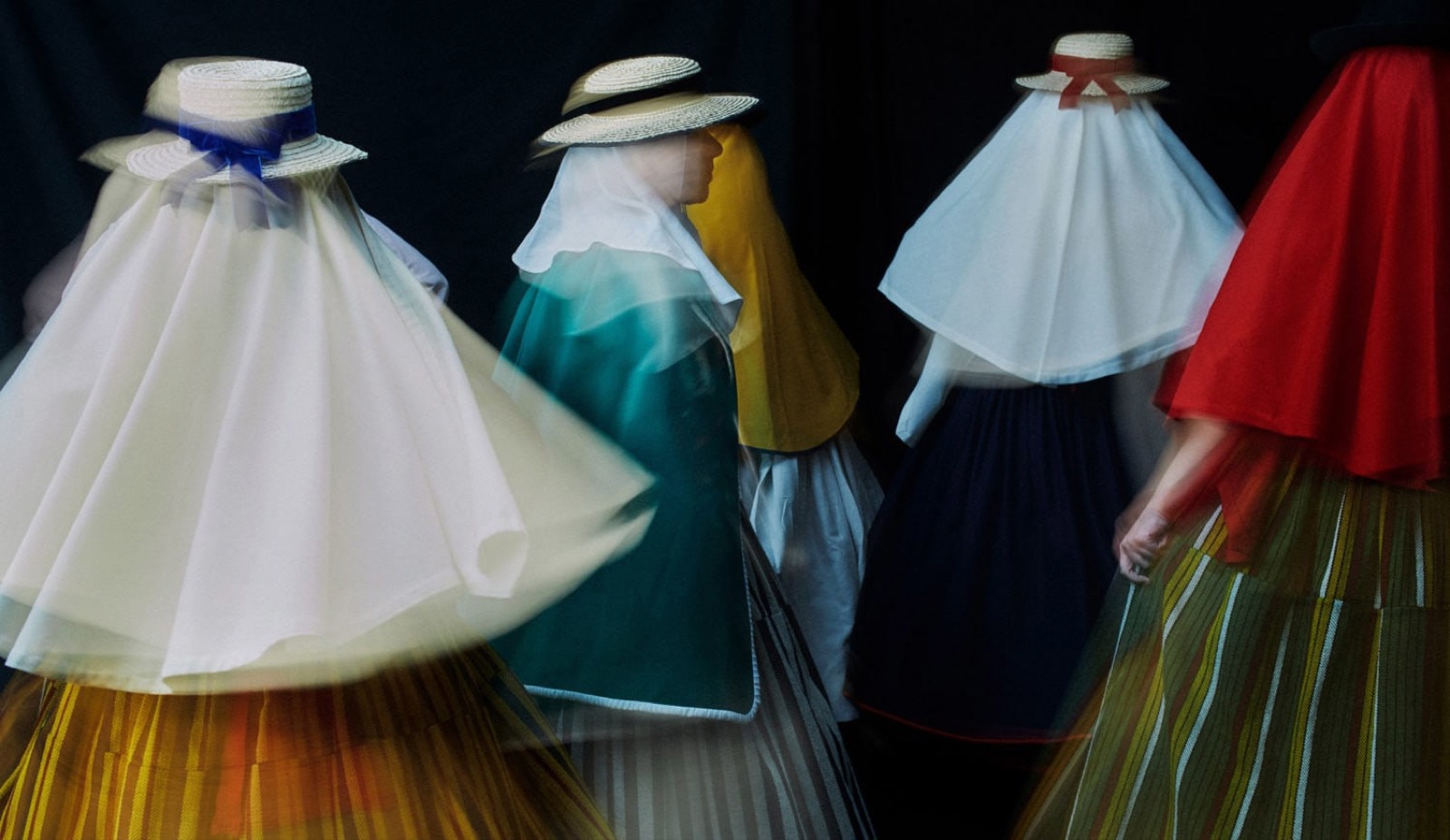
A knot of blue ribbon, tied at the brim of a straw boater, holds a veil of sheer white cloth against the air; and once you have seen it, the same small fastening repeats down the line — a red bow here, a plain band there, each pinning a colored shroud to a hat. It is the least conspicuous thing in the frame and the one that explains the rest.
These are the everyday hats of the Canary Islands, the flat sombreros that island women wore to church and market, and the photographer has caught a row of them mid-turn, so the long exposure drags each veil into a moving smear of white, teal, yellow and red. The costumes are folk objects with a history of use; the picture treats them as sculpture that will not hold still. Striped skirts — golden, navy, olive — anchor the base while the upper bodies blur toward abstraction.
The series turns regional dress into something close to procession, honoring the vernacular without collapsing into postcard. Working from the front rank of Spanish fashion photography and its major magazines, the photographer brings a studio eye to a living tradition, and the result is issued as an archival pigment print, a stable process whose flat, saturated surface suits these clean blocks of ribbon color. What remains is less a document than a made thing: costume, movement and pigment pressed into one object. Prints like this circulate far from Tenerife, carrying a local rite into rooms that have never seen it.

A knot of blue ribbon, tied at the brim of a straw boater, holds a veil of sheer white cloth against the air; and once you have seen it, the same small fastening repeats down the line — a red bow here, a plain band there, each pinning a colored shroud to a hat. It is the least conspicuous thing in the frame and the one that explains the rest.
These are the everyday hats of the Canary Islands, the flat sombreros that island women wore to church and market, and the photographer has caught a row of them mid-turn, so the long exposure drags each veil into a moving smear of white, teal, yellow and red. The costumes are folk objects with a history of use; the picture treats them as sculpture that will not hold still. Striped skirts — golden, navy, olive — anchor the base while the upper bodies blur toward abstraction.
The series turns regional dress into something close to procession, honoring the vernacular without collapsing into postcard. Working from the front rank of Spanish fashion photography and its major magazines, the photographer brings a studio eye to a living tradition, and the result is issued as an archival pigment print, a stable process whose flat, saturated surface suits these clean blocks of ribbon color. What remains is less a document than a made thing: costume, movement and pigment pressed into one object. Prints like this circulate far from Tenerife, carrying a local rite into rooms that have never seen it.