Long before fashion had a season, a mountain town like Candelario kept its finest dress for feast days and rites of invitation, and here a woman lifts exactly such a costume into the light — a heavy red skirt worked with black damask, an emerald sash crossed at the breast — as if performing it once more for the camera. She does not look up; the gesture is for the cloth, not for us.
Everything about the lighting recalls Spanish painting: a single source lifts the figure from a black ground, gilding the green silk and the black-on-red appliqué while consigning the rest to shadow. Yet this is emphatically a photograph, and it knows the difference — it freezes a real body mid-gesture, the skirt swung wide, the head bowed, the white lace stockings and patent shoes caught in the middle of a step. Gold at the throat and ears flares where the light finds it. The image borrows the authority of the museum and keeps the immediacy of the shutter.
The series photographs regional Spanish dress not as costume history but as living material, and this is among its most painterly frames. Working from the front rank of Spanish fashion photography and the magazines that define it, the photographer treats a village heirloom with the seriousness usually reserved for couture. As an archival pigment print, the deep blacks stay dense and the reds hold their heat, so the object reads as both garment and event. An invitation, the title says — to a ceremony we are permitted only to watch.
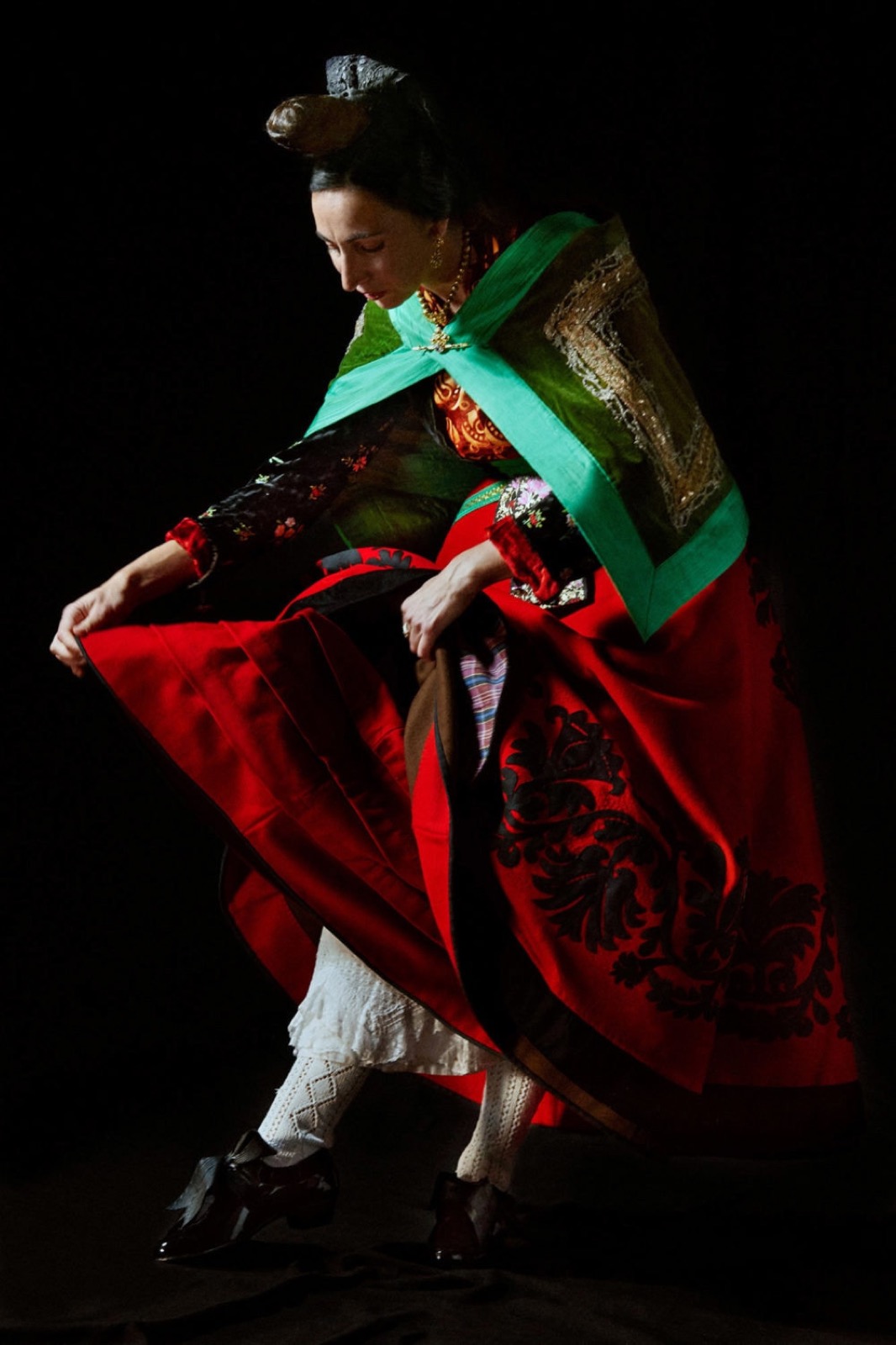

Long before fashion had a season, a mountain town like Candelario kept its finest dress for feast days and rites of invitation, and here a woman lifts exactly such a costume into the light — a heavy red skirt worked with black damask, an emerald sash crossed at the breast — as if performing it once more for the camera. She does not look up; the gesture is for the cloth, not for us.
Everything about the lighting recalls Spanish painting: a single source lifts the figure from a black ground, gilding the green silk and the black-on-red appliqué while consigning the rest to shadow. Yet this is emphatically a photograph, and it knows the difference — it freezes a real body mid-gesture, the skirt swung wide, the head bowed, the white lace stockings and patent shoes caught in the middle of a step. Gold at the throat and ears flares where the light finds it. The image borrows the authority of the museum and keeps the immediacy of the shutter.
The series photographs regional Spanish dress not as costume history but as living material, and this is among its most painterly frames. Working from the front rank of Spanish fashion photography and the magazines that define it, the photographer treats a village heirloom with the seriousness usually reserved for couture. As an archival pigment print, the deep blacks stay dense and the reds hold their heat, so the object reads as both garment and event. An invitation, the title says — to a ceremony we are permitted only to watch.