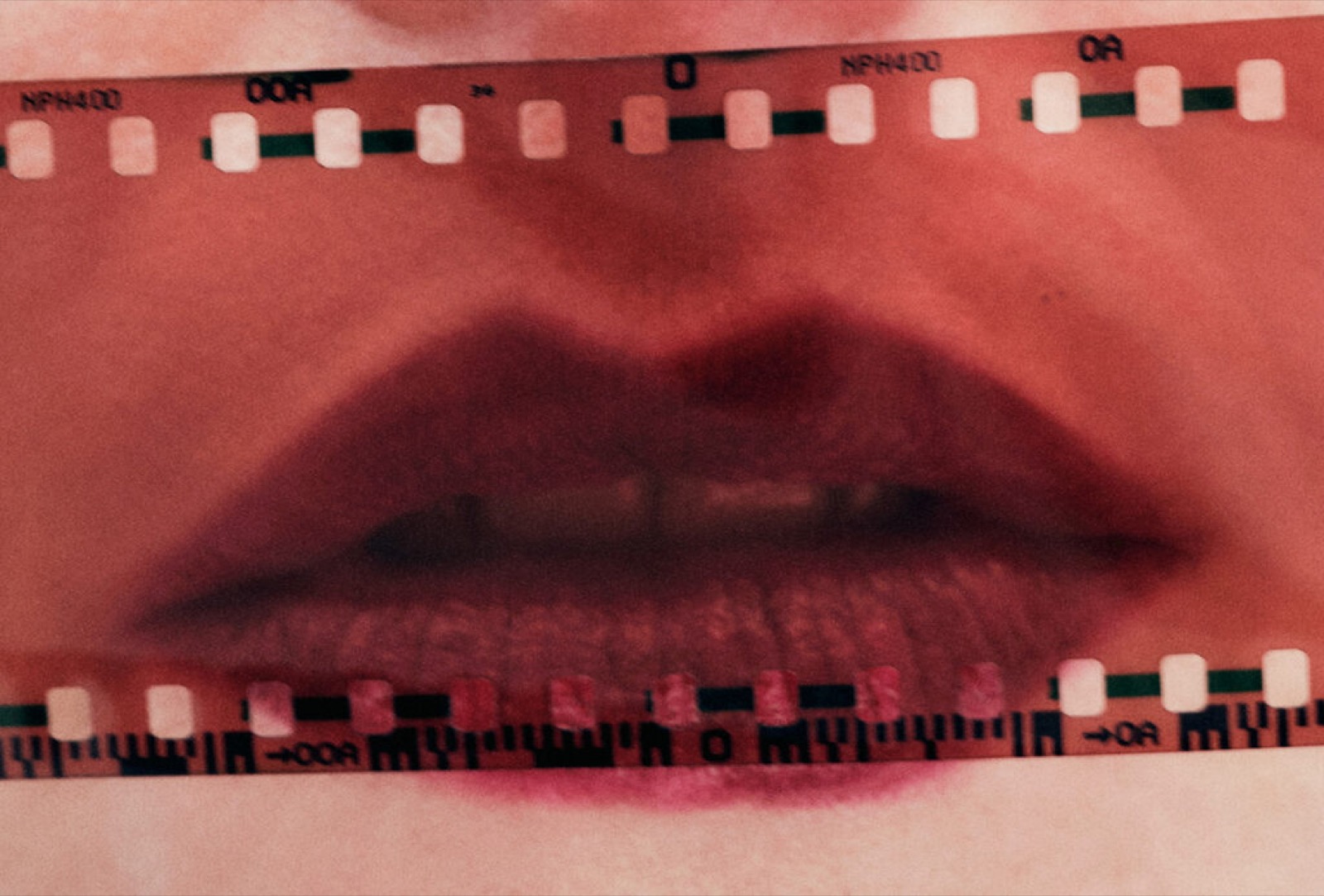
A roll of NPH400 could still be bought over a counter, loaded, and run through a camera in the recent past; this picture speaks from its far edge. Yeste lays two strips of that colour negative across a mouth — Bárbara Lennie’s, parted, warm, faintly out of focus — so the film becomes as much the subject as the lips beneath it. The perforated margins, the printed edge codes, the row of sprocket holes glowing pink: these are the true skin of the image.
This is a photograph of a photographic thing: emulsion once handled in the dark, cut with scissors, held up to a bulb to be read. Everything soft in the mouth is answered by everything precise in the edge printing — NPH400, a stray frame number, the letters running along the lower strip. Chemistry meets flesh, and neither wins. The lips stay just past legibility, a colour between rose and bruise, while the film that would ordinarily record them lies across them instead.
Yeste belongs to the front rank of Spanish fashion photography, his work for Vogue and Harper’s Bazaar shot through with an elemental streak — fire, water, wind, and here the vanished material of film itself. That it survives as an archival pigment print is its own small irony: the analogue relic reborn on an inkjet bed, its perforations and glowing sprockets rendered with a permanence the original negative never had. The mouth keeps its secret. What you remember afterward is the strip, and the era it quietly mourns.
A roll of NPH400 could still be bought over a counter, loaded, and run through a camera in the recent past; this picture speaks from its far edge. Yeste lays two strips of that colour negative across a mouth — Bárbara Lennie’s, parted, warm, faintly out of focus — so the film becomes as much the subject as the lips beneath it. The perforated margins, the printed edge codes, the row of sprocket holes glowing pink: these are the true skin of the image.
This is a photograph of a photographic thing: emulsion once handled in the dark, cut with scissors, held up to a bulb to be read. Everything soft in the mouth is answered by everything precise in the edge printing — NPH400, a stray frame number, the letters running along the lower strip. Chemistry meets flesh, and neither wins. The lips stay just past legibility, a colour between rose and bruise, while the film that would ordinarily record them lies across them instead.
Yeste belongs to the front rank of Spanish fashion photography, his work for Vogue and Harper’s Bazaar shot through with an elemental streak — fire, water, wind, and here the vanished material of film itself. That it survives as an archival pigment print is its own small irony: the analogue relic reborn on an inkjet bed, its perforations and glowing sprockets rendered with a permanence the original negative never had. The mouth keeps its secret. What you remember afterward is the strip, and the era it quietly mourns.