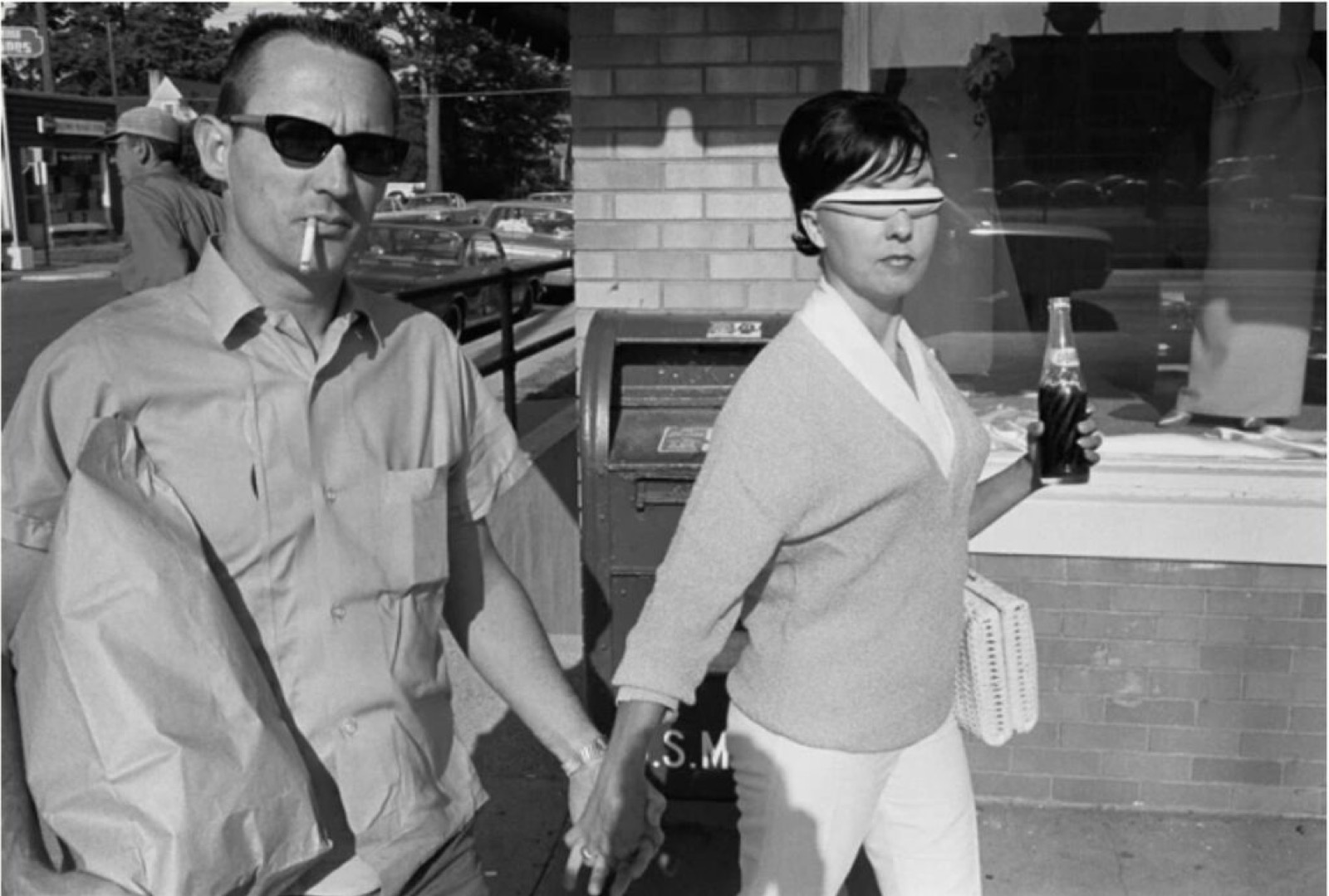
The whites gather on one body. The woman wears white-rimmed visor sunglasses, a pale cardigan, white trousers, and carries a white woven box of a purse, so that she reads almost as a single luminous unit against the gray brick and the darker figure beside her. He is her tonal opposite: dark glasses, a cigarette clamped in his lips, a garment slung over one shoulder, his mid-tones sinking into shadow. Between them, at the frame’s base, their hands are clasped, her ring catching the light.
Attend to the objects that make such a street legible, this one dense with them. A U.S. Mail box stands between the couple like a chaperone, its lettering a reminder that this is a landscape built for the circulation of things — letters, cigarettes, dry-cleaning, the cold glass Coca-Cola bottle she holds by the neck, its dark liquid the deepest note in the picture. Each is a mass-produced object recorded as evenly as the two faces. Nothing is incidental here; the vernacular world is the subject.
Meyerowitz made this on the street, in black and white, years before the color work that, with Shore and Eggleston, changed the medium’s status and secured him a place at MoMA, the Met and the Boston MFA. What already distinguishes him is a describer’s evenhandedness, the refusal to rank a purse below a portrait. As an archival pigment print the tonal scale is clean, from the blown highlight on her trousers to the tar-black of the bottle. It is, finally, a photograph about the feel of a hot American afternoon.
The whites gather on one body. The woman wears white-rimmed visor sunglasses, a pale cardigan, white trousers, and carries a white woven box of a purse, so that she reads almost as a single luminous unit against the gray brick and the darker figure beside her. He is her tonal opposite: dark glasses, a cigarette clamped in his lips, a garment slung over one shoulder, his mid-tones sinking into shadow. Between them, at the frame’s base, their hands are clasped, her ring catching the light.
Attend to the objects that make such a street legible, this one dense with them. A U.S. Mail box stands between the couple like a chaperone, its lettering a reminder that this is a landscape built for the circulation of things — letters, cigarettes, dry-cleaning, the cold glass Coca-Cola bottle she holds by the neck, its dark liquid the deepest note in the picture. Each is a mass-produced object recorded as evenly as the two faces. Nothing is incidental here; the vernacular world is the subject.
Meyerowitz made this on the street, in black and white, years before the color work that, with Shore and Eggleston, changed the medium’s status and secured him a place at MoMA, the Met and the Boston MFA. What already distinguishes him is a describer’s evenhandedness, the refusal to rank a purse below a portrait. As an archival pigment print the tonal scale is clean, from the blown highlight on her trousers to the tar-black of the bottle. It is, finally, a photograph about the feel of a hot American afternoon.