The only weather in this room is on the screen. Everything else — the dark archway, the tufted leather at the left edge, the ornate mantel and its small convex mirror — sits in a domestic dusk, while the pulled-down projection screen burns with a borrowed brightness, a hazy seascape or a stretch of pale water under a blown-out sky. The light of a distant afternoon has been carried indoors on a beam and thrown against cloth. It is the brightest thing here, and also the least real.
Behind the screen a person stands, given away by feet and a floral hem beneath the tripod. They are eclipsed by the very picture they came to show, present as legs and absent as a face. There is a gentle irony in this: the machine for sharing a view has swallowed its operator. Meyerowitz lets the accident stand, trusting the room to say more than a tidier arrangement could. A music stand, a leaning guitar, a trailing cable: the props of an evening at home.
He would soon give himself over to color and the view camera, to the Atlantic light of Cape Light and the long American afternoons that made his name beside Shore and Eggleston and placed his work in MoMA, the Met and the Boston MFA. Here that fascination is already latent, displaced onto a projected sea. As an archival pigment print the image holds its low interior tones against the flaring screen without losing either. It is, above all, a photograph about looking at photographs.
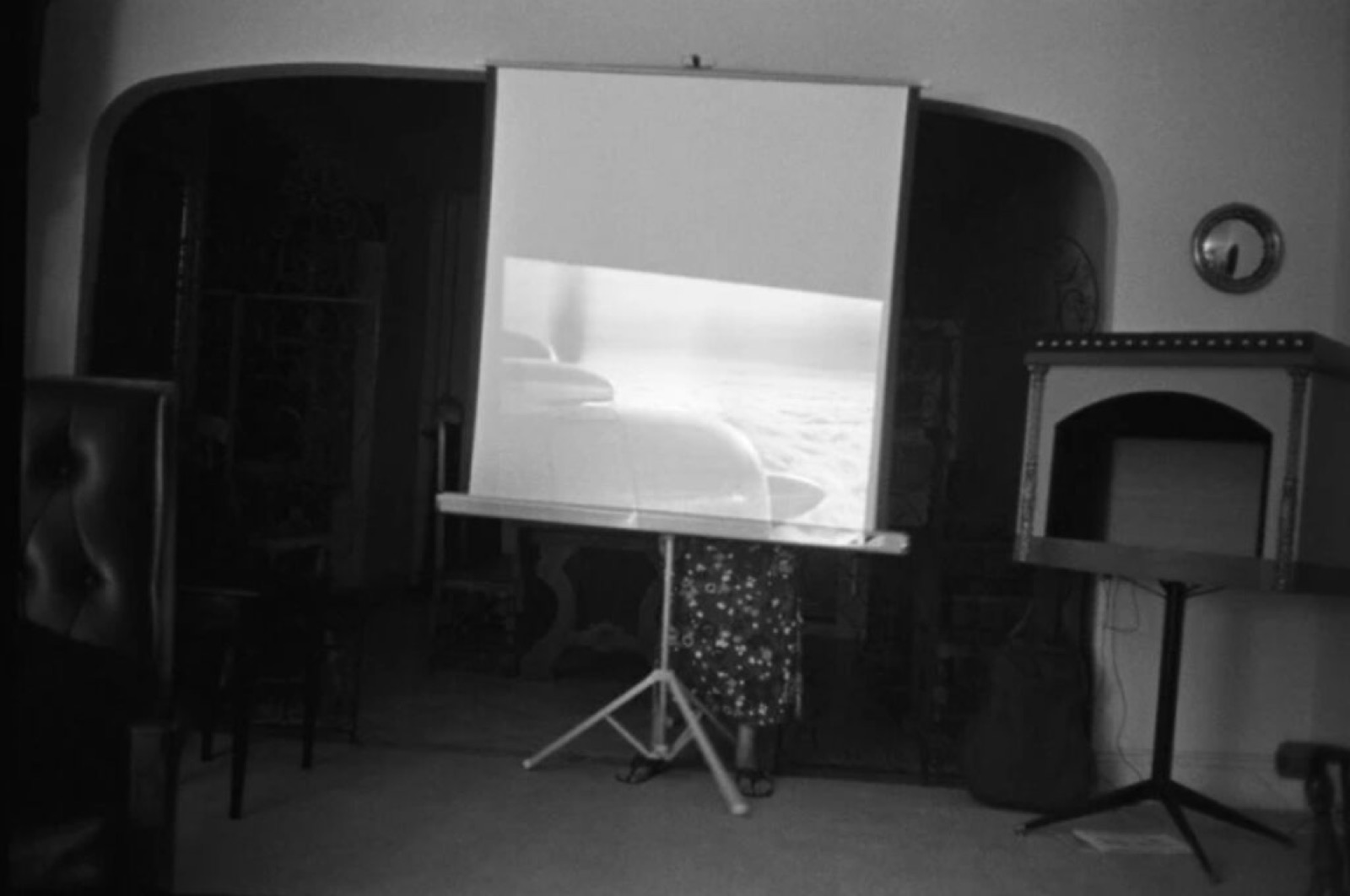
The only weather in this room is on the screen. Everything else — the dark archway, the tufted leather at the left edge, the ornate mantel and its small convex mirror — sits in a domestic dusk, while the pulled-down projection screen burns with a borrowed brightness, a hazy seascape or a stretch of pale water under a blown-out sky. The light of a distant afternoon has been carried indoors on a beam and thrown against cloth. It is the brightest thing here, and also the least real.
Behind the screen a person stands, given away by feet and a floral hem beneath the tripod. They are eclipsed by the very picture they came to show, present as legs and absent as a face. There is a gentle irony in this: the machine for sharing a view has swallowed its operator. Meyerowitz lets the accident stand, trusting the room to say more than a tidier arrangement could. A music stand, a leaning guitar, a trailing cable: the props of an evening at home.
He would soon give himself over to color and the view camera, to the Atlantic light of Cape Light and the long American afternoons that made his name beside Shore and Eggleston and placed his work in MoMA, the Met and the Boston MFA. Here that fascination is already latent, displaced onto a projected sea. As an archival pigment print the image holds its low interior tones against the flaring screen without losing either. It is, above all, a photograph about looking at photographs.