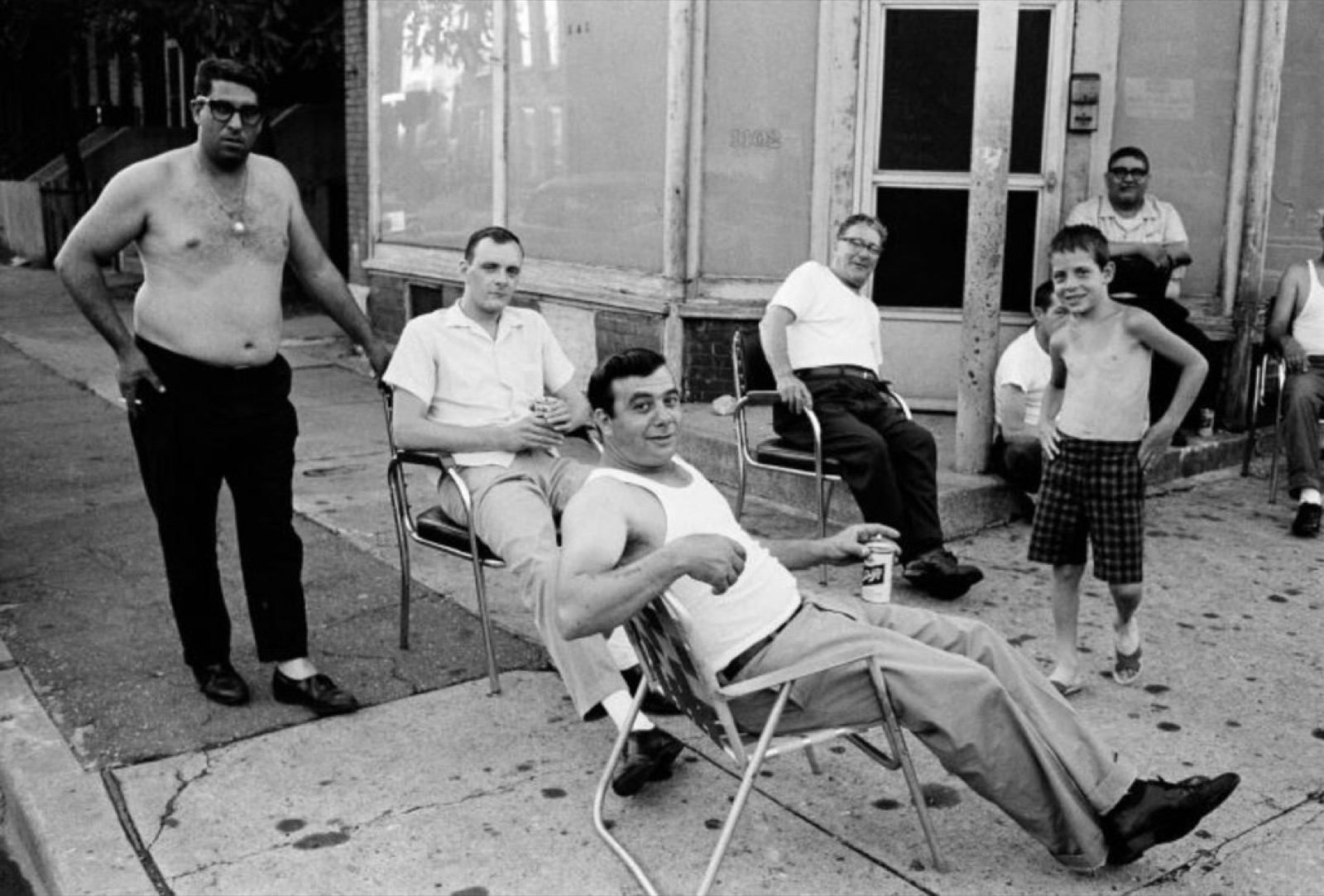
A paper cup, held loosely in the reclining man’s fist, is the hinge on which the whole scene turns. He sprawls in a folding lawn chair set out on the public sidewalk as though it were a porch, white undershirt taut across his chest, grinning into the lens with the ease of a man who owns this square of pavement. The cup makes the picture a leisure, and lets the camera in as a welcome guest rather than a thief. Around him the men compose a loose court.
To photograph people at their ease is not to leave them innocent. Note the arrangement of bodies: the shirtless heavy man to the left, medallion on his chest, cigarette between his fingers, presides standing; a younger man in a short-sleeved shirt sits back; an older man in a white T-shirt holds the doorway; a boy in plaid shorts plants a hand on his hip in imitation of the adults. It is a group portrait of an American masculinity that did not know it was posing, which is exactly why it convinces.
Meyerowitz made this in the mid-1960s, on the street, in black and white, when he still worked in the spirit of Robert Frank, before the color that would make his name alongside Shore and Eggleston and carry him into MoMA, the Met and the Boston MFA. As an archival pigment print the tonal range runs from white cotton to dark trousers. What survives is his appetite for the vernacular scene: the cracked pavement, the numbered storefront window, the summer heat undressing the block.
A paper cup, held loosely in the reclining man’s fist, is the hinge on which the whole scene turns. He sprawls in a folding lawn chair set out on the public sidewalk as though it were a porch, white undershirt taut across his chest, grinning into the lens with the ease of a man who owns this square of pavement. The cup makes the picture a leisure, and lets the camera in as a welcome guest rather than a thief. Around him the men compose a loose court.
To photograph people at their ease is not to leave them innocent. Note the arrangement of bodies: the shirtless heavy man to the left, medallion on his chest, cigarette between his fingers, presides standing; a younger man in a short-sleeved shirt sits back; an older man in a white T-shirt holds the doorway; a boy in plaid shorts plants a hand on his hip in imitation of the adults. It is a group portrait of an American masculinity that did not know it was posing, which is exactly why it convinces.
Meyerowitz made this in the mid-1960s, on the street, in black and white, when he still worked in the spirit of Robert Frank, before the color that would make his name alongside Shore and Eggleston and carry him into MoMA, the Met and the Boston MFA. As an archival pigment print the tonal range runs from white cotton to dark trousers. What survives is his appetite for the vernacular scene: the cracked pavement, the numbered storefront window, the summer heat undressing the block.