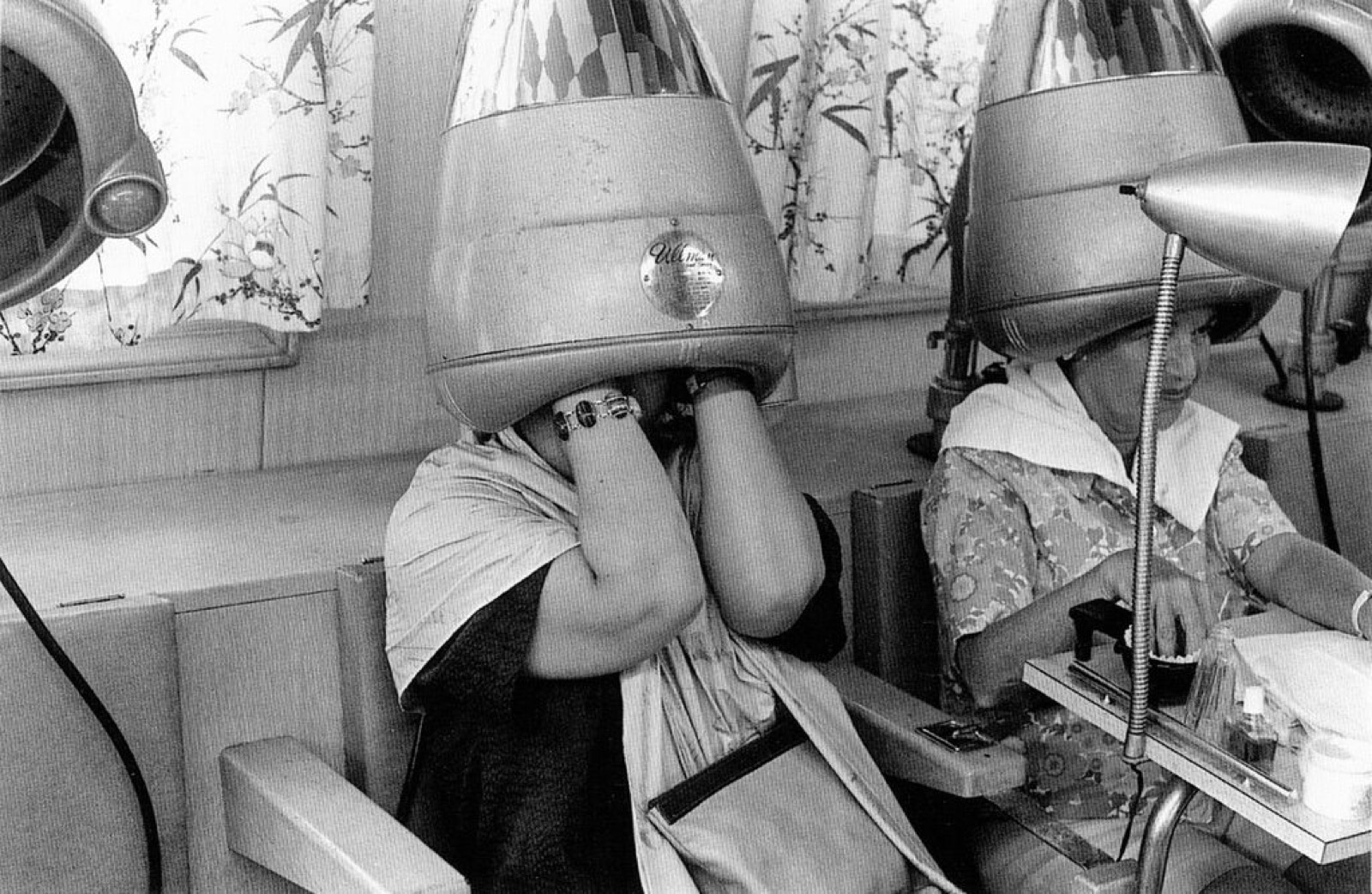
A machine lowered over a head is supposed to beautify, yet here it does something stranger: it erases. The woman in the foreground has pulled her own hands up to hide what little face the chrome dome has left visible, so that two forearms and a glinting bracelet become the whole of her expression. Photography loves this kind of substitution, an appliance standing in for a portrait. Meyerowitz, still in black and white and close to the street, treats the beauty parlor as a small theatre of machines and postures.
Notice how the salon organizes itself into rhymes. The bulbous dryer over the second woman answers the first; two more domes crowd the top corners; a gooseneck lamp arcs in from the right like another mechanical neck. Against all that hardware the floral curtain and the printed blouse insist on softness, on the pattern the customers wore in. The picture is built on this argument between the manufactured and the personal, and it will not resolve it. The manicure tray with its bottles sits between the two women like evidence.
This is early Meyerowitz, before the view camera and the luminous color of Cape Light, when he was learning on the street in Robert Frank’s wake. The wit is already here, with the describer’s patience for American surfaces. Printed now as an archival pigment print, the grays hold their register, from the hot highlight on the dome to the shadowed cape. A photographer later collected by MoMA, the Met and the Boston MFA was, in this frame, simply watching two strangers vanish under their weekly ritual.
A machine lowered over a head is supposed to beautify, yet here it does something stranger: it erases. The woman in the foreground has pulled her own hands up to hide what little face the chrome dome has left visible, so that two forearms and a glinting bracelet become the whole of her expression. Photography loves this kind of substitution, an appliance standing in for a portrait. Meyerowitz, still in black and white and close to the street, treats the beauty parlor as a small theatre of machines and postures.
Notice how the salon organizes itself into rhymes. The bulbous dryer over the second woman answers the first; two more domes crowd the top corners; a gooseneck lamp arcs in from the right like another mechanical neck. Against all that hardware the floral curtain and the printed blouse insist on softness, on the pattern the customers wore in. The picture is built on this argument between the manufactured and the personal, and it will not resolve it. The manicure tray with its bottles sits between the two women like evidence.
This is early Meyerowitz, before the view camera and the luminous color of Cape Light, when he was learning on the street in Robert Frank’s wake. The wit is already here, with the describer’s patience for American surfaces. Printed now as an archival pigment print, the grays hold their register, from the hot highlight on the dome to the shadowed cape. A photographer later collected by MoMA, the Met and the Boston MFA was, in this frame, simply watching two strangers vanish under their weekly ritual.