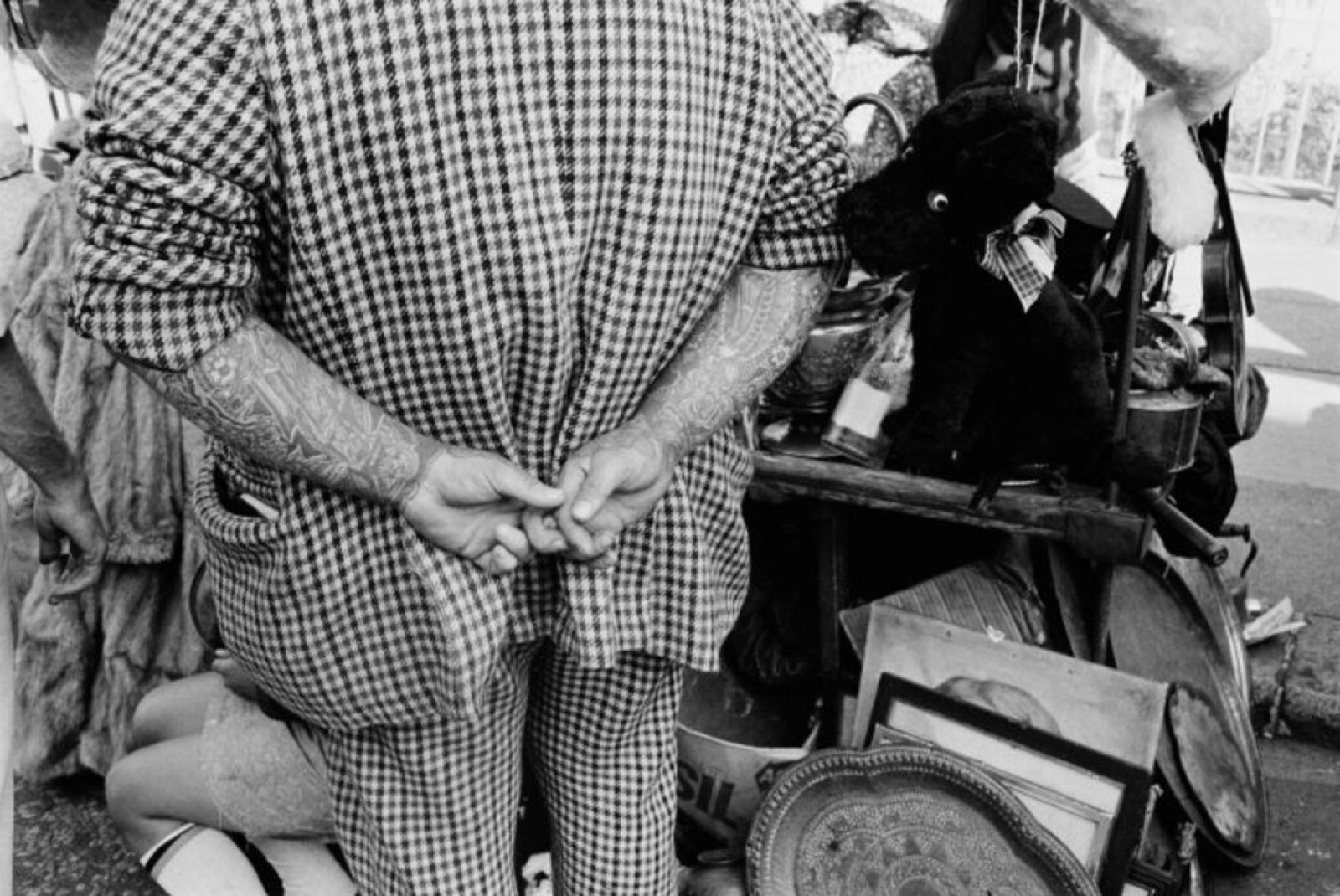
Long before photographers built their tableaux in the studio, the street handed them ready-made ones, and this houndstooth-suited back — turned squarely to us at a London junk stall — belongs to that lineage of the found arrangement. The man is cropped to a torso and a pair of clasped hands, his forearm sleeved in an elaborate tattoo, the fine check of his jacket and trousers reading as its own graphic pattern. He has become, without knowing it, the best-dressed object at a market of cast-off things.
Everything to his right is for sale and forlorn: a black teddy bear with a gingham bow strung up by the neck, framed paintings stacked and leaning, an engraved metal tray, brass pots, a bin lettered in fragments. To his left a fur coat hangs and a child kneels half-hidden behind his legs. The picture works as a compressed still life of used goods, held together by the man’s dandyish silhouette. Meyerowitz frames it tight, refusing the wide establishing view, so that pattern answers pattern across the crowded surface.
This was made on the street, in black and white, years before the color photography that, with Shore and Eggleston, he would make serious, while Robert Frank’s spirit still guided his eye. His pictures would in time be collected by MoMA, the Met and the Boston MFA. What already shows is a compositional nerve, the willingness to let a stranger’s back organize the frame. As an archival pigment print the range holds from the crisp check to the black plush of the bear.
Long before photographers built their tableaux in the studio, the street handed them ready-made ones, and this houndstooth-suited back — turned squarely to us at a London junk stall — belongs to that lineage of the found arrangement. The man is cropped to a torso and a pair of clasped hands, his forearm sleeved in an elaborate tattoo, the fine check of his jacket and trousers reading as its own graphic pattern. He has become, without knowing it, the best-dressed object at a market of cast-off things.
Everything to his right is for sale and forlorn: a black teddy bear with a gingham bow strung up by the neck, framed paintings stacked and leaning, an engraved metal tray, brass pots, a bin lettered in fragments. To his left a fur coat hangs and a child kneels half-hidden behind his legs. The picture works as a compressed still life of used goods, held together by the man’s dandyish silhouette. Meyerowitz frames it tight, refusing the wide establishing view, so that pattern answers pattern across the crowded surface.
This was made on the street, in black and white, years before the color photography that, with Shore and Eggleston, he would make serious, while Robert Frank’s spirit still guided his eye. His pictures would in time be collected by MoMA, the Met and the Boston MFA. What already shows is a compositional nerve, the willingness to let a stranger’s back organize the frame. As an archival pigment print the range holds from the crisp check to the black plush of the bear.