To the left of the huts, a thread of little figures crosses the sand, upright and dark, like the letters of a word I cannot quite read. It is this detail that governs me. The village itself is composed, almost decorous: timber walls, pitched roofs, thatch pressed down against the wind. But those walking marks, and the knot of children gathered by the furthest shelter on the right, insist that the photograph is not a landscape at all. It is a portrait of persistence.
Everything here is inverted, and the inversion is delicious and cruel at once: the sky, which ought to give light, is a slab of darkness; the ground, which ought to be dark, radiates. The houses inhabit the narrow seam between these two impossibilities. And in the foreground, filling half the frame, the dune advances with its slow ribs of shadow, a wave that will take years to break. The people play, walk, gather, on the very element that is coming for their walls. I find I cannot decide whether the picture records a siege or a truce.
The object before me has its own body: a gelatin silver print, made by the photographer’s hand a year after the negative, and passed through selenium, which cools the blacks until they resemble iron. On this skin the whites are not empty; they are worked, faintly granular, alive. Photography says, always, this was. Here it says something gentler: this was, and someone stood on the warm sand long enough to love it into permanence.
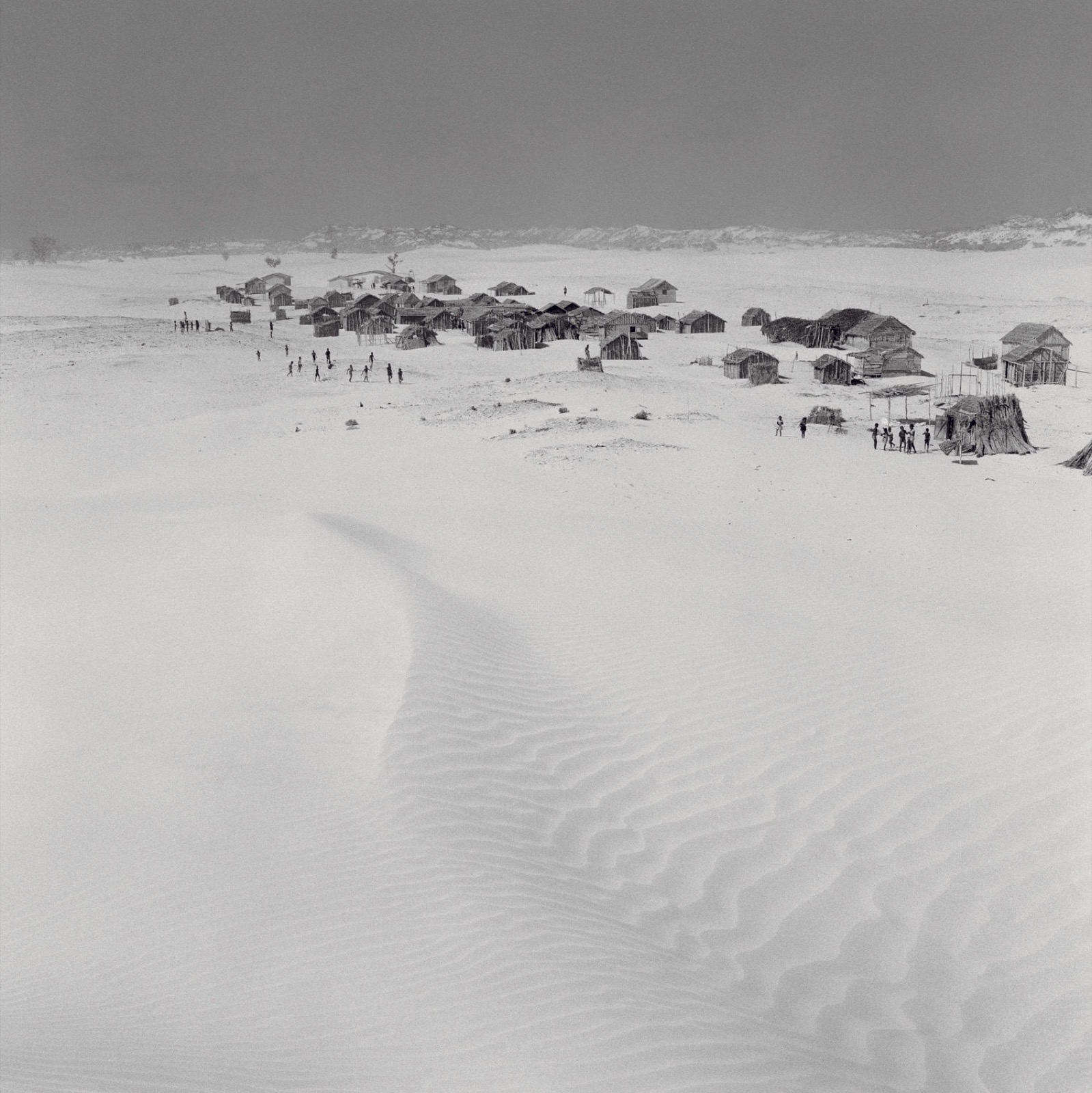

To the left of the huts, a thread of little figures crosses the sand, upright and dark, like the letters of a word I cannot quite read. It is this detail that governs me. The village itself is composed, almost decorous: timber walls, pitched roofs, thatch pressed down against the wind. But those walking marks, and the knot of children gathered by the furthest shelter on the right, insist that the photograph is not a landscape at all. It is a portrait of persistence.
Everything here is inverted, and the inversion is delicious and cruel at once: the sky, which ought to give light, is a slab of darkness; the ground, which ought to be dark, radiates. The houses inhabit the narrow seam between these two impossibilities. And in the foreground, filling half the frame, the dune advances with its slow ribs of shadow, a wave that will take years to break. The people play, walk, gather, on the very element that is coming for their walls. I find I cannot decide whether the picture records a siege or a truce.
The object before me has its own body: a gelatin silver print, made by the photographer’s hand a year after the negative, and passed through selenium, which cools the blacks until they resemble iron. On this skin the whites are not empty; they are worked, faintly granular, alive. Photography says, always, this was. Here it says something gentler: this was, and someone stood on the warm sand long enough to love it into permanence.