Hand-signed by the artist, with title, date, and edition number inscribed in ink on an archival label affixed to the reverse side of the mounted photograph.
A tub of glowing turquoise water in a dark garden arrives with a lineage: Hockney’s chlorinated Edens, the lit pools of Hollywood noir, all the backyard paradises America has wired for light. Photography loves such pools because they are images already, stages built of water and electricity. Every illuminated pool at night is a theater waiting for its incident; the camera has only to attend.
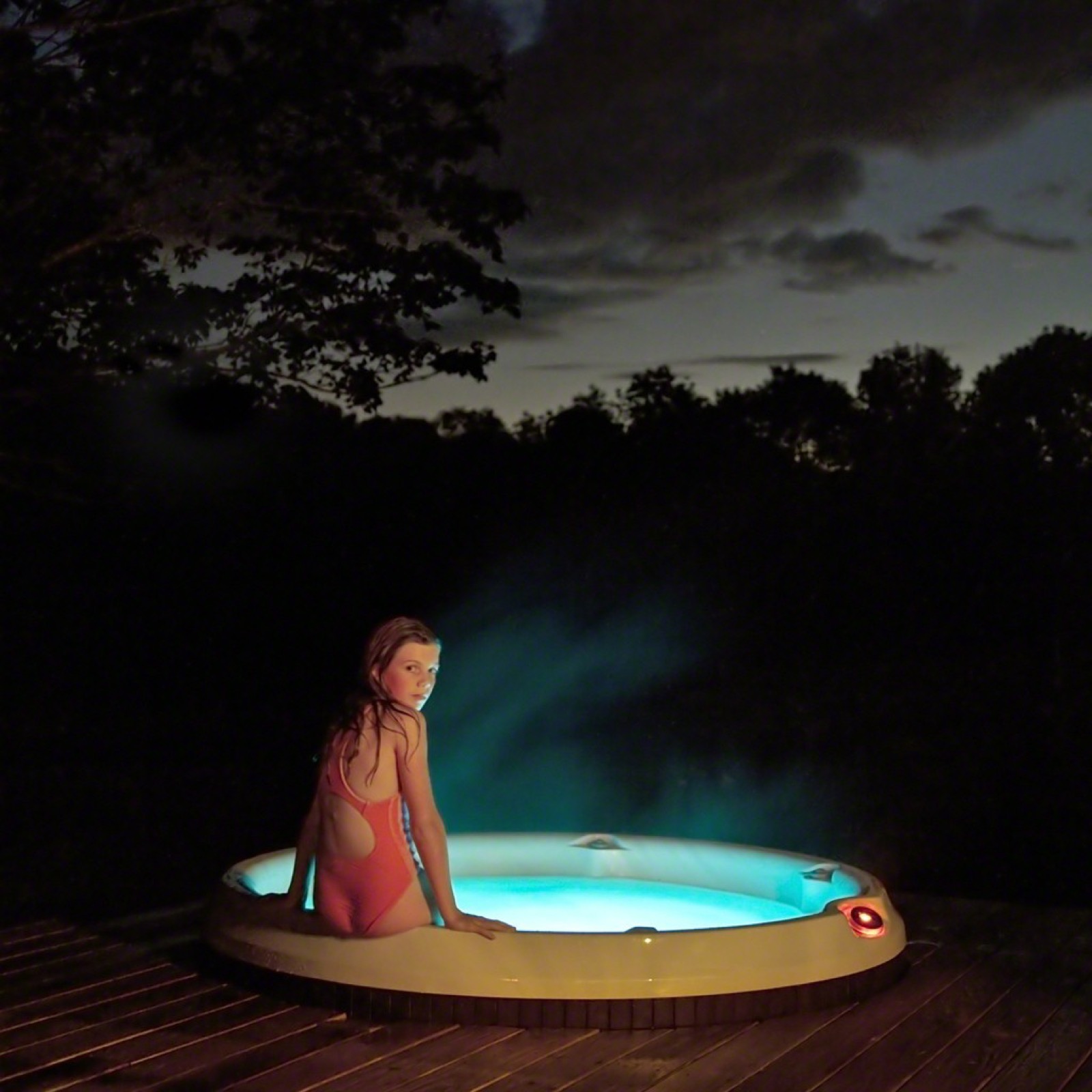
The incident here is small and total: a girl in a coral swimsuit kneels on the white rim, wet hair pasted against her neck, and turns to look back at us. Her glance is the picture’s moral center. It says: you are in the dark and I am in the light; which of us is exposed? Steam rises off the water and drifts sideways, dyed aquamarine; the trees mass black under the last gray-blue of the sky; a single red lamp burns on the tub’s edge like a small alarm. The warmth is real and bought, the glow chemical, the night enormous. The image seduces exactly as comfort does, by making the lit circle seem the whole world.
Harvey photographs her own life in Rockport, Maine, and refuses to pretend it is safe; that refusal is her distinction among photographers of family. The books (The Blue Notebook, You an Orchestra a Bomb) read like fever charts of the domestic, and American museums have taken notice. In this archival pigment print the night holds its saturation, turquoise against black, and childhood appears as the thing it actually is: a brightness we watch from outside, briefly permitted to look back.

A tub of glowing turquoise water in a dark garden arrives with a lineage: Hockney’s chlorinated Edens, the lit pools of Hollywood noir, all the backyard paradises America has wired for light. Photography loves such pools because they are images already, stages built of water and electricity. Every illuminated pool at night is a theater waiting for its incident; the camera has only to attend.
The incident here is small and total: a girl in a coral swimsuit kneels on the white rim, wet hair pasted against her neck, and turns to look back at us. Her glance is the picture’s moral center. It says: you are in the dark and I am in the light; which of us is exposed? Steam rises off the water and drifts sideways, dyed aquamarine; the trees mass black under the last gray-blue of the sky; a single red lamp burns on the tub’s edge like a small alarm. The warmth is real and bought, the glow chemical, the night enormous. The image seduces exactly as comfort does, by making the lit circle seem the whole world.
Harvey photographs her own life in Rockport, Maine, and refuses to pretend it is safe; that refusal is her distinction among photographers of family. The books (The Blue Notebook, You an Orchestra a Bomb) read like fever charts of the domestic, and American museums have taken notice. In this archival pigment print the night holds its saturation, turquoise against black, and childhood appears as the thing it actually is: a brightness we watch from outside, briefly permitted to look back.