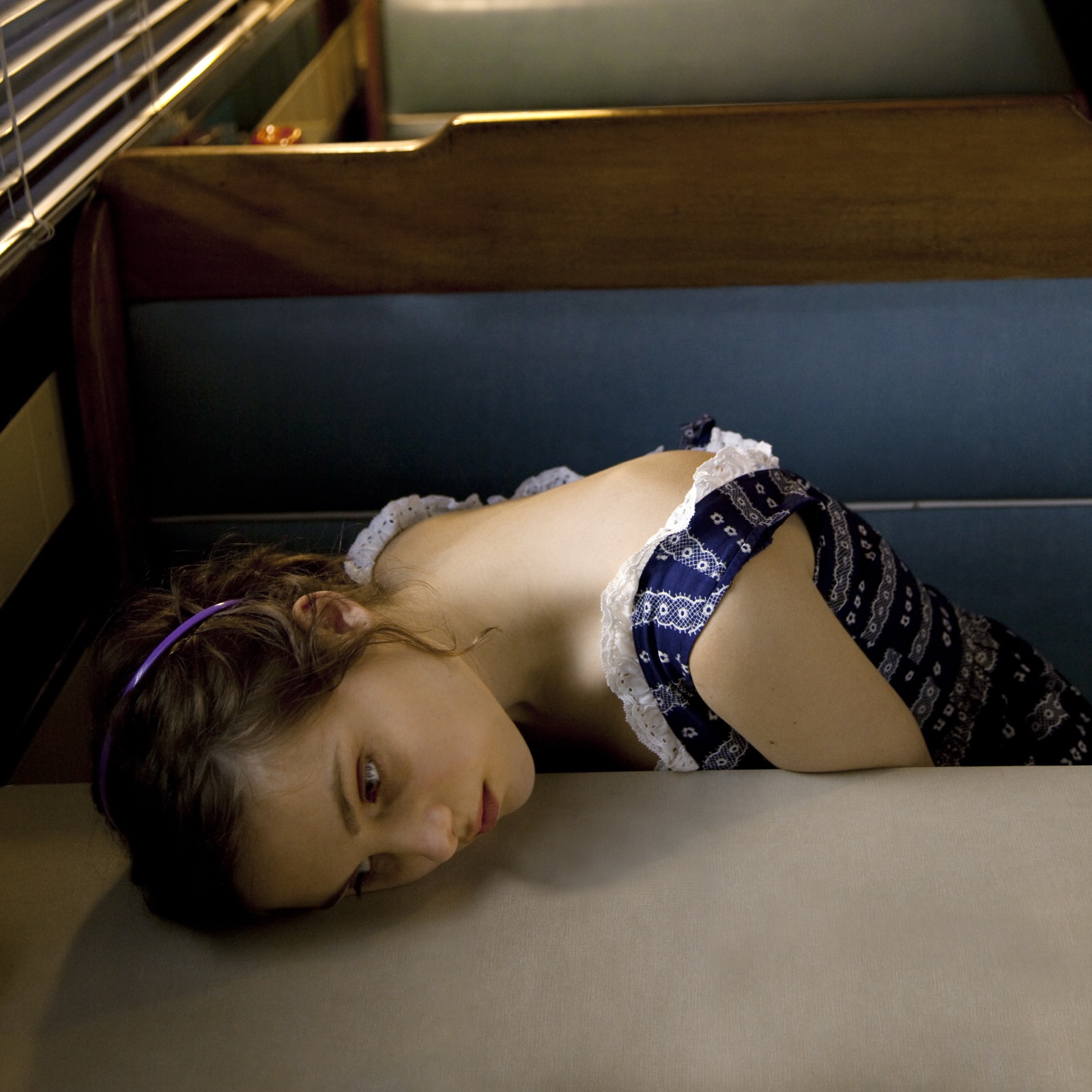
Sadie at Miss Portland's Diner, Portland, Maine, 2010
Archival Pigment Print.
35.6 x 35.6 cm / 14 x 14 in
71.1 x 71.1 cm / 28 x 28 in
101.6 x 101.6 cm / 40 x 40 in
Hand-signed by the artist, with title, date, and edition number inscribed in ink on an archival label affixed to the reverse side of the mounted photograph.
Late sun, sliced thin by a venetian blind, runs along the wooden rail of the booth and turns it to honey. That is the weather here: indoor weather, diner weather, the kind of low amber light that arrives in the afternoon lull between customers and settles over every surface as if it too were tired. It warms the tin edge of the blind, grazes the teal vinyl of the banquette, and comes to rest, at last, on the bare curve of a girl’s shoulder.
Sadie has laid her cheek flat against the pale tabletop, and one eye stays open, wide and unblinking, fixed on something outside the frame. Her navy dress, edged in white eyelet, has slipped from one shoulder; a purple plastic headband holds back her brown hair. Nothing about the pose suggests sleep. It is closer to the theatrical boredom children perform when adults talk too long, though the stillness is almost devotional. The composition is built in long horizontal bands (table, bench, rail, blind) so that her head, turned sideways, becomes the single interruption the eye cannot leave.
Harvey, British-born and based in Rockport, Maine, composes with color the way the diner itself does: teal against honey, navy against putty gray. The archival pigment print holds these values faithfully, saturated but never loud, shadows open enough to read the vinyl’s weave. Her books, from The Blue Notebook to Blue Violet, have carried this domestic lyric to a wide audience; her prints are collected by American museums. What stays is the patience: a photograph willing to wait, with its subject, for whatever the light does next.

Late sun, sliced thin by a venetian blind, runs along the wooden rail of the booth and turns it to honey. That is the weather here: indoor weather, diner weather, the kind of low amber light that arrives in the afternoon lull between customers and settles over every surface as if it too were tired. It warms the tin edge of the blind, grazes the teal vinyl of the banquette, and comes to rest, at last, on the bare curve of a girl’s shoulder.
Sadie has laid her cheek flat against the pale tabletop, and one eye stays open, wide and unblinking, fixed on something outside the frame. Her navy dress, edged in white eyelet, has slipped from one shoulder; a purple plastic headband holds back her brown hair. Nothing about the pose suggests sleep. It is closer to the theatrical boredom children perform when adults talk too long, though the stillness is almost devotional. The composition is built in long horizontal bands (table, bench, rail, blind) so that her head, turned sideways, becomes the single interruption the eye cannot leave.
Harvey, British-born and based in Rockport, Maine, composes with color the way the diner itself does: teal against honey, navy against putty gray. The archival pigment print holds these values faithfully, saturated but never loud, shadows open enough to read the vinyl’s weave. Her books, from The Blue Notebook to Blue Violet, have carried this domestic lyric to a wide audience; her prints are collected by American museums. What stays is the patience: a photograph willing to wait, with its subject, for whatever the light does next.