Hand-signed by the artist, with title, date, and edition number inscribed in ink on an archival label affixed to the reverse side of the mounted photograph.
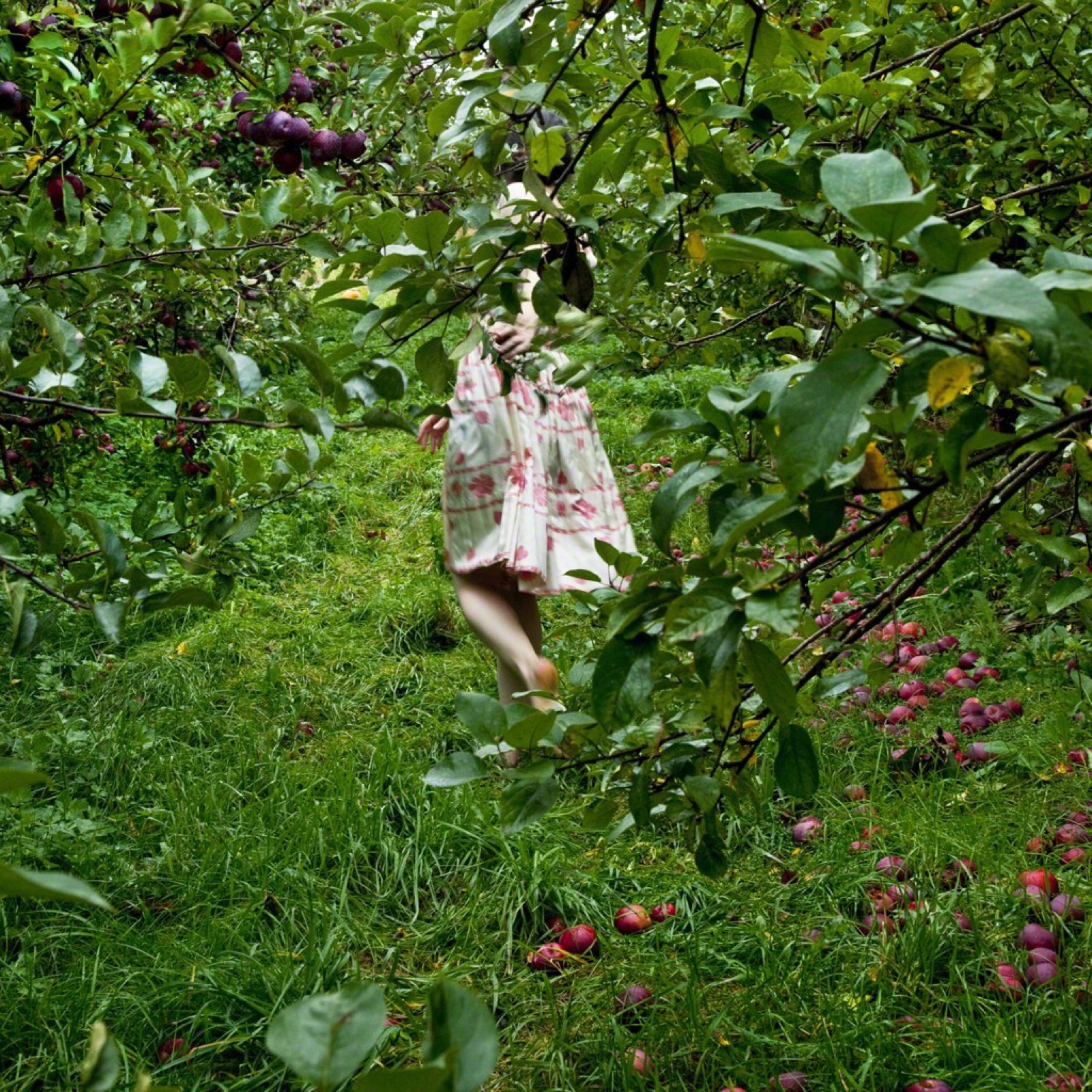
She is mid-stride when the shutter finds her: barefoot, one pale heel kicked up out of the deep grass, the skirt of her flowered dress swinging with the momentum of leaving. Photography cannot show pursuit, only imply it, and this frame implies it perfectly. Something has just happened, or is about to; the grass is thick with both possibilities. A branch hangs across the lens like a censor’s bar, hiding her head, so that we watch from inside the tree, complicit, as she goes.
The orchard does its own storytelling. Dark plums hang in clusters overhead while windfalls lie scattered through the grass, some red, some already bruising toward purple: two tenses of the same fruit, before and after. Her dress repeats the lesson, white cotton printed with pink blooms, flowering as she runs. Cinema would give us the next shot, the reverse angle, the face. The still photograph refuses, and the refusal is the point. Headless, nameless, she becomes any woman ever glimpsed leaving a garden, and the picture the first frame of a story we must finish ourselves.
Harvey makes her pictures close to home in midcoast Maine, where fruit, gardens, weather and family supply her whole lexicon. Her books, The Blue Notebook and You an Orchestra a Bomb among them, restored urgency to the domestic image, and American museums have been collecting the results. As an archival pigment print, this one carries the orchard’s full register, greens saturated to the edge of night, plums nearly black, a dress the only page of white.

She is mid-stride when the shutter finds her: barefoot, one pale heel kicked up out of the deep grass, the skirt of her flowered dress swinging with the momentum of leaving. Photography cannot show pursuit, only imply it, and this frame implies it perfectly. Something has just happened, or is about to; the grass is thick with both possibilities. A branch hangs across the lens like a censor’s bar, hiding her head, so that we watch from inside the tree, complicit, as she goes.
The orchard does its own storytelling. Dark plums hang in clusters overhead while windfalls lie scattered through the grass, some red, some already bruising toward purple: two tenses of the same fruit, before and after. Her dress repeats the lesson, white cotton printed with pink blooms, flowering as she runs. Cinema would give us the next shot, the reverse angle, the face. The still photograph refuses, and the refusal is the point. Headless, nameless, she becomes any woman ever glimpsed leaving a garden, and the picture the first frame of a story we must finish ourselves.
Harvey makes her pictures close to home in midcoast Maine, where fruit, gardens, weather and family supply her whole lexicon. Her books, The Blue Notebook and You an Orchestra a Bomb among them, restored urgency to the domestic image, and American museums have been collecting the results. As an archival pigment print, this one carries the orchard’s full register, greens saturated to the edge of night, plums nearly black, a dress the only page of white.