Botticelli beached his Venus on a scallop shell; here the shell has been cast in black, strapped to the chest like a small piece of armor, and the goddess, instead of rising, folds herself in half above the sand of Fuerteventura. Fashion photography has always plundered the altarpiece, but rarely with such candor about the theft. Birth is restaged as contortion; modesty becomes lacquer; the sea is nowhere in sight, only its mineral residue, a desert that remembers being a shore.
The pose is an argument. Legs straight as dividers, black patent pumps planted in the ripples, the body hinging until the face arrives upside down inside its dark cloud of curls, cheeks rouged an implausible pink. A face inverted becomes a mask, and a mask cannot plead. We are meant to be seduced, and we are; but the picture is honest about the machinery of seduction, which is arrangement, not intimacy. The dress barely functions as a dress. It functions as a silhouette, which is what fashion always wanted to be.
Yeste belongs to the front rank of Spanish fashion photography, and the pages of Numéro, Harper’s Bazaar and Vogue have carried his images for years; through them runs an elemental strain, sand and wind and water, of which this dune is the driest instance. The archival pigment print keeps faith with the picture’s two temperatures, the mineral warmth of the ground and that immense, indifferent blue. What survives the seduction is a proposition: that glamour is a discipline of the body, performed, like all disciplines, against a horizon that could not care less.
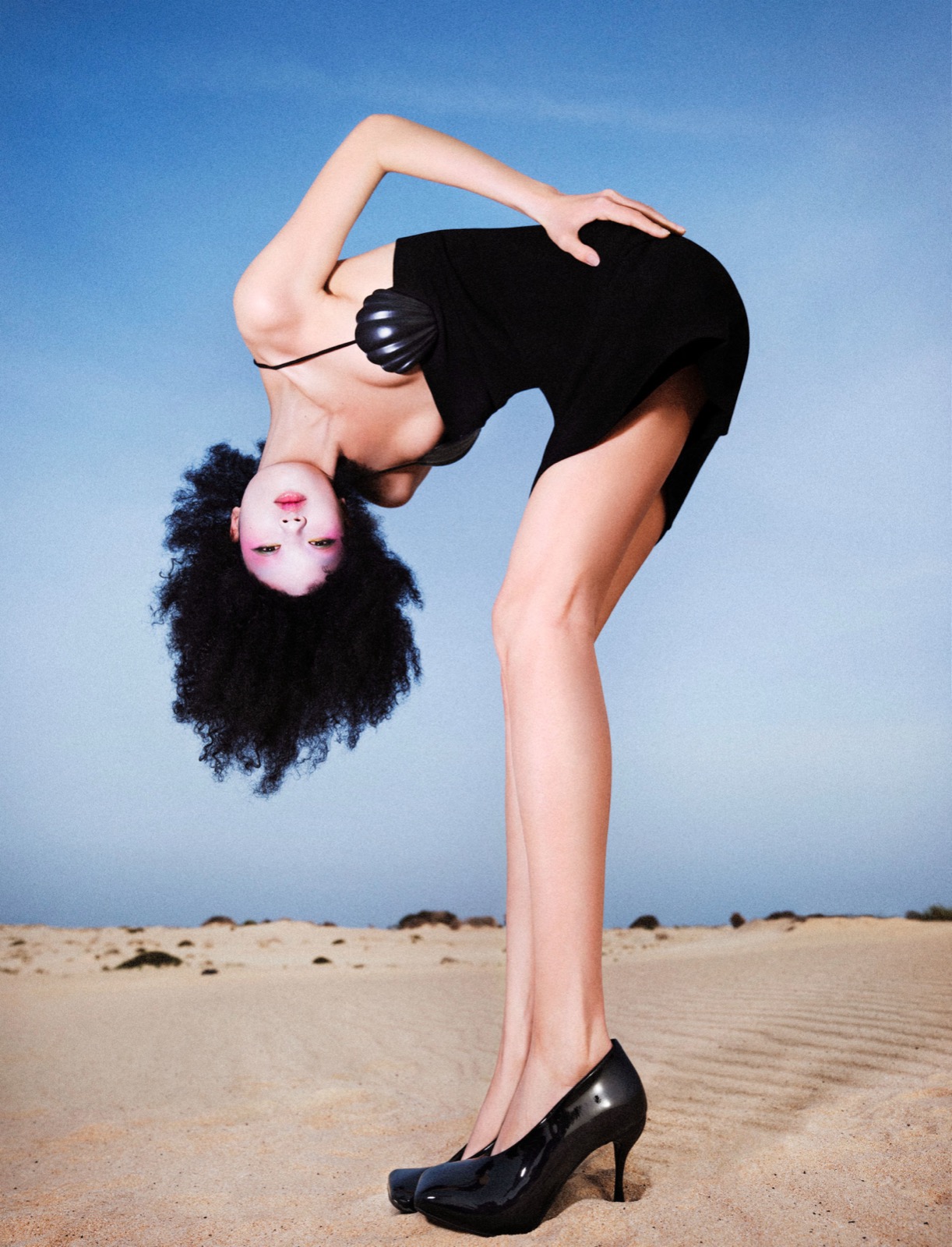

Botticelli beached his Venus on a scallop shell; here the shell has been cast in black, strapped to the chest like a small piece of armor, and the goddess, instead of rising, folds herself in half above the sand of Fuerteventura. Fashion photography has always plundered the altarpiece, but rarely with such candor about the theft. Birth is restaged as contortion; modesty becomes lacquer; the sea is nowhere in sight, only its mineral residue, a desert that remembers being a shore.
The pose is an argument. Legs straight as dividers, black patent pumps planted in the ripples, the body hinging until the face arrives upside down inside its dark cloud of curls, cheeks rouged an implausible pink. A face inverted becomes a mask, and a mask cannot plead. We are meant to be seduced, and we are; but the picture is honest about the machinery of seduction, which is arrangement, not intimacy. The dress barely functions as a dress. It functions as a silhouette, which is what fashion always wanted to be.
Yeste belongs to the front rank of Spanish fashion photography, and the pages of Numéro, Harper’s Bazaar and Vogue have carried his images for years; through them runs an elemental strain, sand and wind and water, of which this dune is the driest instance. The archival pigment print keeps faith with the picture’s two temperatures, the mineral warmth of the ground and that immense, indifferent blue. What survives the seduction is a proposition: that glamour is a discipline of the body, performed, like all disciplines, against a horizon that could not care less.