Notice the small rectangle set into the umbrella’s dark hollow: a printed face, its eyes ringed in hot pink and red, pale hair falling past a reddened mouth, propped like a portrait in a doorway. Once you register that the head is a picture and not a face, the whole scene tilts. Below it the real body takes over — black leather gloves to the elbow, an ocean of cloth spilling down the dune, one bare knee and a heeled shoe escaping at the lower right.
Yeste keeps returning to this substitution, a face swapped for its own reproduction, and it turns the picture into a quiet argument about what a fashion image is: a surface standing in for a person. Here the swap sits inside pure theatre — a black umbrella opened against a cloudless blue, a gown poured across pale Fuerteventura sand, dune grass scratching in at both edges. The three zones, sky, cloth and dune, divide so cleanly that the little inset face becomes the one place the eye can rest and the one it cannot trust.
That instinct — smuggling conceptual mischief into a glossy commission — is what sets Yeste apart, and it has carried him through Numéro, Harper’s Bazaar and Vogue. The elements do their part, wind lifting the hem, sun flattening the sky to enamel. As an archival pigment print the blacks stay dense and unbroken while the sand keeps its warm grain, the contrast the whole picture depends on. It is a portrait that hides its sitter and, in hiding her, shows you exactly how the image was built.
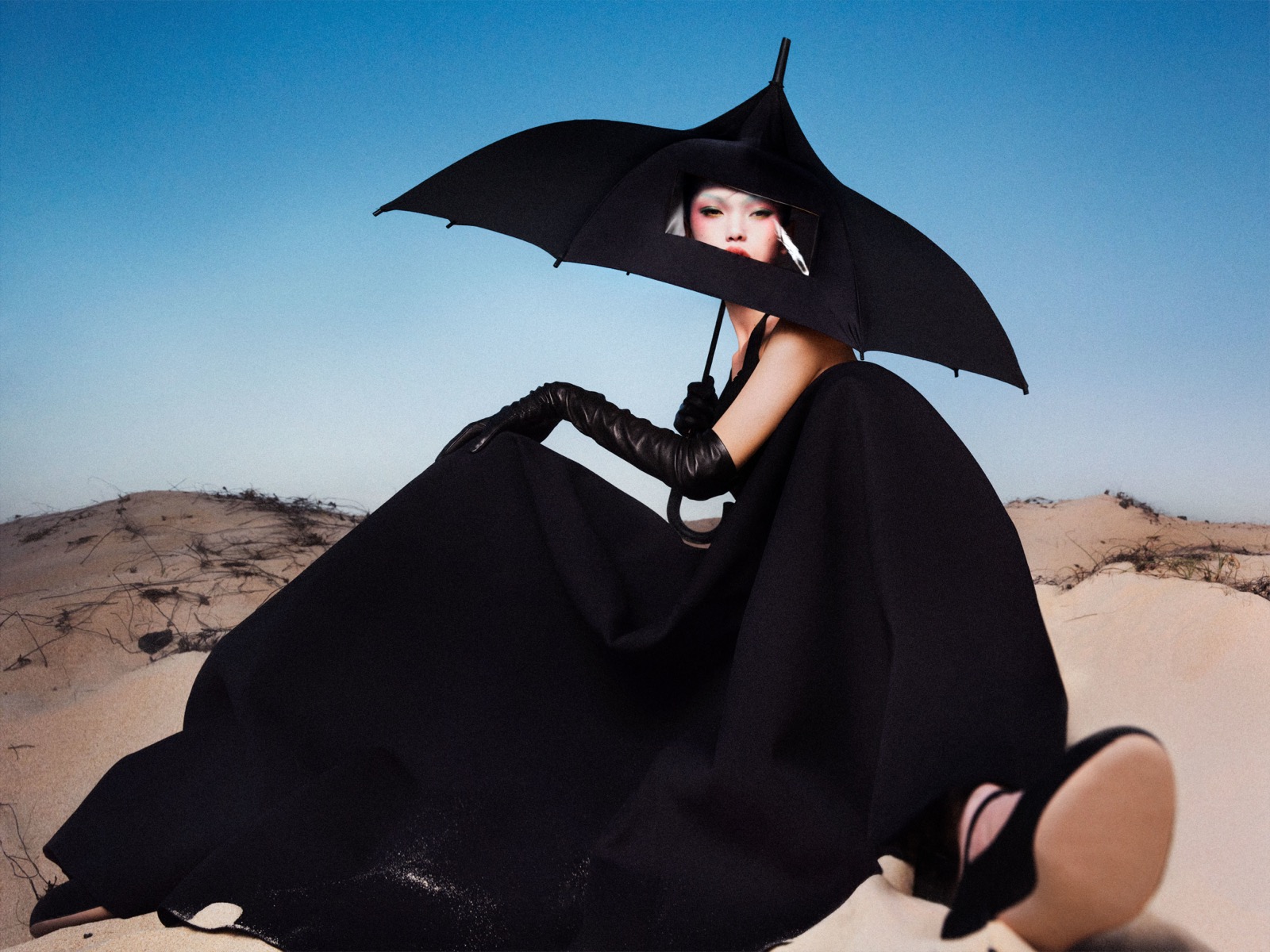

Notice the small rectangle set into the umbrella’s dark hollow: a printed face, its eyes ringed in hot pink and red, pale hair falling past a reddened mouth, propped like a portrait in a doorway. Once you register that the head is a picture and not a face, the whole scene tilts. Below it the real body takes over — black leather gloves to the elbow, an ocean of cloth spilling down the dune, one bare knee and a heeled shoe escaping at the lower right.
Yeste keeps returning to this substitution, a face swapped for its own reproduction, and it turns the picture into a quiet argument about what a fashion image is: a surface standing in for a person. Here the swap sits inside pure theatre — a black umbrella opened against a cloudless blue, a gown poured across pale Fuerteventura sand, dune grass scratching in at both edges. The three zones, sky, cloth and dune, divide so cleanly that the little inset face becomes the one place the eye can rest and the one it cannot trust.
That instinct — smuggling conceptual mischief into a glossy commission — is what sets Yeste apart, and it has carried him through Numéro, Harper’s Bazaar and Vogue. The elements do their part, wind lifting the hem, sun flattening the sky to enamel. As an archival pigment print the blacks stay dense and unbroken while the sand keeps its warm grain, the contrast the whole picture depends on. It is a portrait that hides its sitter and, in hiding her, shows you exactly how the image was built.