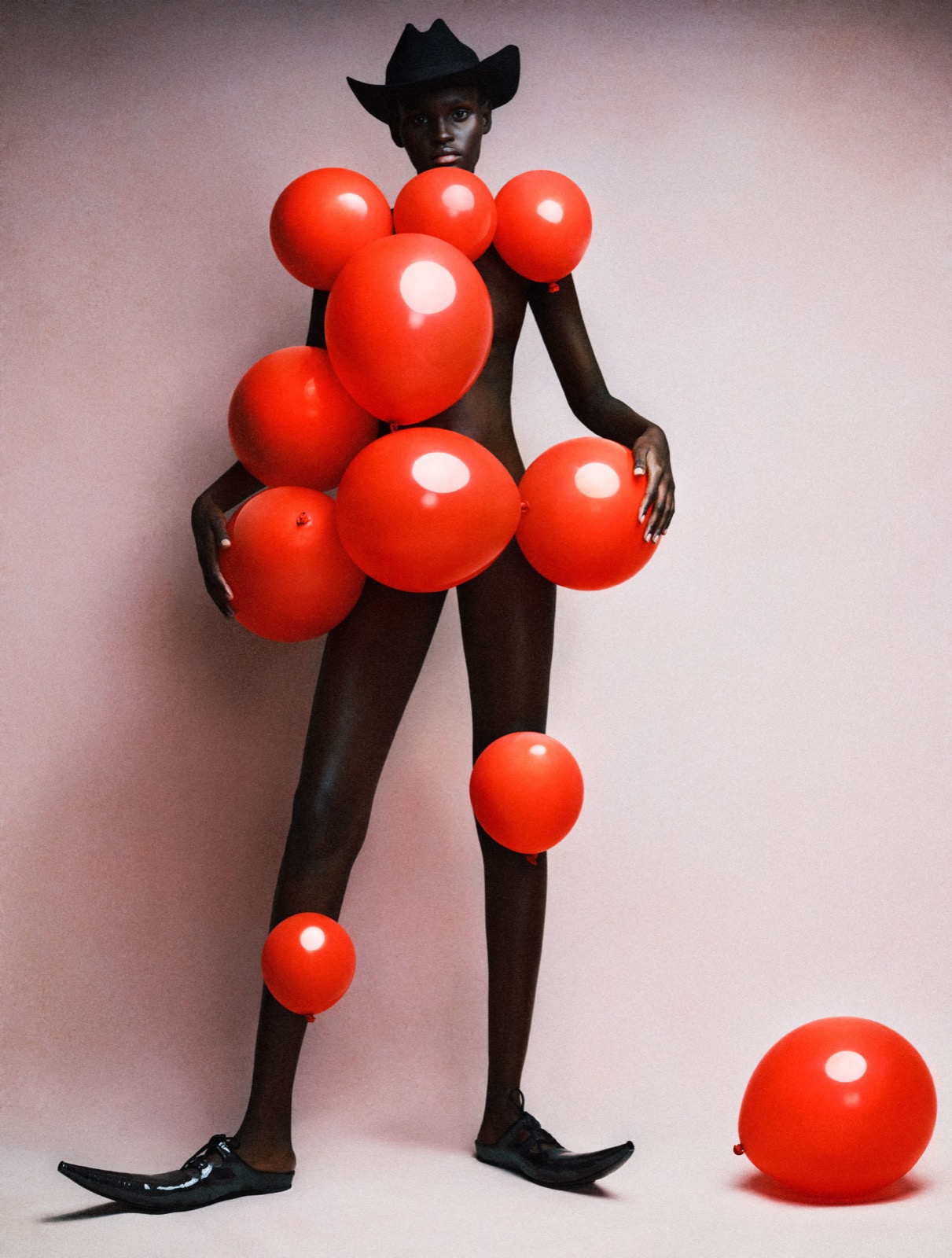
How many balloons does it take to dress a body? A dozen, apparently — glossy tomato-red spheres bunched from collarbone to knee, each one pressed to dark skin so the whole cluster reads as a bristling, buoyant couture. Above them a black cowboy hat sits low; below, a pair of patent shoes tapers into long curled toes like something out of a fairy tale. One balloon has escaped and rests on the floor, waiting.
Yeste knows that fashion’s oldest thrill is the improbable made to look inevitable, and he plays it straight-faced. The model holds two of the spheres at the hip with manicured fingers, entirely composed, as if latex were the most natural material in the world to be caught in. The palette does the seducing: a field of soft rose behind, the near-black gloss of the body, and that insistent red multiplying across the frame. It is playful and slightly perilous at once, a costume you could pop with a pin.
This is the register Yeste commands better than most of his Spanish peers — Numéro, Harper’s Bazaar, Vogue behind him — the studio conceit pushed until it turns strange and stays elegant. Air is the material here, the way sand or fire is elsewhere in his work, and the picture treats it with the same seriousness. As an archival pigment print the reds hold at full saturation without bleeding into the rose ground, and the skin keeps its deep sculptural sheen. A cowboy assembled from party balloons, and somehow he swaggers.
How many balloons does it take to dress a body? A dozen, apparently — glossy tomato-red spheres bunched from collarbone to knee, each one pressed to dark skin so the whole cluster reads as a bristling, buoyant couture. Above them a black cowboy hat sits low; below, a pair of patent shoes tapers into long curled toes like something out of a fairy tale. One balloon has escaped and rests on the floor, waiting.
Yeste knows that fashion’s oldest thrill is the improbable made to look inevitable, and he plays it straight-faced. The model holds two of the spheres at the hip with manicured fingers, entirely composed, as if latex were the most natural material in the world to be caught in. The palette does the seducing: a field of soft rose behind, the near-black gloss of the body, and that insistent red multiplying across the frame. It is playful and slightly perilous at once, a costume you could pop with a pin.
This is the register Yeste commands better than most of his Spanish peers — Numéro, Harper’s Bazaar, Vogue behind him — the studio conceit pushed until it turns strange and stays elegant. Air is the material here, the way sand or fire is elsewhere in his work, and the picture treats it with the same seriousness. As an archival pigment print the reds hold at full saturation without bleeding into the rose ground, and the skin keeps its deep sculptural sheen. A cowboy assembled from party balloons, and somehow he swaggers.