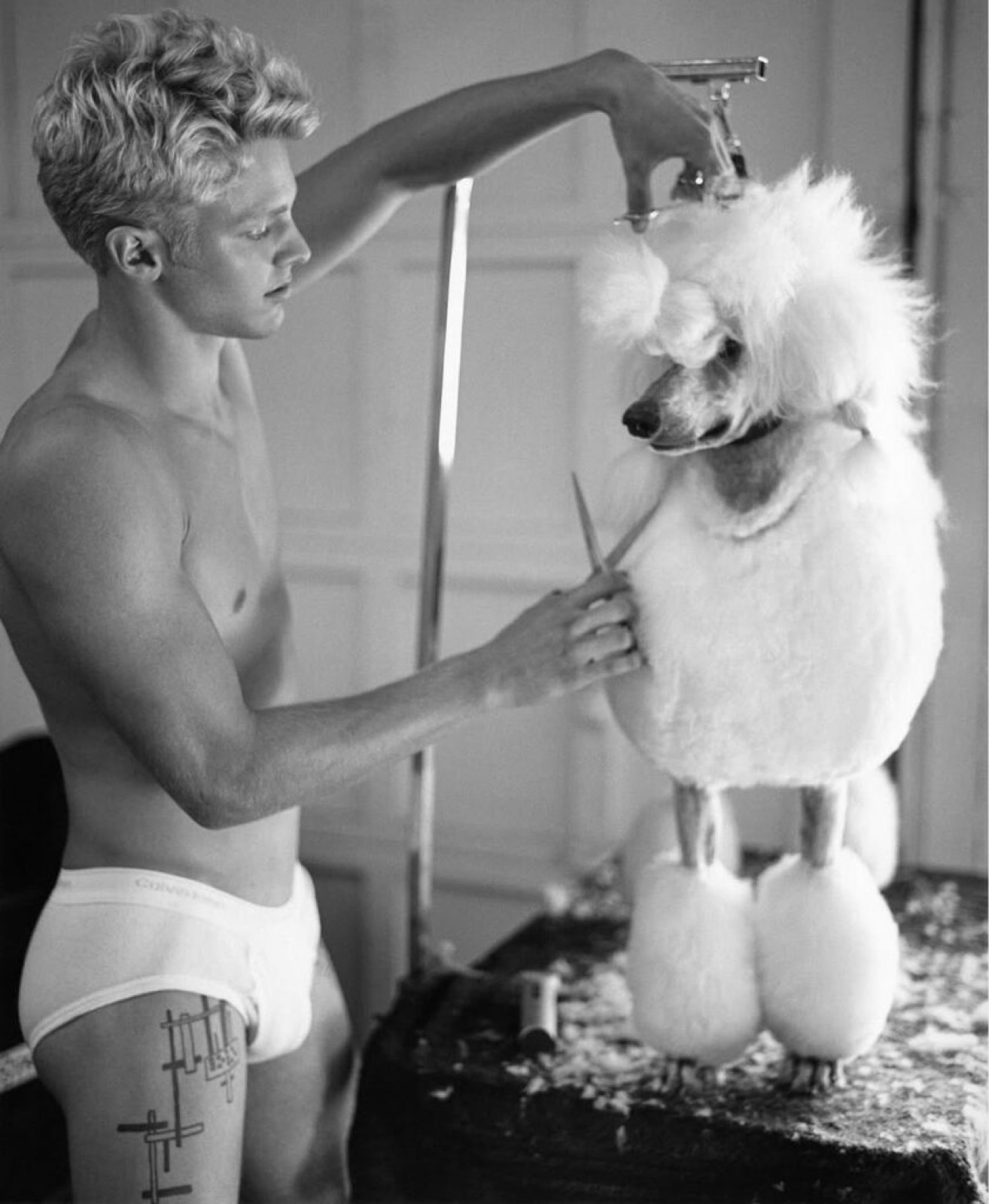
The grooming of a show poodle is an old theatre, shears and topiary treating a living animal as a thing to be sculpted, and here it is staged in a Florida room with a bare-chested youth cast as the barber. He wears nothing but white Calvin Klein briefs, the waistband spelling the brand that made this photographer famous; the dog stands on a dark pedestal, its coat carved into pom-poms and mane, shavings scattered like snow. One hand lifts the clippers, the other closes a pair of scissors against the animal’s flank.
What Weber understands is that grooming is touch made visible; the whole picture is about hands. The right hand pinches the shears delicately, thumb and finger poised, while the left arm arcs overhead in a gesture as formal as an annunciation. Every surface answers that touch — fur worked into topiary softness, skin catching a broad even light, the geometric tattoo inked across his thigh, the loose clippings that prove the labor already happened. Nothing is casual here; even the scattered fur is composed.
Weber built a career on this collision of tenderness and Americana — athletes, dogs, sun-warmed skin, the Calvin Klein campaigns that turned underwear into a national image. A poodle barbered by a half-dressed youth is his kind of joke, affectionate and mildly absurd. As a gelatin silver print the object carries its own chemistry: silver suspended in gelatin, the whites of fur and cotton kept luminous, the blacks of the pedestal deep, a hand-scaled thing made to be looked at closely. The care lavished on the dog is the care the print asks of us.
The grooming of a show poodle is an old theatre, shears and topiary treating a living animal as a thing to be sculpted, and here it is staged in a Florida room with a bare-chested youth cast as the barber. He wears nothing but white Calvin Klein briefs, the waistband spelling the brand that made this photographer famous; the dog stands on a dark pedestal, its coat carved into pom-poms and mane, shavings scattered like snow. One hand lifts the clippers, the other closes a pair of scissors against the animal’s flank.
What Weber understands is that grooming is touch made visible; the whole picture is about hands. The right hand pinches the shears delicately, thumb and finger poised, while the left arm arcs overhead in a gesture as formal as an annunciation. Every surface answers that touch — fur worked into topiary softness, skin catching a broad even light, the geometric tattoo inked across his thigh, the loose clippings that prove the labor already happened. Nothing is casual here; even the scattered fur is composed.
Weber built a career on this collision of tenderness and Americana — athletes, dogs, sun-warmed skin, the Calvin Klein campaigns that turned underwear into a national image. A poodle barbered by a half-dressed youth is his kind of joke, affectionate and mildly absurd. As a gelatin silver print the object carries its own chemistry: silver suspended in gelatin, the whites of fur and cotton kept luminous, the blacks of the pedestal deep, a hand-scaled thing made to be looked at closely. The care lavished on the dog is the care the print asks of us.