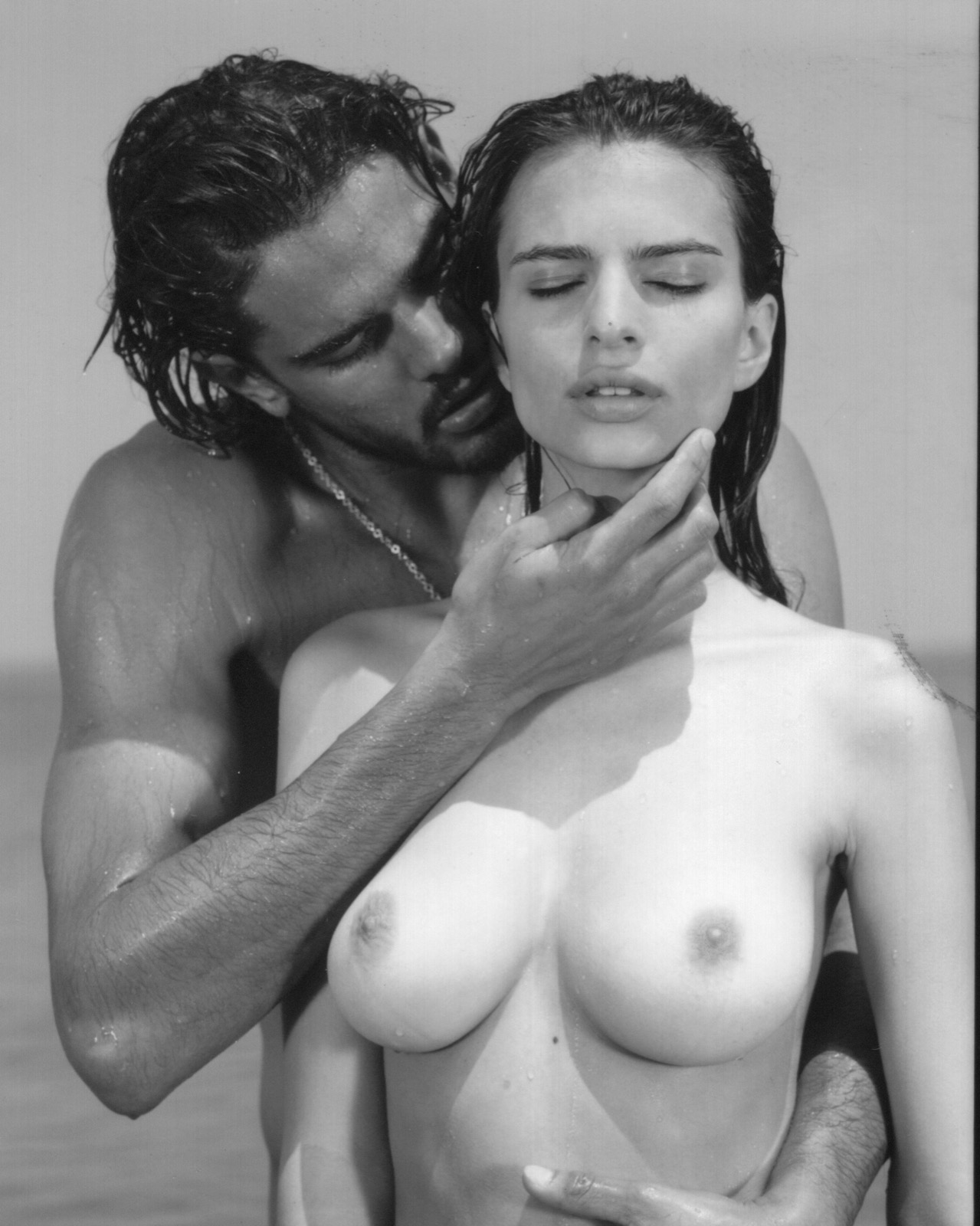
The sea behind them is a pale band with no weather in it, so the picture is all skin. They have just come out of the water: her hair is combed flat to her skull by it, his hangs in dark wet strands over one eye, and the same beads stand on both their shoulders. He is behind her, mouth at the corner of her jaw, eyes closed, a thin chain at his throat. His arm crosses her chest on the diagonal and the hand opens under her chin, thumb along the jawline, holding her face up the way you hold something to be looked at. Beneath it her own hand curls at her throat. His other hand rests low on her waist at the bottom edge of the frame.
What marks it as a picture rather than a moment is the tan line. Her shoulders and arms have had days of sun; her breasts are several tones lighter, a swimsuit's negative still printed on her. Weber leaves that in — the week before the shoot, the beach as a place of work. The arm is the only hard line in the composition, an armature laid across everything soft, and it does what his best pictures do: it stages the intimacy so plainly that you stop asking whether it is real and start admiring how well it is built.
Weber has been photographing people at the waterline since the early eighties, when a beach, two unknowns and a Calvin Klein budget became a national style, and the machinery that grew around it — the casting, the long magazine portfolios, the models made into names on the strength of one summer — is what a picture like this is finally about. In 2013 Ratajkowski was months from the fame that arrives by music video and Teixeira was a Brazilian face booked everywhere at once. Weber photographs them as though none of that were the point, which is his particular form of flattery, and it still works.

The sea behind them is a pale band with no weather in it, so the picture is all skin. They have just come out of the water: her hair is combed flat to her skull by it, his hangs in dark wet strands over one eye, and the same beads stand on both their shoulders. He is behind her, mouth at the corner of her jaw, eyes closed, a thin chain at his throat. His arm crosses her chest on the diagonal and the hand opens under her chin, thumb along the jawline, holding her face up the way you hold something to be looked at. Beneath it her own hand curls at her throat. His other hand rests low on her waist at the bottom edge of the frame.
What marks it as a picture rather than a moment is the tan line. Her shoulders and arms have had days of sun; her breasts are several tones lighter, a swimsuit's negative still printed on her. Weber leaves that in — the week before the shoot, the beach as a place of work. The arm is the only hard line in the composition, an armature laid across everything soft, and it does what his best pictures do: it stages the intimacy so plainly that you stop asking whether it is real and start admiring how well it is built.
Weber has been photographing people at the waterline since the early eighties, when a beach, two unknowns and a Calvin Klein budget became a national style, and the machinery that grew around it — the casting, the long magazine portfolios, the models made into names on the strength of one summer — is what a picture like this is finally about. In 2013 Ratajkowski was months from the fame that arrives by music video and Teixeira was a Brazilian face booked everywhere at once. Weber photographs them as though none of that were the point, which is his particular form of flattery, and it still works.