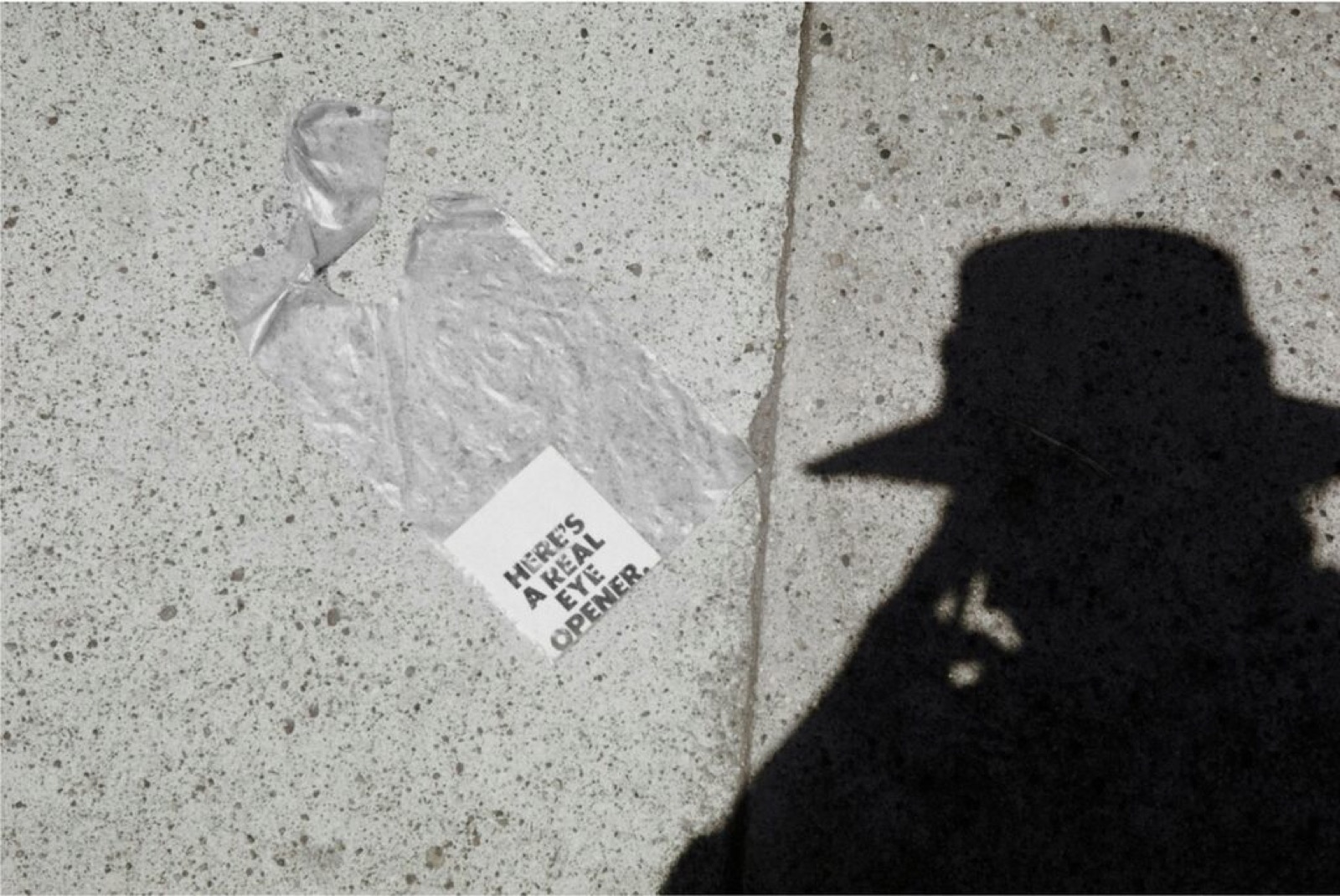
The color here is almost a refusal of color: pale terrazzo the shade of old chewing gum, a scatter of dark aggregate, the cool nothing-gray of city pavement at noon, seamed by a single dark expansion joint. This is a chromogenic print, and yet Maier has found a scene that hoards its hues like a miser, giving us only the off-whites and ashes of a sidewalk. Photography flatters us with the promise that the world is worth looking at; she answers by aiming the camera down at concrete, and daring the print to make even that seductive.
The sharp black shadow of a figure in a broad-brimmed hat spills in from the right. It is the photographer herself, present only as absence, a silhouette laid over grit. Near it a crumpled sheet of clear plastic catches the light in wrinkled highlights, and a small printed slip, tucked into the litter, reads HERE’S A REAL EYE OPENER. The joke is almost too neat: a self-portrait that keeps its author unseen, captioned by trash.
What unsettles is how willingly the picture agrees to be about seeing while showing so little. Maier photographed herself this way for decades, as shadow and reflection, refusing the face while insisting on the eye. The archive was found only after she died in obscurity, a nanny’s secret life in negatives; this color print was made later, from that vast hoard. The pleasure it offers is real and slightly guilty, the pleasure of a mind that looked hardest at what the rest of us step over.
The color here is almost a refusal of color: pale terrazzo the shade of old chewing gum, a scatter of dark aggregate, the cool nothing-gray of city pavement at noon, seamed by a single dark expansion joint. This is a chromogenic print, and yet Maier has found a scene that hoards its hues like a miser, giving us only the off-whites and ashes of a sidewalk. Photography flatters us with the promise that the world is worth looking at; she answers by aiming the camera down at concrete, and daring the print to make even that seductive.
The sharp black shadow of a figure in a broad-brimmed hat spills in from the right. It is the photographer herself, present only as absence, a silhouette laid over grit. Near it a crumpled sheet of clear plastic catches the light in wrinkled highlights, and a small printed slip, tucked into the litter, reads HERE’S A REAL EYE OPENER. The joke is almost too neat: a self-portrait that keeps its author unseen, captioned by trash.
What unsettles is how willingly the picture agrees to be about seeing while showing so little. Maier photographed herself this way for decades, as shadow and reflection, refusing the face while insisting on the eye. The archive was found only after she died in obscurity, a nanny’s secret life in negatives; this color print was made later, from that vast hoard. The pleasure it offers is real and slightly guilty, the pleasure of a mind that looked hardest at what the rest of us step over.