Low late-day sun rakes the pavement almost flat, warming the concrete to a dull gold and throwing one long shadow clear across the frame. It is the kind of light photographers wait for, and Maier has spent it not on a face but on a newspaper someone dropped and the sidewalk half-swallowed. The weather is the subject here: that raking spring glare turns cheap newsprint into something burnished, and lays her own silhouette, hat and shoulders, down beside it like a second reader.
And what a page it is. The tabloid lolls open to a spread only she could have loved, high and low pressed cheek to cheek. “Leaders, neighbors bid Daley farewell” runs a banner over a knot of mourners in dark coats; below, an Action Line column, a lonely-hearts confession, and a Zayre ad crowing “we’re open round the clock Thursday!” beside a boxed discount camera. It is a whole city’s Sunday reduced to grayscale and left in the sun to curl.
This is the pleasure of Maier at her most sidelong: a self-portrait in which the self is only a stain of shade, present the way a byline is present, over the story rather than in it. The chromogenic print, made later from her negative, keeps the muted, sun-bleached palette intact, all warm grays and one bruise of wet asphalt. Only after her death did the enormous archive surface, and pictures like this one show how completely she had already edited her city, reading it face down on the ground.
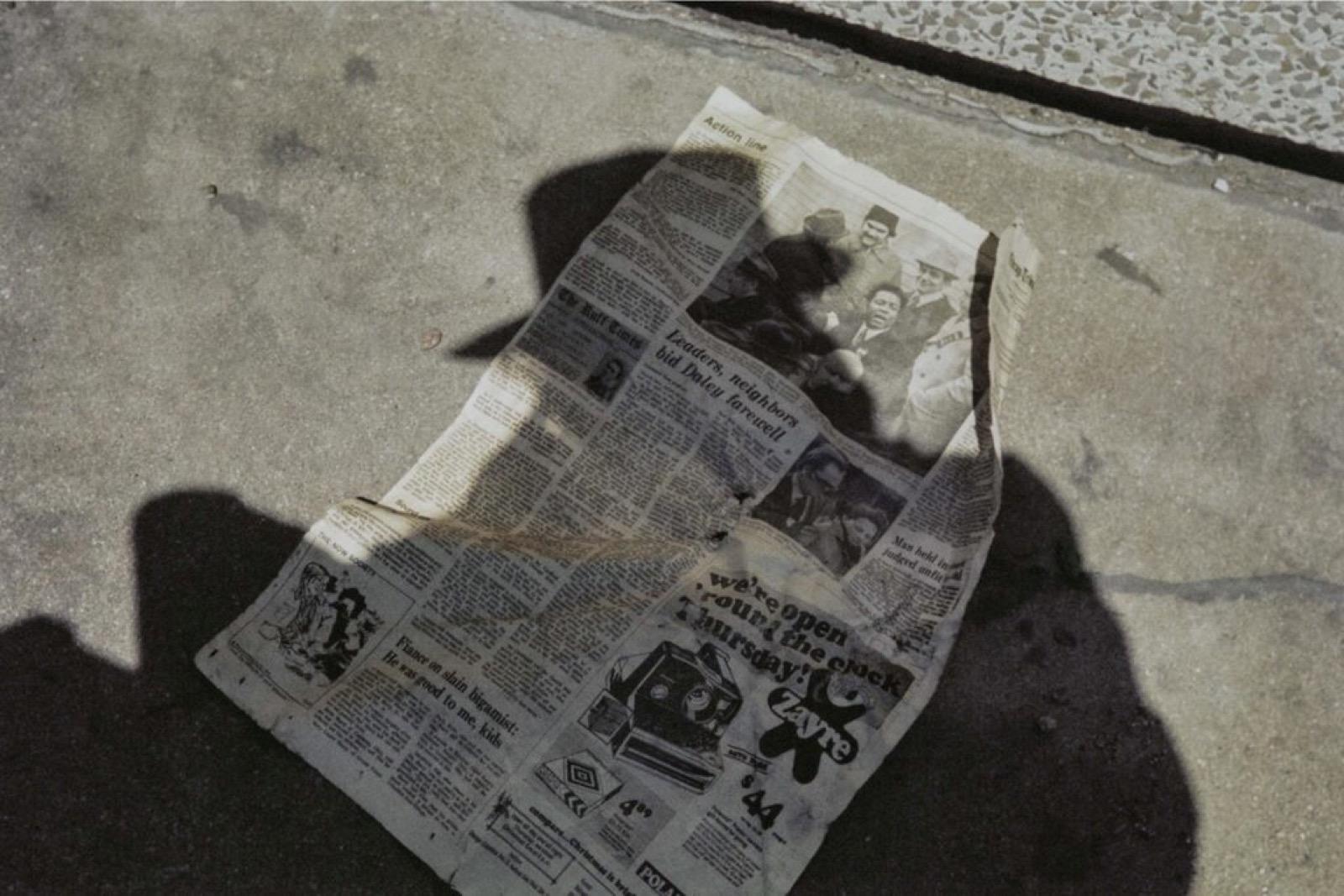

Low late-day sun rakes the pavement almost flat, warming the concrete to a dull gold and throwing one long shadow clear across the frame. It is the kind of light photographers wait for, and Maier has spent it not on a face but on a newspaper someone dropped and the sidewalk half-swallowed. The weather is the subject here: that raking spring glare turns cheap newsprint into something burnished, and lays her own silhouette, hat and shoulders, down beside it like a second reader.
And what a page it is. The tabloid lolls open to a spread only she could have loved, high and low pressed cheek to cheek. “Leaders, neighbors bid Daley farewell” runs a banner over a knot of mourners in dark coats; below, an Action Line column, a lonely-hearts confession, and a Zayre ad crowing “we’re open round the clock Thursday!” beside a boxed discount camera. It is a whole city’s Sunday reduced to grayscale and left in the sun to curl.
This is the pleasure of Maier at her most sidelong: a self-portrait in which the self is only a stain of shade, present the way a byline is present, over the story rather than in it. The chromogenic print, made later from her negative, keeps the muted, sun-bleached palette intact, all warm grays and one bruise of wet asphalt. Only after her death did the enormous archive surface, and pictures like this one show how completely she had already edited her city, reading it face down on the ground.