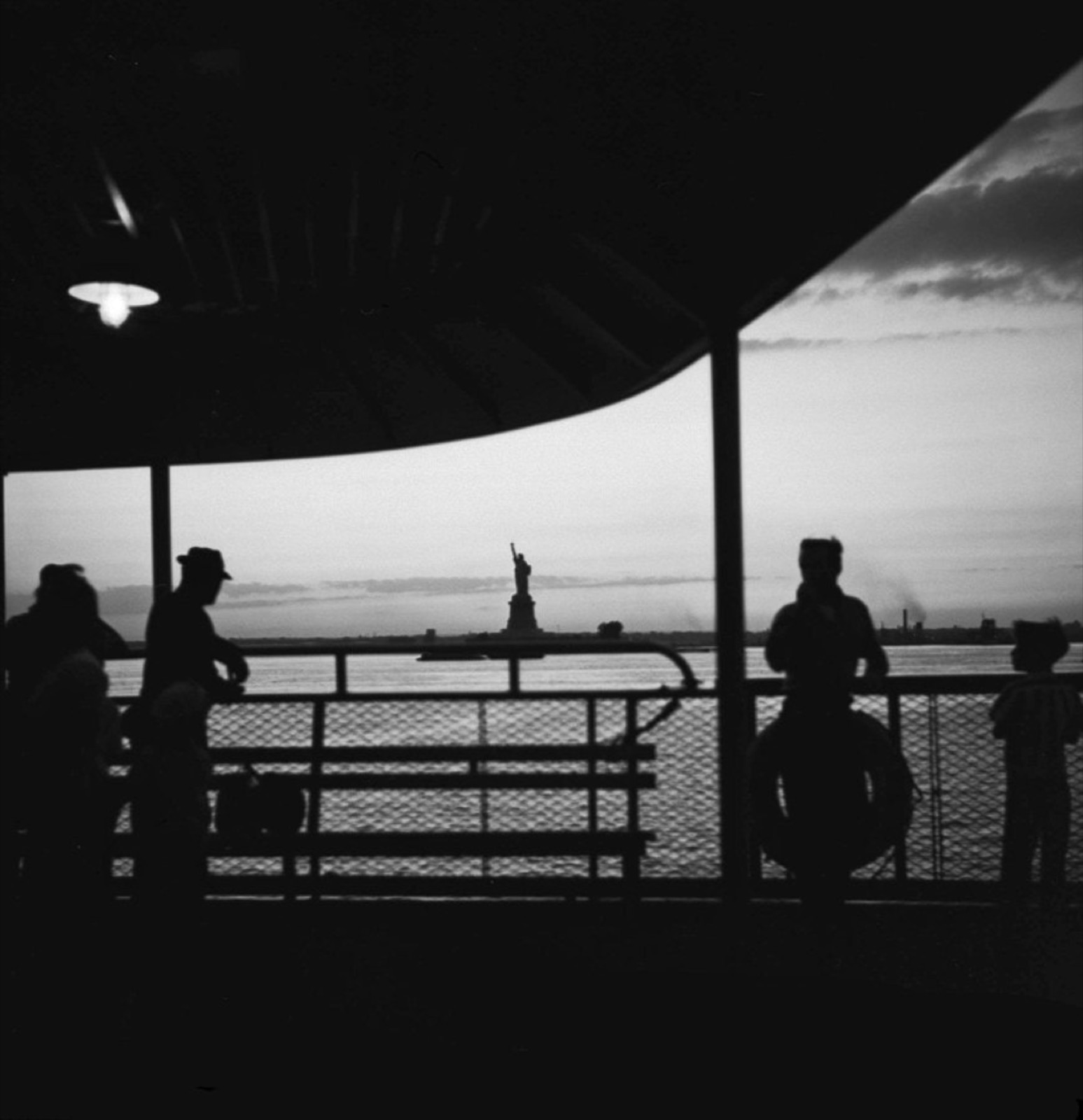
The picture withholds every face. Under the ferry’s curved canopy, backlit almost to pure black, a handful of passengers stand at the railing as silhouettes — a figure in a hat, a child, a man beside a hanging life ring — and none of them will turn toward us. What we are given instead is the far shape they are looking at: the Statue of Liberty, tiny on the dusk horizon across the darkening harbor.
Maier lets the exposure fall for the sky, not the deck, and the choice converts the passengers into shadow theatre. A round lamp burns overhead with a flare; the water glows pewter behind the chain-link and the pipe rail. Photography here is doing what it does best and worst, printing the bright distance while surrendering the near and human to darkness. The famous statue is legible; the travelers who came to see it are not.
That inversion, monument sharp and citizens obscured, is a quiet argument Maier made again and again, without commission or audience. She rode the ferries with a Rolleiflex, one more unremarked passenger, and left the negative among thousands unseen until her archive surfaced after her death. This gelatin silver print, made later from her film, needs a deep black to hold the canopy’s dark against the luminous water, and it has one. What she refuses to show, the faces, is exactly what makes the picture: a boat full of private hopes, all turned toward a distant figure none of them can yet reach.
The picture withholds every face. Under the ferry’s curved canopy, backlit almost to pure black, a handful of passengers stand at the railing as silhouettes — a figure in a hat, a child, a man beside a hanging life ring — and none of them will turn toward us. What we are given instead is the far shape they are looking at: the Statue of Liberty, tiny on the dusk horizon across the darkening harbor.
Maier lets the exposure fall for the sky, not the deck, and the choice converts the passengers into shadow theatre. A round lamp burns overhead with a flare; the water glows pewter behind the chain-link and the pipe rail. Photography here is doing what it does best and worst, printing the bright distance while surrendering the near and human to darkness. The famous statue is legible; the travelers who came to see it are not.
That inversion, monument sharp and citizens obscured, is a quiet argument Maier made again and again, without commission or audience. She rode the ferries with a Rolleiflex, one more unremarked passenger, and left the negative among thousands unseen until her archive surfaced after her death. This gelatin silver print, made later from her film, needs a deep black to hold the canopy’s dark against the luminous water, and it has one. What she refuses to show, the faces, is exactly what makes the picture: a boat full of private hopes, all turned toward a distant figure none of them can yet reach.