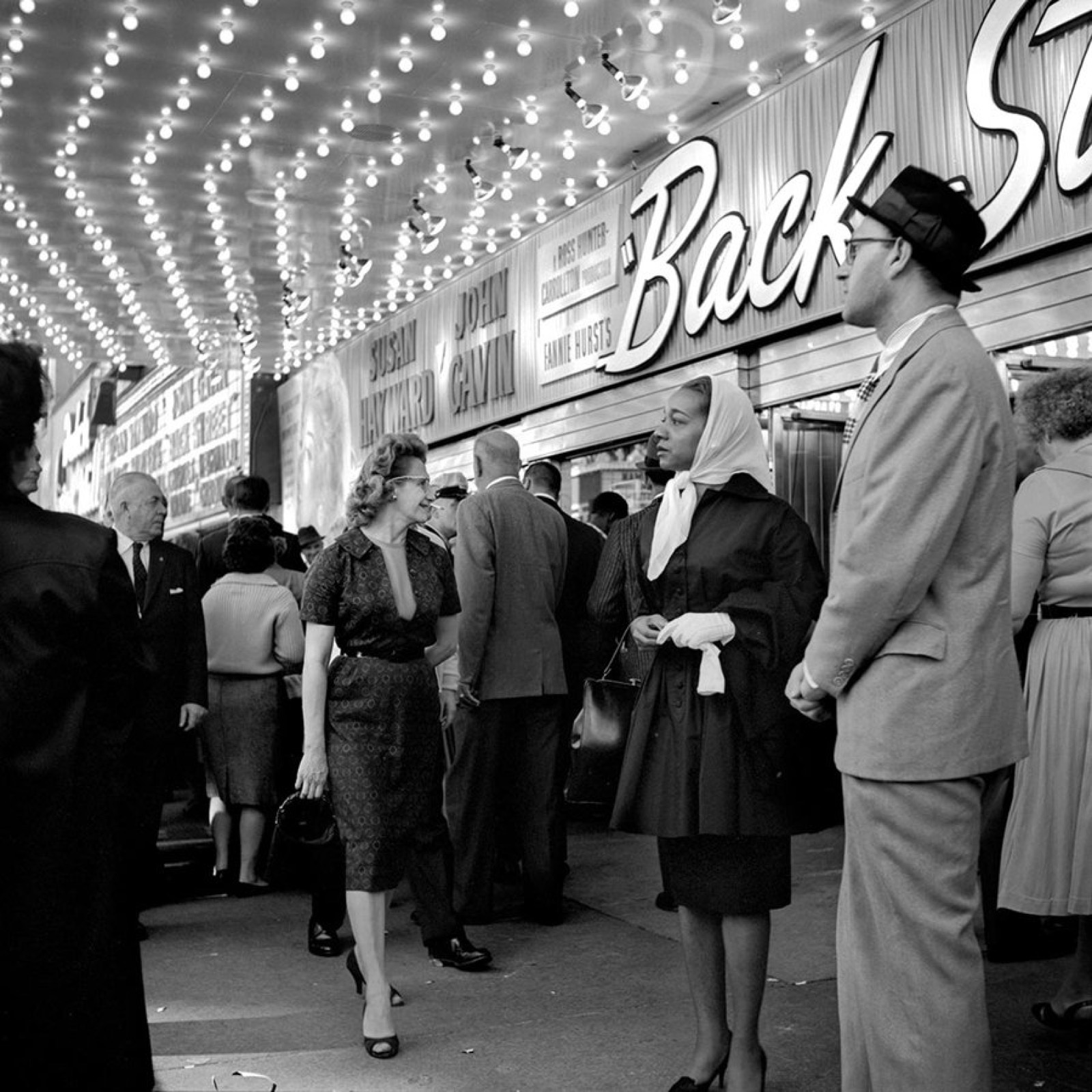
The film itself is withheld. We stand beneath the marquee of a picture palace, its ceiling a galaxy of small bulbs receding into the dark, and the letters overhead spell BACK STREET, promise Susan Hayward and John Gavin, a Ross Hunter production from a Fannie Hurst story, yet the screen and its drama stay locked somewhere behind us. What Maier gives instead is the vestibule, the crowd, the waiting, an entire audience caught in the moments before the lights go down.
And she withholds sound. A woman in a white headscarf and gloves, black handbag on her arm, leans toward a man in a pale suit and hat, mid-conversation, but the words are sealed inside the picture forever. Another woman in a patterned dress and glasses walks toward us, purse swinging, thinking something we will never learn. The theater sells one kind of story; the sidewalk quietly stages a dozen others the camera can show but never explain. Their errands and dramas remain entirely their own.
This is the paradox of the photograph as object: it preserves surfaces with perfect fidelity and keeps every interior locked away. Maier understood that, shooting compulsively and printing almost nothing, her negatives hidden until an auction after her death delivered them to strangers. Made later as a gelatin silver print, this frame fixes the marquee’s electric shimmer and the deep blacks of coats and doorways, a night at the movies preserved down to the last bulb, everything visible except the thing they all came to see.

The film itself is withheld. We stand beneath the marquee of a picture palace, its ceiling a galaxy of small bulbs receding into the dark, and the letters overhead spell BACK STREET, promise Susan Hayward and John Gavin, a Ross Hunter production from a Fannie Hurst story, yet the screen and its drama stay locked somewhere behind us. What Maier gives instead is the vestibule, the crowd, the waiting, an entire audience caught in the moments before the lights go down.
And she withholds sound. A woman in a white headscarf and gloves, black handbag on her arm, leans toward a man in a pale suit and hat, mid-conversation, but the words are sealed inside the picture forever. Another woman in a patterned dress and glasses walks toward us, purse swinging, thinking something we will never learn. The theater sells one kind of story; the sidewalk quietly stages a dozen others the camera can show but never explain. Their errands and dramas remain entirely their own.
This is the paradox of the photograph as object: it preserves surfaces with perfect fidelity and keeps every interior locked away. Maier understood that, shooting compulsively and printing almost nothing, her negatives hidden until an auction after her death delivered them to strangers. Made later as a gelatin silver print, this frame fixes the marquee’s electric shimmer and the deep blacks of coats and doorways, a night at the movies preserved down to the last bulb, everything visible except the thing they all came to see.