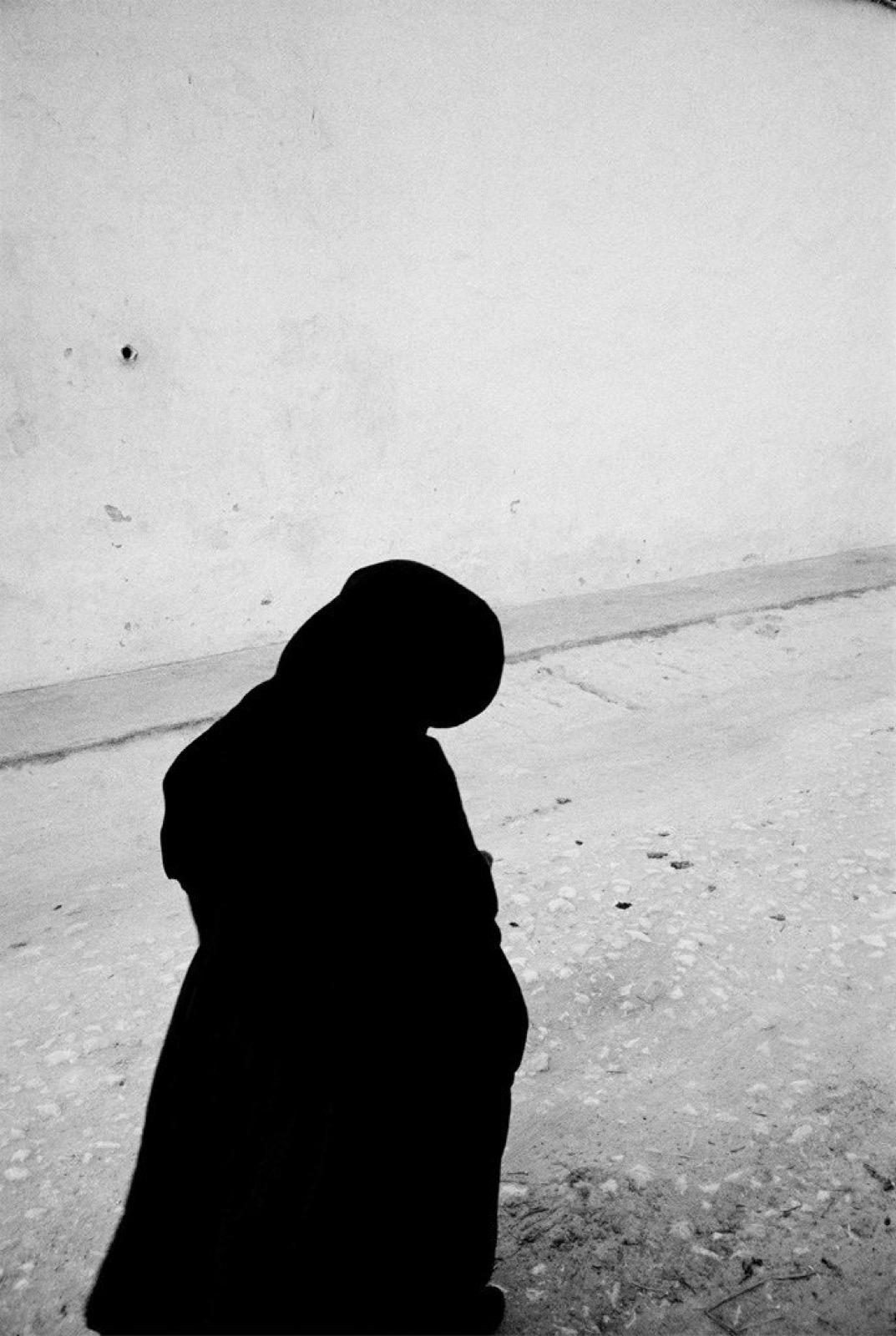
She lowers her head and moves along the white wall, and the movement is all we are given, for the woman herself has been reduced to a single black silhouette without a face. Wrapped head to foot in dark cloth, she bends slightly forward as she passes, her whole figure printed like an ink stain against the sunstruck plaster and the pale, pebbled ground. The gesture of walking with lowered eyes has become, in one exposure, the shape of an entire condition.
There is a temptation to read poverty, mourning, submission into this black shape, and the photograph both invites and refuses the reading. It gives us no face on which to verify grief, only the eloquent contour: the hunched shoulders, the shrouded head, the hem swallowing the feet. What we supply is our own, and the picture knows it. To photograph a person as pure silhouette is to make of them a sign, beautiful and slightly unjust, a legibility bought at the cost of the individual.
Moral de Calatrava, a village of the Castilian plain, gave Masats one of his most severe images of Franco-era rural life, made in the years after the AFAL group had turned Spanish photography toward such unsentimental looking; a lifetime of it brought him the Premio Nacional. This gelatin silver print depends on the purity of its two tones, the depthless black of the figure set against the luminous wall, a contrast only a good print sustains. We are given a whole life and denied the woman who carried it.
She lowers her head and moves along the white wall, and the movement is all we are given, for the woman herself has been reduced to a single black silhouette without a face. Wrapped head to foot in dark cloth, she bends slightly forward as she passes, her whole figure printed like an ink stain against the sunstruck plaster and the pale, pebbled ground. The gesture of walking with lowered eyes has become, in one exposure, the shape of an entire condition.
There is a temptation to read poverty, mourning, submission into this black shape, and the photograph both invites and refuses the reading. It gives us no face on which to verify grief, only the eloquent contour: the hunched shoulders, the shrouded head, the hem swallowing the feet. What we supply is our own, and the picture knows it. To photograph a person as pure silhouette is to make of them a sign, beautiful and slightly unjust, a legibility bought at the cost of the individual.
Moral de Calatrava, a village of the Castilian plain, gave Masats one of his most severe images of Franco-era rural life, made in the years after the AFAL group had turned Spanish photography toward such unsentimental looking; a lifetime of it brought him the Premio Nacional. This gelatin silver print depends on the purity of its two tones, the depthless black of the figure set against the luminous wall, a contrast only a good print sustains. We are given a whole life and denied the woman who carried it.