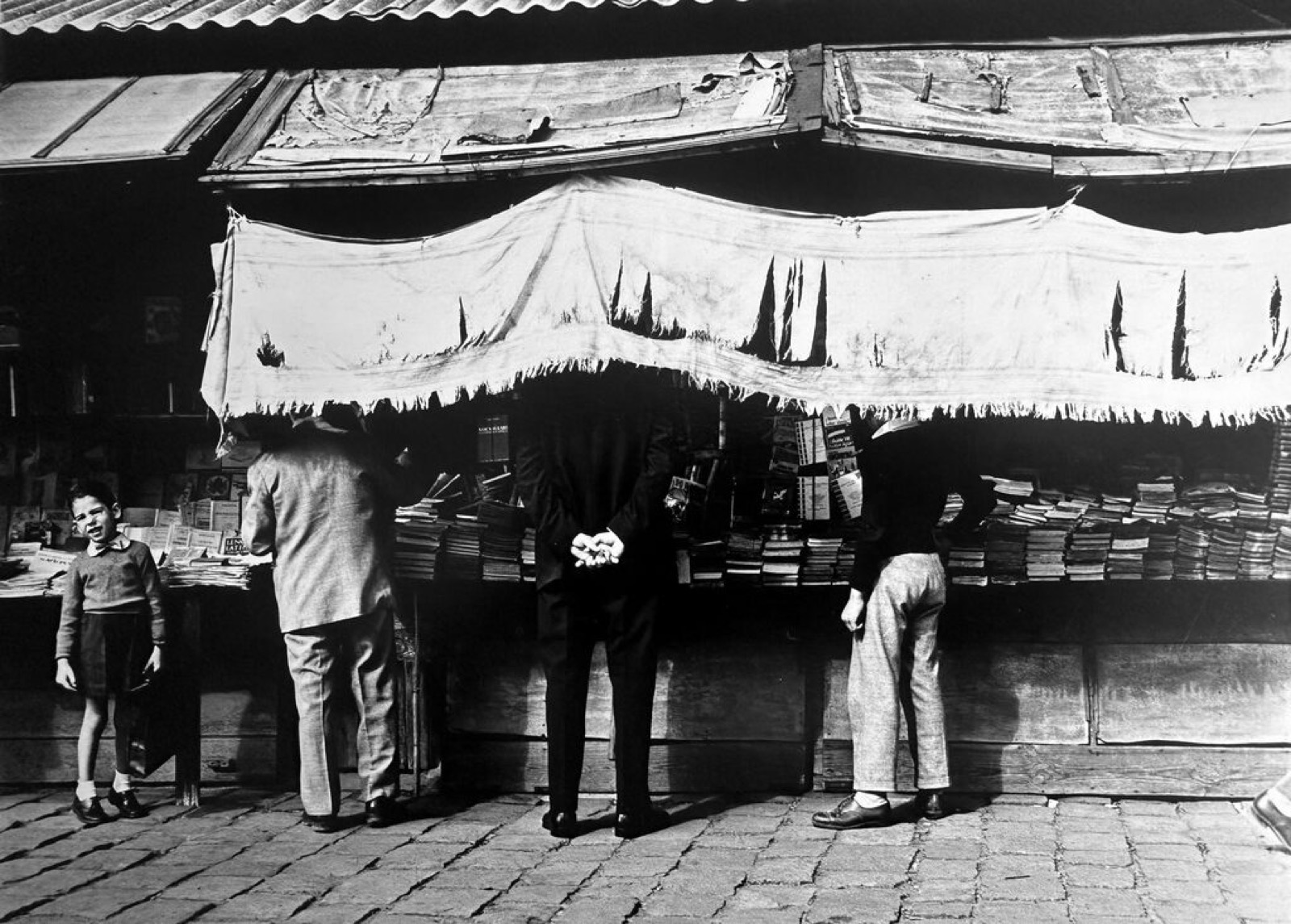
Words are the stock in trade at this stall, yet the one legible run of them across the awning isn’t words at all but a printed frieze of cypress trees, their black spires snipped into pale canvas like a landscape left unfinished. Below that decorative horizon the real text begins: spines, covers, a leaning placard, magazines fanned across the wooden counter in a density no reader could exhaust. Masats frames a whole economy of reading, then fills it with people who have turned their backs to us.
Three men lean into the shelves, absorbed almost to the point of vanishing; the central figure has folded his hands behind his back with the patience of someone who means to buy nothing and stay forever. Only the boy in short trousers, one sock slipping, faces the camera, planted on the cobblestones as if he alone has noticed a photograph being made. There is comedy in it, grown men bent to their reading while a child keeps watch, and Masats lets the joke stand without a caption.
This is Barcelona in the mid-fifties, and the picture belongs to the moment when Masats and the AFAL circle were pulling Spanish photography out of soft pictorial habit into something quicker and more alert to the street. He would go on to the Sanfermines, the boxing ring, and eventually the Premio Nacional de Fotografía; here he simply reads the readers. The gelatin silver print carries the argument whole, from the sooty corrugated roof to the bleached canvas to the grey cliff of paper, and holds it in a single breath.
Words are the stock in trade at this stall, yet the one legible run of them across the awning isn’t words at all but a printed frieze of cypress trees, their black spires snipped into pale canvas like a landscape left unfinished. Below that decorative horizon the real text begins: spines, covers, a leaning placard, magazines fanned across the wooden counter in a density no reader could exhaust. Masats frames a whole economy of reading, then fills it with people who have turned their backs to us.
Three men lean into the shelves, absorbed almost to the point of vanishing; the central figure has folded his hands behind his back with the patience of someone who means to buy nothing and stay forever. Only the boy in short trousers, one sock slipping, faces the camera, planted on the cobblestones as if he alone has noticed a photograph being made. There is comedy in it, grown men bent to their reading while a child keeps watch, and Masats lets the joke stand without a caption.
This is Barcelona in the mid-fifties, and the picture belongs to the moment when Masats and the AFAL circle were pulling Spanish photography out of soft pictorial habit into something quicker and more alert to the street. He would go on to the Sanfermines, the boxing ring, and eventually the Premio Nacional de Fotografía; here he simply reads the readers. The gelatin silver print carries the argument whole, from the sooty corrugated roof to the bleached canvas to the grey cliff of paper, and holds it in a single breath.