The doorway keeps its subject firmly out of sight. Behind that narrow opening lies only blackness, from which no mourner, no body, no interior room ever resolves, and the coffin propped in the lower gap is plainly empty, its raw slatted interior tilted toward the light. Whatever grief the object was built to carry has either not yet arrived or has already passed through, and Masats lets the threshold hold that suspense.
Everything else is surface and light. The whitewashed wall fills the frame, its lime skin crazed with hairline cracks, water stains and old repairs, a chalk field graded from bright noon to soft grey. Against it the pale unfinished pine of the coffin reads almost tenderly, while the doorway itself is the single passage of absolute black the composition allows. Masats sets the darkest dark beside the lightest light and asks the picture to balance on that stone step.
The scene is a village in the province of Cádiz, and it belongs to the years when Masats and the AFAL photographers were reading Franco-era Spain through its plainest objects rather than its ceremonies. He has found the country’s mortality not at a funeral but in an empty box left standing in a doorway, an economy of means that would carry him to the Premio Nacional de Fotografía in 2004. The gelatin silver print keeps both extremes intact, the sun-bleached lime and the unyielding dark, so that the absence at the centre stays exactly as legible as the wall.
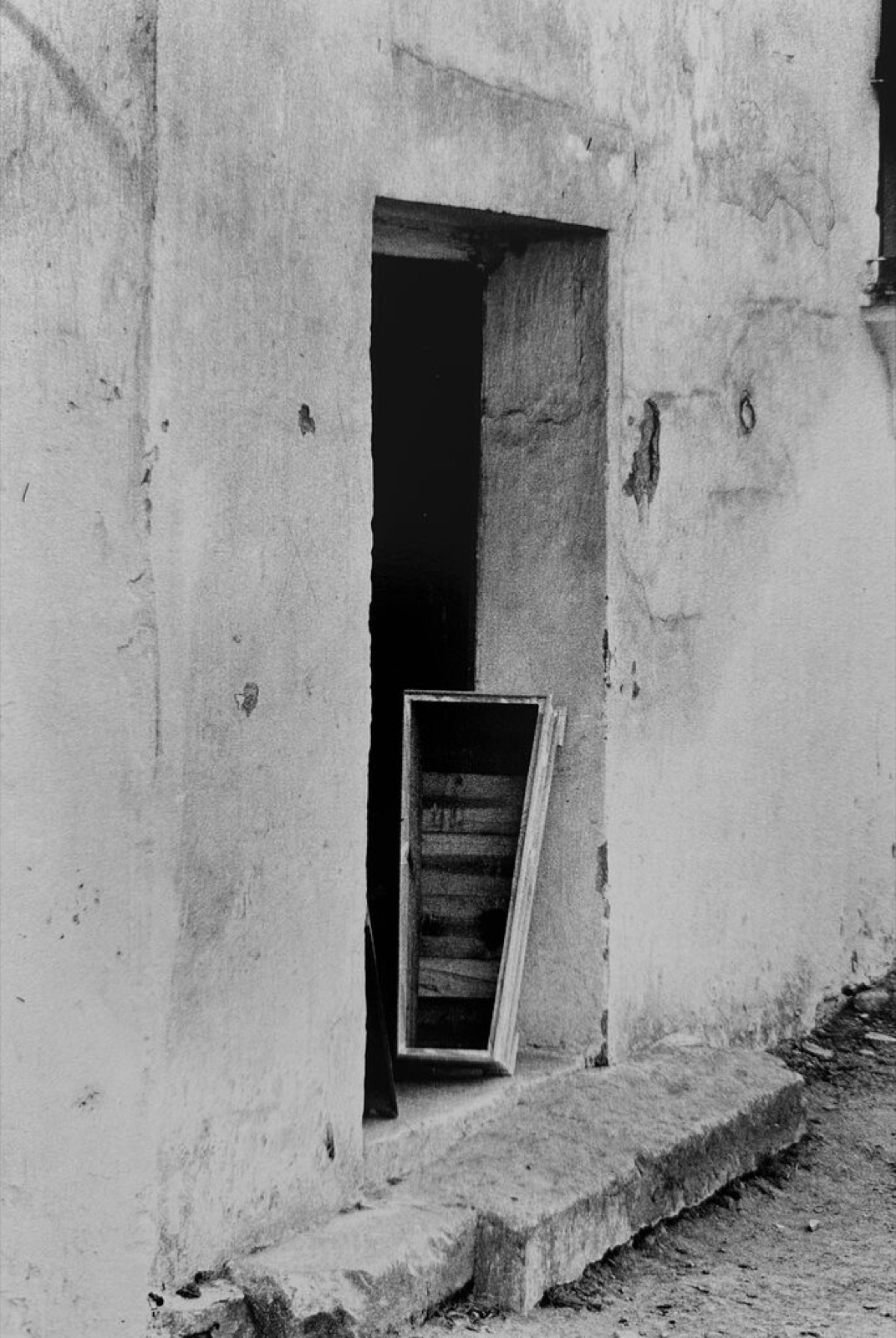

The doorway keeps its subject firmly out of sight. Behind that narrow opening lies only blackness, from which no mourner, no body, no interior room ever resolves, and the coffin propped in the lower gap is plainly empty, its raw slatted interior tilted toward the light. Whatever grief the object was built to carry has either not yet arrived or has already passed through, and Masats lets the threshold hold that suspense.
Everything else is surface and light. The whitewashed wall fills the frame, its lime skin crazed with hairline cracks, water stains and old repairs, a chalk field graded from bright noon to soft grey. Against it the pale unfinished pine of the coffin reads almost tenderly, while the doorway itself is the single passage of absolute black the composition allows. Masats sets the darkest dark beside the lightest light and asks the picture to balance on that stone step.
The scene is a village in the province of Cádiz, and it belongs to the years when Masats and the AFAL photographers were reading Franco-era Spain through its plainest objects rather than its ceremonies. He has found the country’s mortality not at a funeral but in an empty box left standing in a doorway, an economy of means that would carry him to the Premio Nacional de Fotografía in 2004. The gelatin silver print keeps both extremes intact, the sun-bleached lime and the unyielding dark, so that the absence at the centre stays exactly as legible as the wall.