Every lit interior at dusk is a small promise made to whoever stands outside in the cooling air. Here the promise is kept twice. A weathered shingle cottage on the Cape has gone the colour of old bark under a cobalt sky, and through its central passage a corridor burns amber, drawing the eye down its length to a second, framed opening where the sea lies at sunset, a horizontal ribbon of rose and mauve above pale water. I want to walk in. The photograph knows this and offers no threshold to cross.
What holds me, though, is neither the shingles nor the sunset but a payphone bolted to the corridor wall, its dark receiver hanging on a coiled cord. It is the most banal object in the picture and the one I cannot stop looking at: a machine for reaching someone far away, installed exactly where the world opens onto the sea. Somebody stood there, coins ready, back to that unbearable light. The rest composes itself, cool blue against warm gold, two white windows keeping watch. This one detail unsettles the calm and makes the scene ache.
Meyerowitz worked this twilight on the 8×10 view camera whose long looking gave us Cape Light, letting the exposure fold two temperatures of light into one frame. Among those who, with Shore and Eggleston, made colour a serious language in the 1970s, he treats a motel corridor as a devotional space. His work is held by MoMA, the Met and the Boston MFA. This archival pigment print preserves the amber tunnel and the fragile band of dusk beyond it.
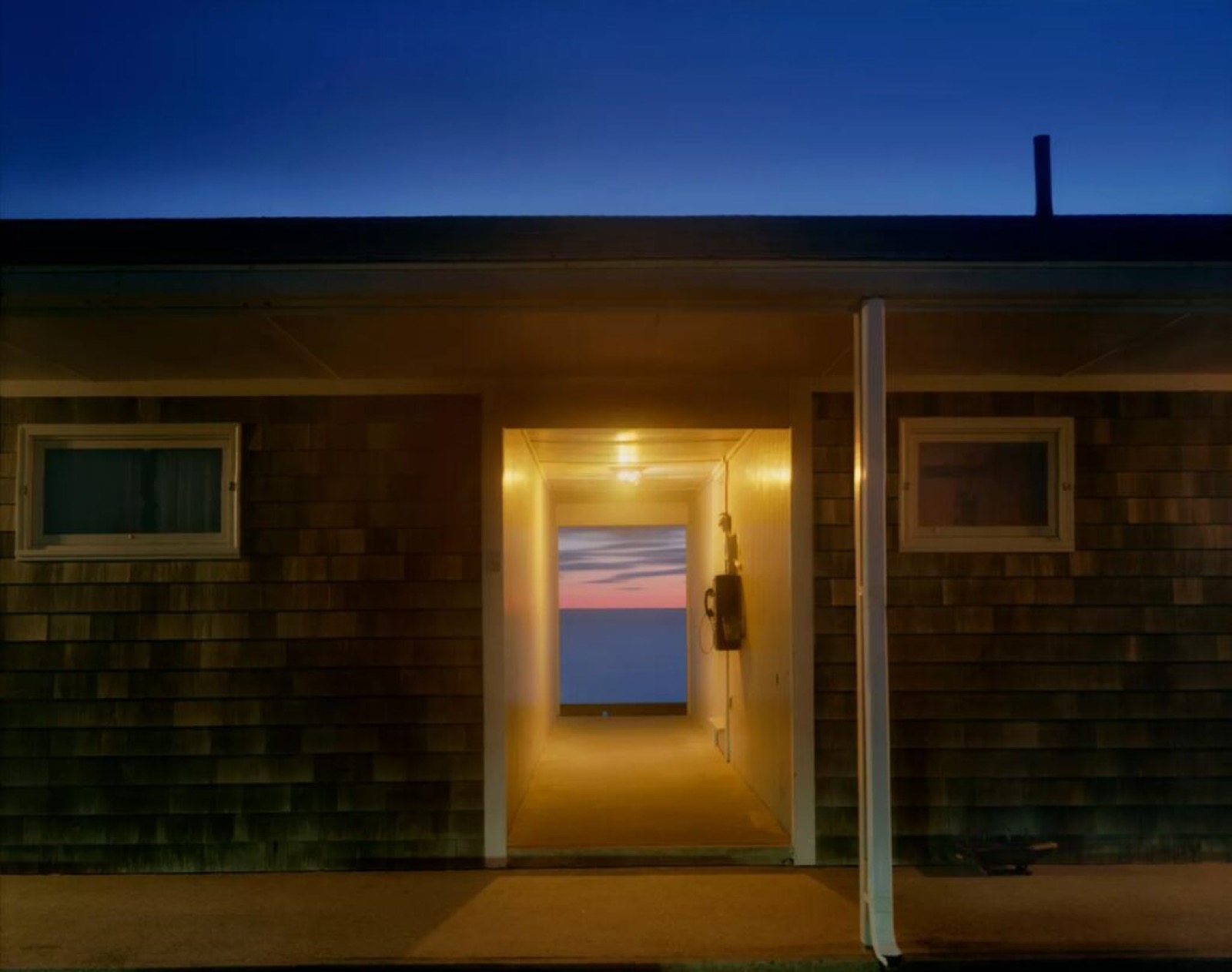

Every lit interior at dusk is a small promise made to whoever stands outside in the cooling air. Here the promise is kept twice. A weathered shingle cottage on the Cape has gone the colour of old bark under a cobalt sky, and through its central passage a corridor burns amber, drawing the eye down its length to a second, framed opening where the sea lies at sunset, a horizontal ribbon of rose and mauve above pale water. I want to walk in. The photograph knows this and offers no threshold to cross.
What holds me, though, is neither the shingles nor the sunset but a payphone bolted to the corridor wall, its dark receiver hanging on a coiled cord. It is the most banal object in the picture and the one I cannot stop looking at: a machine for reaching someone far away, installed exactly where the world opens onto the sea. Somebody stood there, coins ready, back to that unbearable light. The rest composes itself, cool blue against warm gold, two white windows keeping watch. This one detail unsettles the calm and makes the scene ache.
Meyerowitz worked this twilight on the 8×10 view camera whose long looking gave us Cape Light, letting the exposure fold two temperatures of light into one frame. Among those who, with Shore and Eggleston, made colour a serious language in the 1970s, he treats a motel corridor as a devotional space. His work is held by MoMA, the Met and the Boston MFA. This archival pigment print preserves the amber tunnel and the fragile band of dusk beyond it.