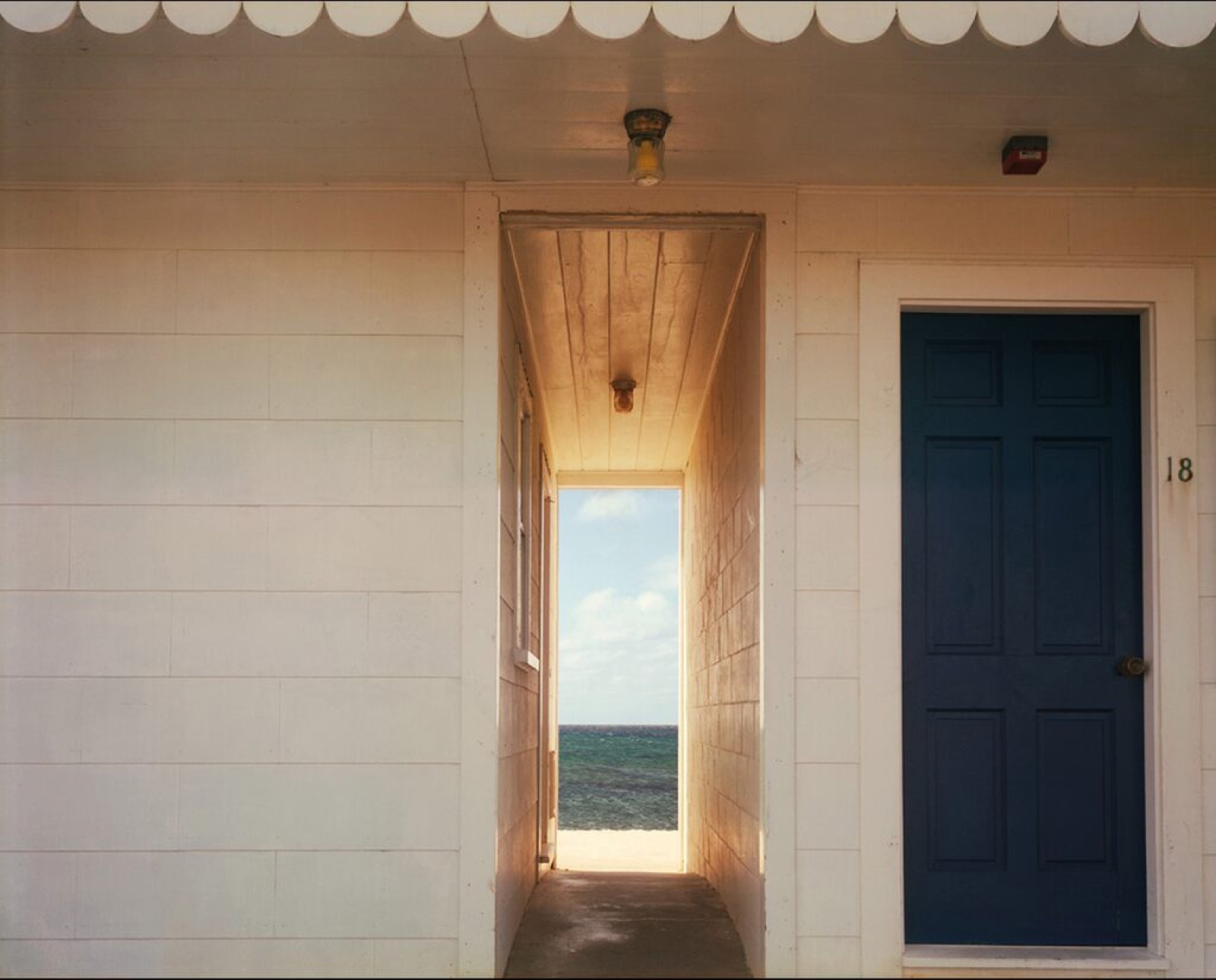
Stand at the front of this Provincetown motel and the architecture does the composing for you: a pale cream facade, a scalloped awning valance running along the top like a paper doily, and a navy blue door marked 18 with a brass knob and a white surround. Between the blank wall and the shut door, a breezeway is cut through the building, and at the far end of that passage the Atlantic is waiting, turquoise under a single cloud, a strip of bleached sand below it. The whole picture is a frame within a frame within a frame.
What reads as documentary is a piece of staging by attention alone. Meyerowitz does nothing to the scene, yet he finds it already directed: warm interior light gilds the plank ceiling and the old bulkhead lamp inside the corridor, while the sea it opens onto stays cool and remote, a rectangle of colour set like a painting into the dim. The closed navy door refuses us; the open passage grants everything. Two thresholds, one denying and one giving, hold the image in a tension no set designer could improve.
This is Cape Light thinking made portable: the seaboard read as a sequence of doorways and colours by the man who, with Shore and Eggleston, made colour serious in the 1970s. He worked here on the 8×10 view camera, whose descriptive patience is why the turquoise sits so precisely against the cream. Collected by MoMA, the Met and the Boston MFA, Meyerowitz turns a rented door into a meditation. This archival pigment print, made later, keeps that gilded corridor intact.
Stand at the front of this Provincetown motel and the architecture does the composing for you: a pale cream facade, a scalloped awning valance running along the top like a paper doily, and a navy blue door marked 18 with a brass knob and a white surround. Between the blank wall and the shut door, a breezeway is cut through the building, and at the far end of that passage the Atlantic is waiting, turquoise under a single cloud, a strip of bleached sand below it. The whole picture is a frame within a frame within a frame.
What reads as documentary is a piece of staging by attention alone. Meyerowitz does nothing to the scene, yet he finds it already directed: warm interior light gilds the plank ceiling and the old bulkhead lamp inside the corridor, while the sea it opens onto stays cool and remote, a rectangle of colour set like a painting into the dim. The closed navy door refuses us; the open passage grants everything. Two thresholds, one denying and one giving, hold the image in a tension no set designer could improve.
This is Cape Light thinking made portable: the seaboard read as a sequence of doorways and colours by the man who, with Shore and Eggleston, made colour serious in the 1970s. He worked here on the 8×10 view camera, whose descriptive patience is why the turquoise sits so precisely against the cream. Collected by MoMA, the Met and the Boston MFA, Meyerowitz turns a rented door into a meditation. This archival pigment print, made later, keeps that gilded corridor intact.