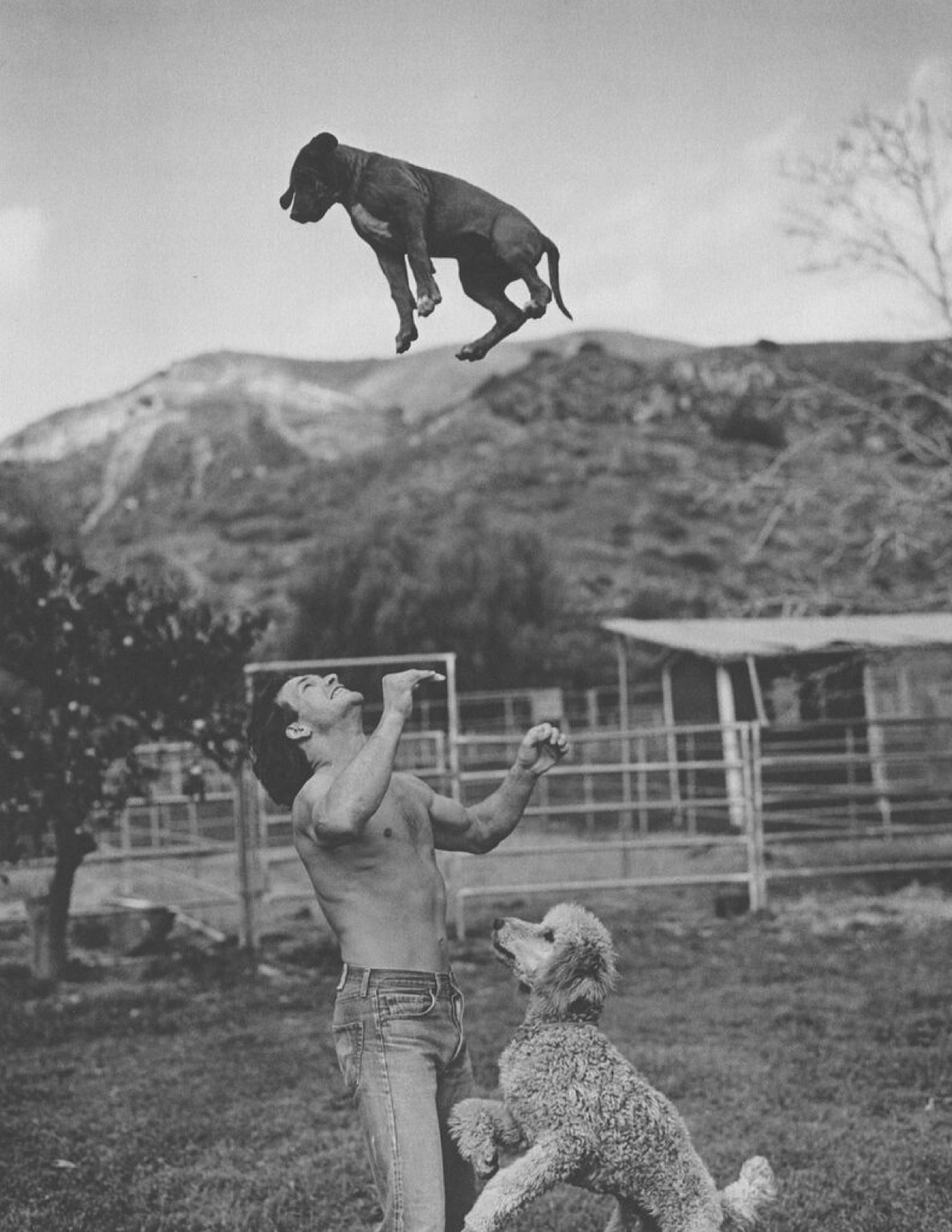
The landing itself is withheld. A dark dog hangs at the top of its arc against a pale sky, paws gathered, tail streaming, and we are not shown whether it drops back into the waiting hands below. Beneath it a shirtless man in blue jeans tilts his face up, arms open, laughing, while a curly white poodle rises on its hind legs to join the game. The corral fence, the bare tree, the brown hills all wait with us.
There is another withholding here, gentler and stranger. The man is Patrick Swayze, though the picture does not know it yet; the fame his name would soon carry is still two years off, and what we watch is simply a young dancer at ease on a ranch, at play with his animals. The image keeps his future from him, which is the odd mercy that photographs grant their subjects. It fixes a person before the story that will define him has arrived.
Weber is the great American pastoralist of the camera, drawn to dogs and horses and sunlit bodies as much as to clothes, and this is the register he loved best: no studio, no wardrobe, only the choreography of delight. The gelatin silver print gives the scene its steady grey weather, the dog’s black coat and the poodle’s white one set at the two ends of a single scale. Everything tends toward the top of the frame, toward the animal in the air, toward a resolution the photographer, wisely, kept for himself.
The landing itself is withheld. A dark dog hangs at the top of its arc against a pale sky, paws gathered, tail streaming, and we are not shown whether it drops back into the waiting hands below. Beneath it a shirtless man in blue jeans tilts his face up, arms open, laughing, while a curly white poodle rises on its hind legs to join the game. The corral fence, the bare tree, the brown hills all wait with us.
There is another withholding here, gentler and stranger. The man is Patrick Swayze, though the picture does not know it yet; the fame his name would soon carry is still two years off, and what we watch is simply a young dancer at ease on a ranch, at play with his animals. The image keeps his future from him, which is the odd mercy that photographs grant their subjects. It fixes a person before the story that will define him has arrived.
Weber is the great American pastoralist of the camera, drawn to dogs and horses and sunlit bodies as much as to clothes, and this is the register he loved best: no studio, no wardrobe, only the choreography of delight. The gelatin silver print gives the scene its steady grey weather, the dog’s black coat and the poodle’s white one set at the two ends of a single scale. Everything tends toward the top of the frame, toward the animal in the air, toward a resolution the photographer, wisely, kept for himself.