The carved wooden foot of the armchair grips nothing but the gritty gravel of a Paris rooftop, a claw where you expect a parquet floor. It is the wrong object for the place: a heavy drawing-room chair, upholstered in dark velvet and studded with a row of nails, hauled up stairs and set down among chimney pots, water tanks and a spidering television antenna. On it two nude figures fold together, a man’s head against a woman’s, limbs interlaced, one bare foot let down to the ground.
Photography loves this kind of transplant. Move a familiar thing to an impossible setting and the camera, which cannot argue, simply reports the contradiction as fact. The bright overhead sun does the rest, printing hard shadows onto the pale stone parapet and modelling the bodies with a clarity that feels almost classical, as if the couple were a marble group set out to weather. Weber understood that the frame turns a private embrace into a public tableau the instant the shutter closes.
He built his name staging American ease, yet this is Europe seen by an American eye: the Haussmann rooftops, the antennas, the grand old furniture reduced to a prop. Working in gelatin silver, he holds the whole scale from the black velvet through sunstruck skin to a bleached sky, a tonal reach the medium was made for. The picture’s wit is that it never resolves the question it poses. Are we watching intimacy, or an elaborate joke about where intimacy is allowed to happen?
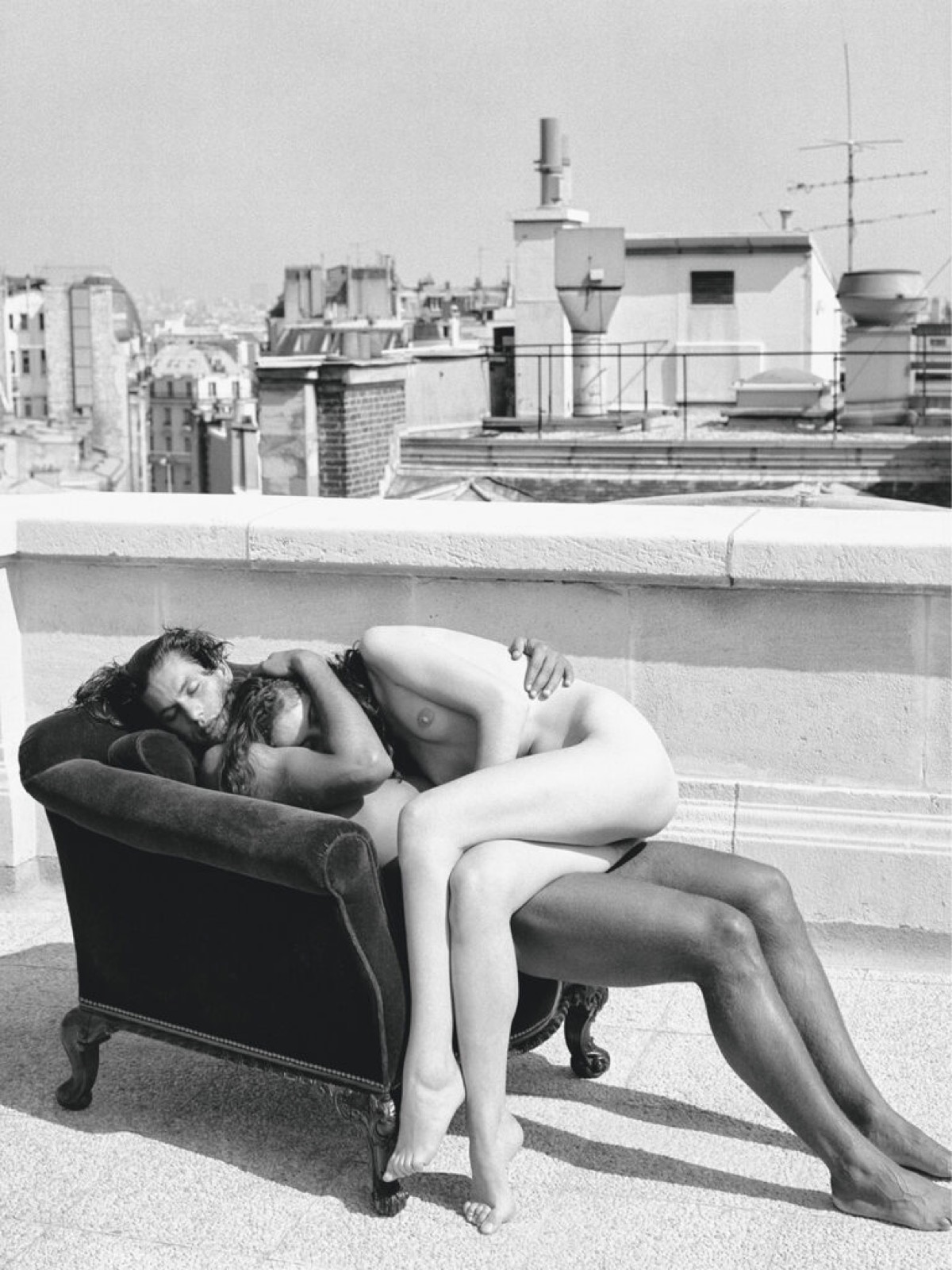

The carved wooden foot of the armchair grips nothing but the gritty gravel of a Paris rooftop, a claw where you expect a parquet floor. It is the wrong object for the place: a heavy drawing-room chair, upholstered in dark velvet and studded with a row of nails, hauled up stairs and set down among chimney pots, water tanks and a spidering television antenna. On it two nude figures fold together, a man’s head against a woman’s, limbs interlaced, one bare foot let down to the ground.
Photography loves this kind of transplant. Move a familiar thing to an impossible setting and the camera, which cannot argue, simply reports the contradiction as fact. The bright overhead sun does the rest, printing hard shadows onto the pale stone parapet and modelling the bodies with a clarity that feels almost classical, as if the couple were a marble group set out to weather. Weber understood that the frame turns a private embrace into a public tableau the instant the shutter closes.
He built his name staging American ease, yet this is Europe seen by an American eye: the Haussmann rooftops, the antennas, the grand old furniture reduced to a prop. Working in gelatin silver, he holds the whole scale from the black velvet through sunstruck skin to a bleached sky, a tonal reach the medium was made for. The picture’s wit is that it never resolves the question it poses. Are we watching intimacy, or an elaborate joke about where intimacy is allowed to happen?