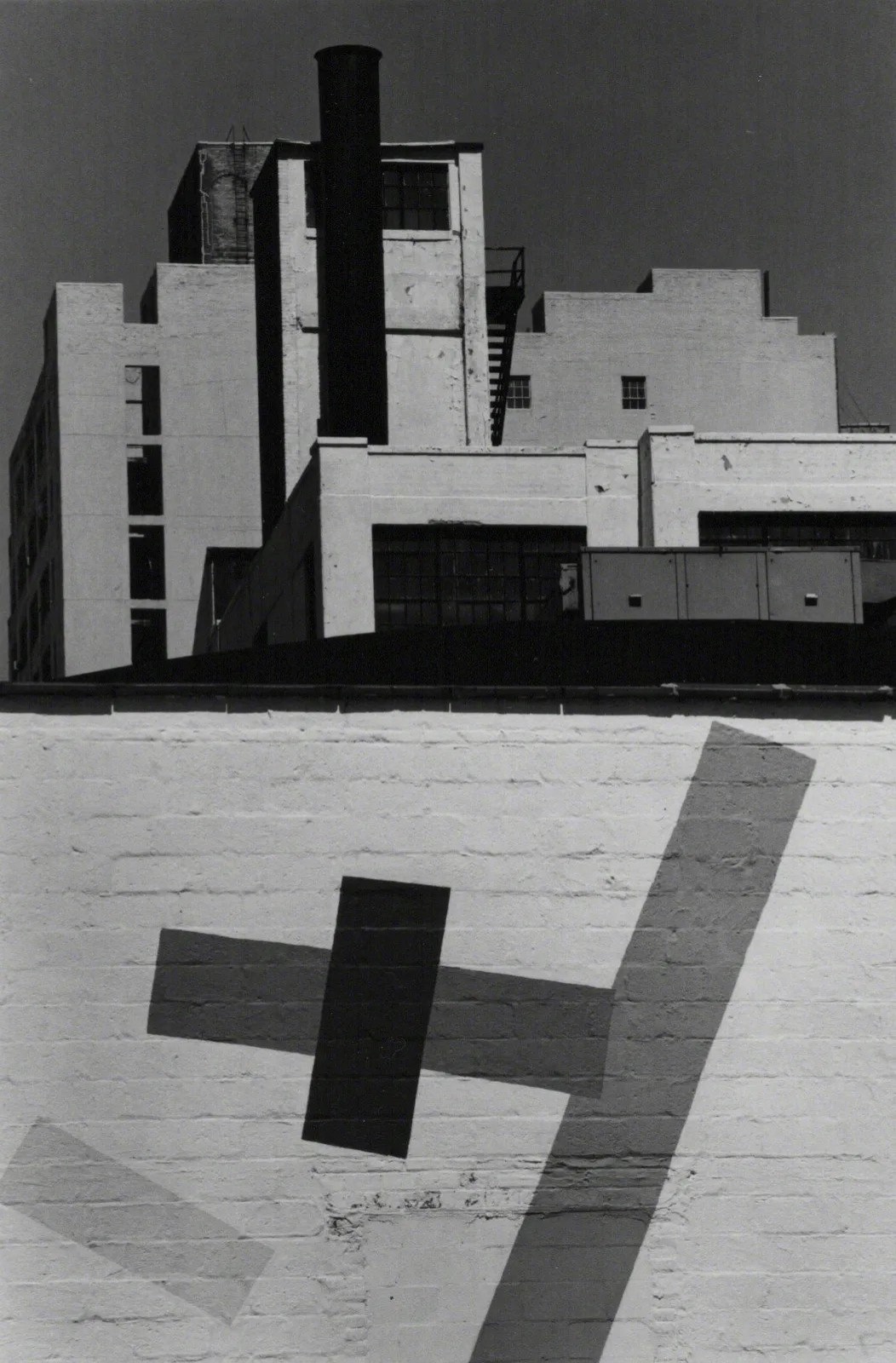
The picture splits in two, the seam a low parapet running clean across the frame. Below, a whitewashed brick wall fills the lower half, lit so hard every course of mortar reads. On it, two dark shapes: a stubby cross, almost a plus sign, and a long diagonal bar leaning toward the corner. You cannot tell whether they are painted or merely shadows thrown by something out of view. That uncertainty is the whole charm. The wall has become a page, written on in a script no one quite remembers.
Above the parapet rises the other city, the working one. A fat black smokestack stands dead center against a darkened sky, flanked by white masonry blocks that step back in shallow planes like a Cubist relief. A skeletal fire escape zigzags down one face; grids of factory window glint and go opaque by turns. This is downtown near Canal in the mid-eighties, the loft district before the money arrived. The eye that found it had walked these blocks for decades, between New York and Paris, patient until masonry confessed something.
What it confesses is geometry as feeling. The lower wall, bright and nearly abstract, answers the upper machinery in the same vocabulary of rectangle and line, so the building rhymes with its own foundation. Nothing is staged; everything is seen. A vintage print holds the silver of that exact afternoon, deep blacks and chalky whites a later reproduction cannot match. Such prints sit now at the Met and the Centre Pompidou, where this long attention to the unglamorous American street is understood, at last, as a kind of devotion.
The picture splits in two, the seam a low parapet running clean across the frame. Below, a whitewashed brick wall fills the lower half, lit so hard every course of mortar reads. On it, two dark shapes: a stubby cross, almost a plus sign, and a long diagonal bar leaning toward the corner. You cannot tell whether they are painted or merely shadows thrown by something out of view. That uncertainty is the whole charm. The wall has become a page, written on in a script no one quite remembers.
Above the parapet rises the other city, the working one. A fat black smokestack stands dead center against a darkened sky, flanked by white masonry blocks that step back in shallow planes like a Cubist relief. A skeletal fire escape zigzags down one face; grids of factory window glint and go opaque by turns. This is downtown near Canal in the mid-eighties, the loft district before the money arrived. The eye that found it had walked these blocks for decades, between New York and Paris, patient until masonry confessed something.
What it confesses is geometry as feeling. The lower wall, bright and nearly abstract, answers the upper machinery in the same vocabulary of rectangle and line, so the building rhymes with its own foundation. Nothing is staged; everything is seen. A vintage print holds the silver of that exact afternoon, deep blacks and chalky whites a later reproduction cannot match. Such prints sit now at the Met and the Centre Pompidou, where this long attention to the unglamorous American street is understood, at last, as a kind of devotion.