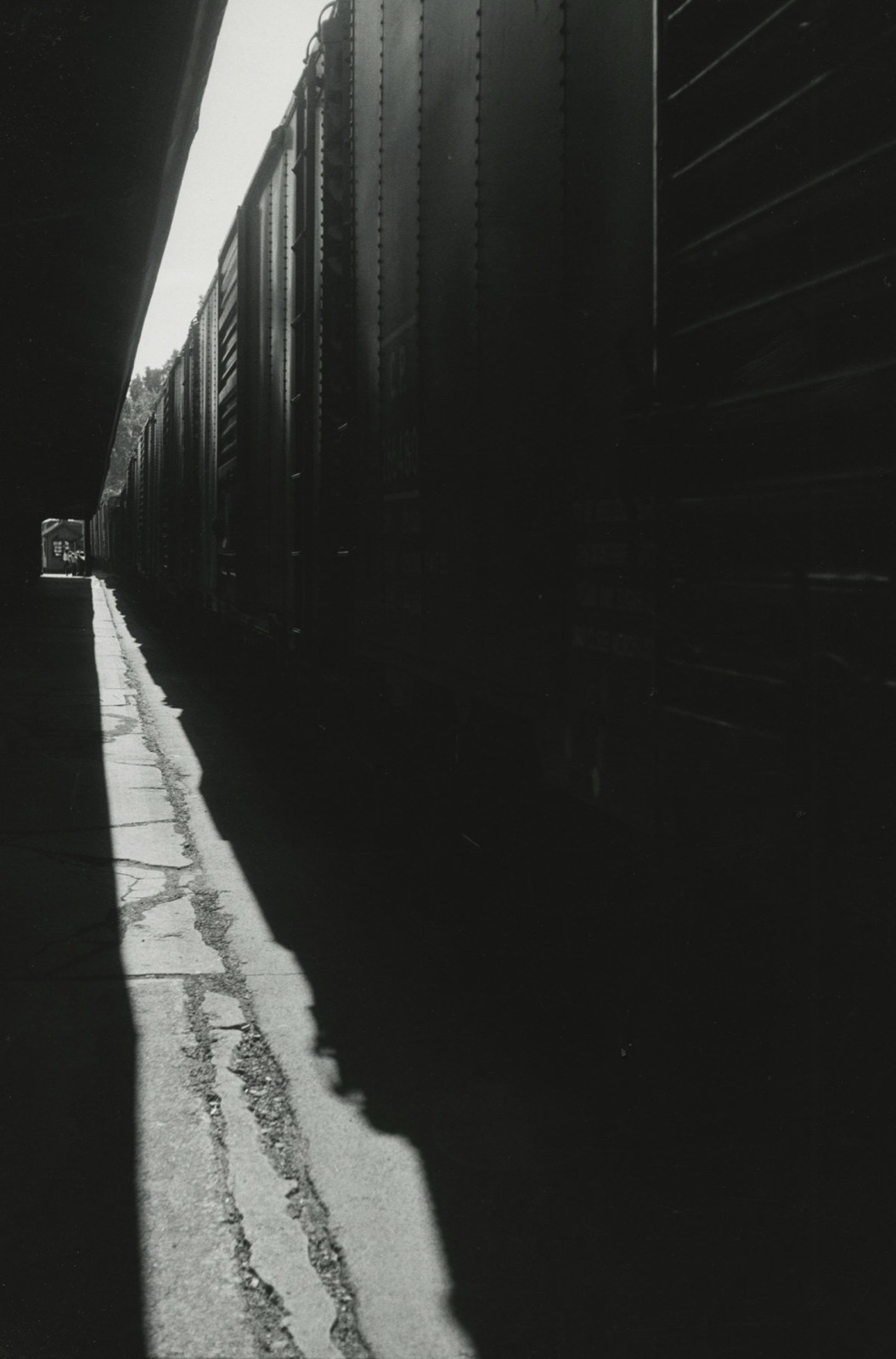
What gets you first is the wedge of light — a long slab of cracked concrete platform that runs the whole left edge and tapers toward a vanishing point somewhere near the front of the train. Everything else is dark, a wall of boxcars holding most of the frame in shadow, their ribbed steel sides catching just enough sun along the top to read as solid weight. The platform is the only thing that breathes. It's lit like a stage with no actor, and that absence is the whole performance, the kind of empty that hums.
You can just make out the freight-car stenciling, ghost lettering and a serial number you'll never finish reading, and at the far end, tiny, the pale snout of a locomotive under trees. The picture is built on one idea worked to the bone — parallel lines pulling away from you, rail and platform edge and the seam of light all racing to the same point — and yet it never feels like a diagram. It feels like waiting. Like the particular boredom and expectancy of a station in mid-afternoon, the heat off the gravel, time gone slack.
This is mid-1950s Stettner, between his New York and his Paris, a humanist who could find a whole mood in cargo and shadow rather than faces. The print carries it: deep blacks that don't clog, that crack of highlight kept just shy of blowing out, grain you can feel. Held now by the Met and the Pompidou, he made the freight yard into a place you could stand and listen. A vintage print is where that silence still lives, exactly as he weighed it.
What gets you first is the wedge of light — a long slab of cracked concrete platform that runs the whole left edge and tapers toward a vanishing point somewhere near the front of the train. Everything else is dark, a wall of boxcars holding most of the frame in shadow, their ribbed steel sides catching just enough sun along the top to read as solid weight. The platform is the only thing that breathes. It's lit like a stage with no actor, and that absence is the whole performance, the kind of empty that hums.
You can just make out the freight-car stenciling, ghost lettering and a serial number you'll never finish reading, and at the far end, tiny, the pale snout of a locomotive under trees. The picture is built on one idea worked to the bone — parallel lines pulling away from you, rail and platform edge and the seam of light all racing to the same point — and yet it never feels like a diagram. It feels like waiting. Like the particular boredom and expectancy of a station in mid-afternoon, the heat off the gravel, time gone slack.
This is mid-1950s Stettner, between his New York and his Paris, a humanist who could find a whole mood in cargo and shadow rather than faces. The print carries it: deep blacks that don't clog, that crack of highlight kept just shy of blowing out, grain you can feel. Held now by the Met and the Pompidou, he made the freight yard into a place you could stand and listen. A vintage print is where that silence still lives, exactly as he weighed it.