The picture is built almost entirely of one thing: the ribbed flank of a modern tower, a vertical screen of close-set aluminum mullions that fills the frame and runs out both sides. Across this corduroy of light the photographer has caught a great triangular shadow, cast by some unseen neighbor, climbing the facade like a dark sail. Because the rhythm of the mullions never breaks, the shadow does not lie flat; it bends with the recessed corner, and the eye reads volume where there is only pattern. Nothing here is incident. Everything is surface, repetition, and the slow geometry of cast light.
Then, low and to the right, the second subject arrives: the parapet of an older brick building, dark and granular, with a single window of small square panes and a cornice that steps down toward the street. It is modest, weathered, irregular—the opposite of the smooth grid above it. The photographer sets the two against each other not as argument but as fact, letting the old roof anchor the corner the tower would otherwise leave empty. A thin railing at the bottom reminds us this was seen from another rooftop.
This is the discipline that has placed his prints in the Met and the Centre Pompidou: the conviction that a city's meaning lives in how its forms are organized in a single frame. Across seven decades he photographed working people and ordinary streets, yet here the human note is withheld entirely. A vintage print holds the silver tonality—the luminous gray of the slab, the dense shadow of the brick—on which the whole quiet drama depends.
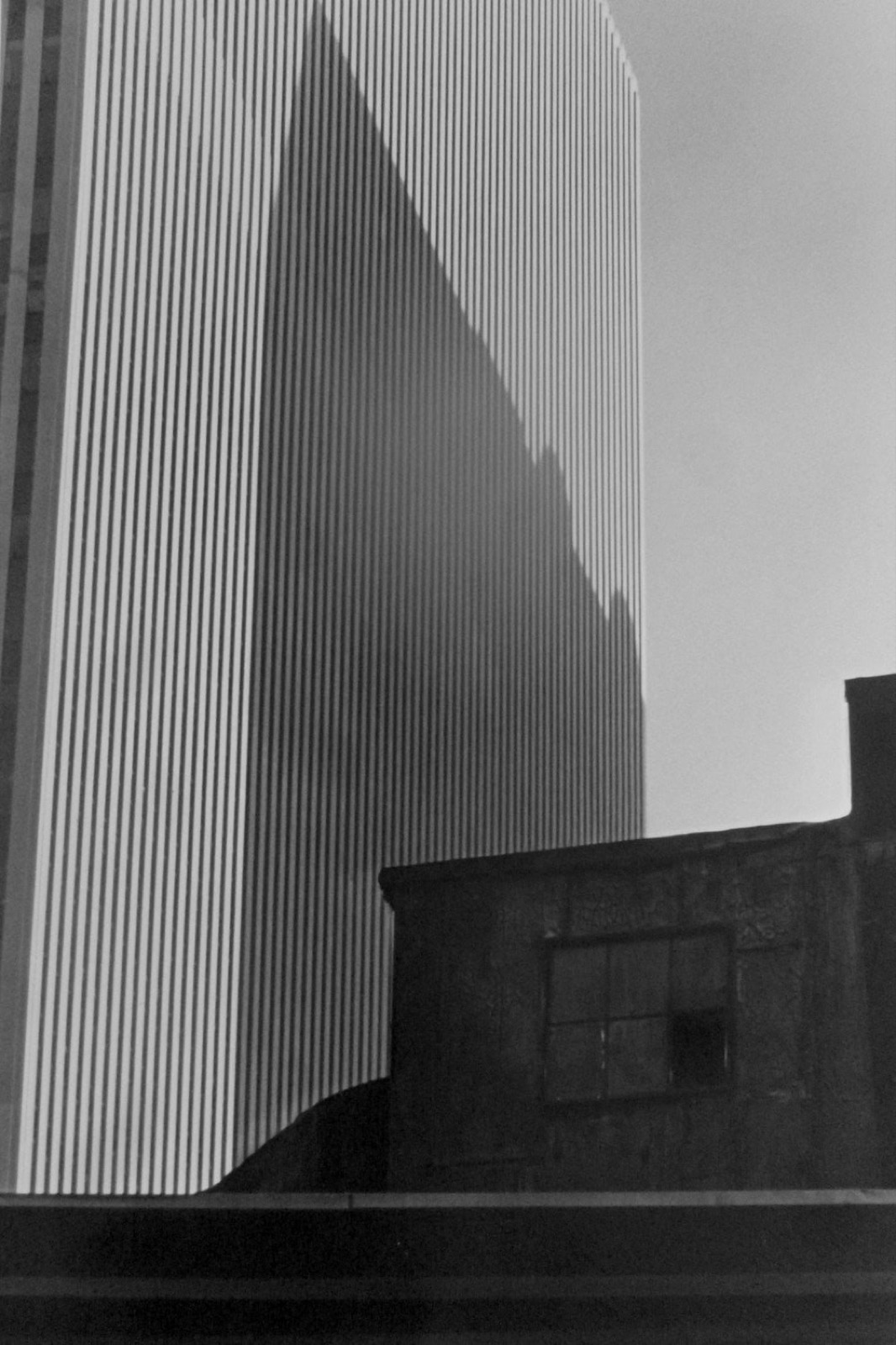

The picture is built almost entirely of one thing: the ribbed flank of a modern tower, a vertical screen of close-set aluminum mullions that fills the frame and runs out both sides. Across this corduroy of light the photographer has caught a great triangular shadow, cast by some unseen neighbor, climbing the facade like a dark sail. Because the rhythm of the mullions never breaks, the shadow does not lie flat; it bends with the recessed corner, and the eye reads volume where there is only pattern. Nothing here is incident. Everything is surface, repetition, and the slow geometry of cast light.
Then, low and to the right, the second subject arrives: the parapet of an older brick building, dark and granular, with a single window of small square panes and a cornice that steps down toward the street. It is modest, weathered, irregular—the opposite of the smooth grid above it. The photographer sets the two against each other not as argument but as fact, letting the old roof anchor the corner the tower would otherwise leave empty. A thin railing at the bottom reminds us this was seen from another rooftop.
This is the discipline that has placed his prints in the Met and the Centre Pompidou: the conviction that a city's meaning lives in how its forms are organized in a single frame. Across seven decades he photographed working people and ordinary streets, yet here the human note is withheld entirely. A vintage print holds the silver tonality—the luminous gray of the slab, the dense shadow of the brick—on which the whole quiet drama depends.