Hand-signed by the artist, with title, date, and edition number inscribed in ink on an archival label affixed to the reverse side of the mounted photograph.
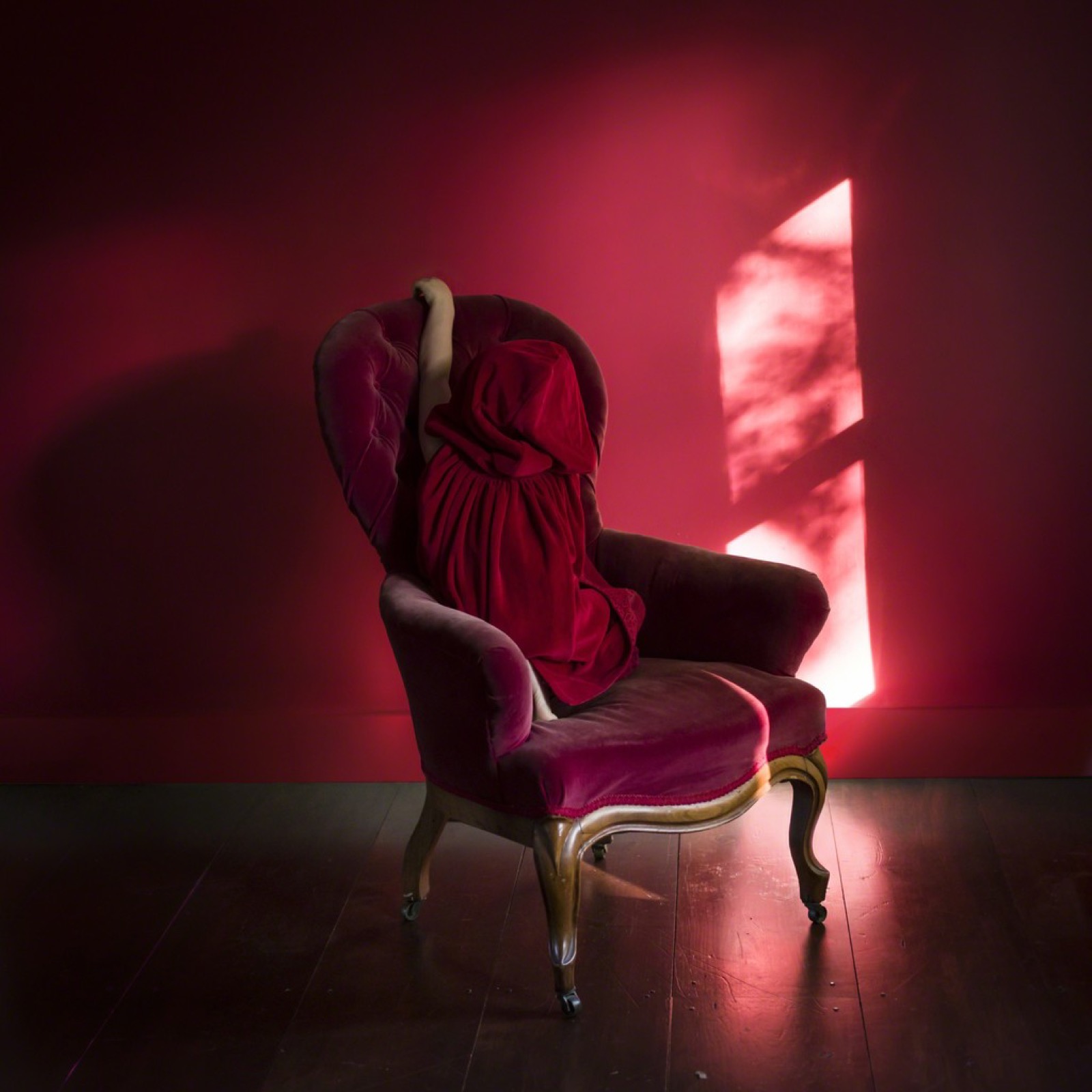
A moment from now the raised arm will either pull the body upright or let it slump back into the velvet; for the length of the exposure it does neither. A figure sits swallowed in a red cloak, face and shoulders gone under the hood, one bare arm thrown up to grip the top of the chair. Everything is caught between gestures. The picture holds the pause a struggle makes when it stops to gather itself, and refuses to tell us which way the next second goes.
The room is one sustained chord of red, wall and cloak and upholstery tuned to nearly the same crimson, so that the person and the chair threaten to become a single soft mass. Against that saturation the picture sets two clarifying facts: the pale arm, the only bare skin in view, and a bright window of light thrown onto the right wall, printed with the shadow of a bare tree outside. The gilded chair legs and casters catch a thin gleam. Dark floorboards run forward to the frame, anchoring all that color to something solid.
Cig Harvey, who lives and works on the Maine coast at Rockport, has made her reputation on exactly this collision of the domestic and the operatic, feeling pushed until an ordinary chair becomes a stage. Her books and prints are widely collected and held in American museums. As an archival pigment print the image can carry its dangerous quantity of red without the tones blocking up, keeping the tree shadow legible and the raised arm luminous against the deepening dark of the room.

A moment from now the raised arm will either pull the body upright or let it slump back into the velvet; for the length of the exposure it does neither. A figure sits swallowed in a red cloak, face and shoulders gone under the hood, one bare arm thrown up to grip the top of the chair. Everything is caught between gestures. The picture holds the pause a struggle makes when it stops to gather itself, and refuses to tell us which way the next second goes.
The room is one sustained chord of red, wall and cloak and upholstery tuned to nearly the same crimson, so that the person and the chair threaten to become a single soft mass. Against that saturation the picture sets two clarifying facts: the pale arm, the only bare skin in view, and a bright window of light thrown onto the right wall, printed with the shadow of a bare tree outside. The gilded chair legs and casters catch a thin gleam. Dark floorboards run forward to the frame, anchoring all that color to something solid.
Cig Harvey, who lives and works on the Maine coast at Rockport, has made her reputation on exactly this collision of the domestic and the operatic, feeling pushed until an ordinary chair becomes a stage. Her books and prints are widely collected and held in American museums. As an archival pigment print the image can carry its dangerous quantity of red without the tones blocking up, keeping the tree shadow legible and the raised arm luminous against the deepening dark of the room.