Hand-signed by the artist, with title, date, and edition number inscribed in ink on an archival label affixed to the reverse side of the mounted photograph.
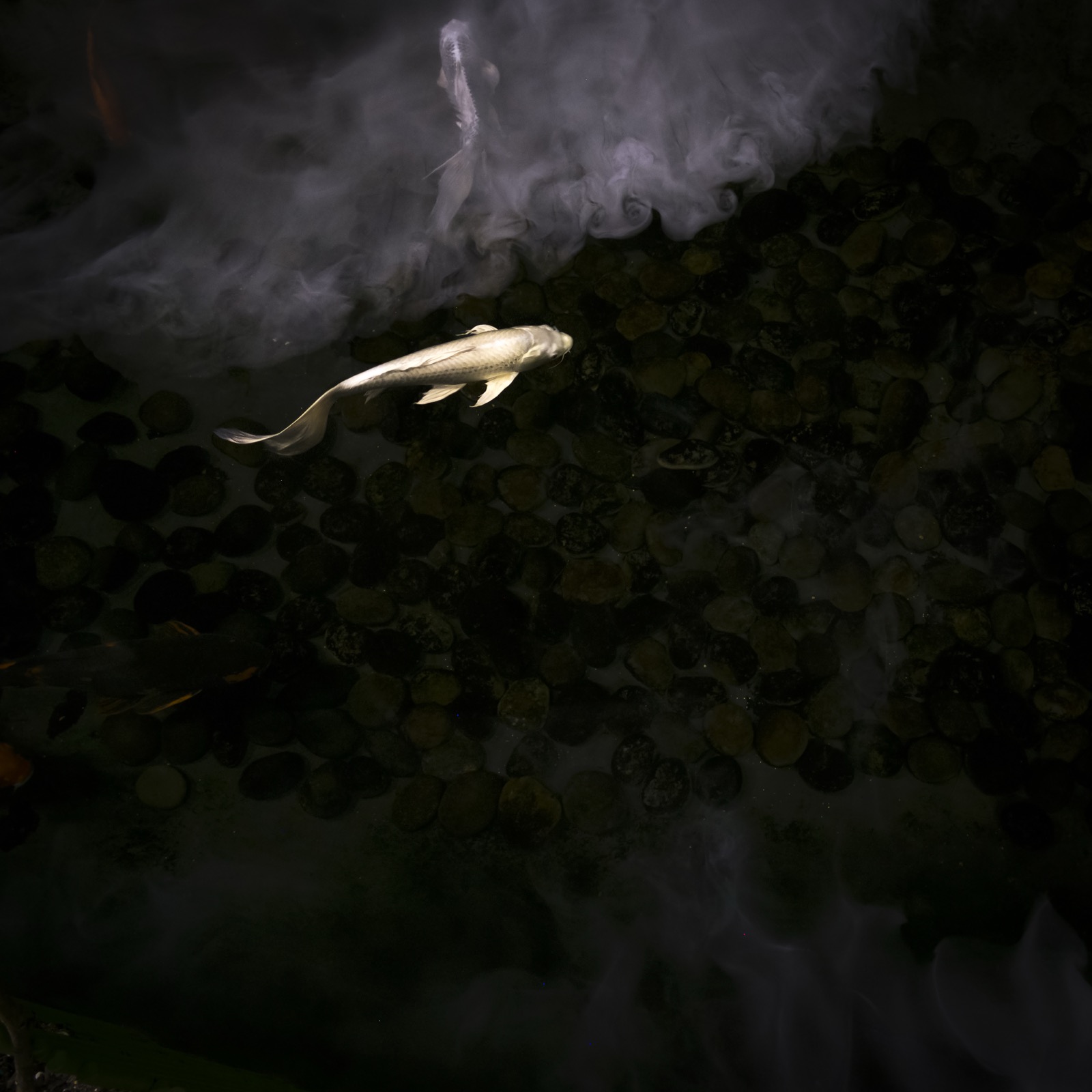
At the lip of a pond in New Orleans, we look straight down into water that has gone the color of night. A pale koi hangs mid-turn above a bed of dark river stones, lit as if it carried its own light; a veil of white mist curls across the surface, and inside it a second fish dissolves to a ghost. At the far left, a smudge of gold barely declares another.
The tonal structure is what a printmaker would notice first. Nearly everything in the frame sits within the deepest values, greens and greys pressed close to black, so that the single fish becomes the whole scale’s high note. Down loses its meaning here: the mist reads as cloud, the koi as something aloft in it, and the stones might be cobbles seen from a great height. Whistler organized his nocturnes on the same wager, that a picture could be built almost entirely of darkness and still feel luminous.
Harvey, British-born and long settled in Rockport, Maine, is best known for color at full volume, the gardens, fruit and family of The Blue Notebook and Blue Violet. Here she pares that palette almost entirely away, and the restraint carries its own authority. The archival pigment print serves her exactly: it keeps the near-blacks open and breathing rather than letting them seal into one flat dark, and it gives the koi’s white its faint metallic warmth. Widely exhibited and collected in American museums, she is a photographer of sensation; this picture proves the sensation survives even when the volume drops to a whisper.
At the lip of a pond in New Orleans, we look straight down into water that has gone the color of night. A pale koi hangs mid-turn above a bed of dark river stones, lit as if it carried its own light; a veil of white mist curls across the surface, and inside it a second fish dissolves to a ghost. At the far left, a smudge of gold barely declares another.
The tonal structure is what a printmaker would notice first. Nearly everything in the frame sits within the deepest values, greens and greys pressed close to black, so that the single fish becomes the whole scale’s high note. Down loses its meaning here: the mist reads as cloud, the koi as something aloft in it, and the stones might be cobbles seen from a great height. Whistler organized his nocturnes on the same wager, that a picture could be built almost entirely of darkness and still feel luminous.
Harvey, British-born and long settled in Rockport, Maine, is best known for color at full volume, the gardens, fruit and family of The Blue Notebook and Blue Violet. Here she pares that palette almost entirely away, and the restraint carries its own authority. The archival pigment print serves her exactly: it keeps the near-blacks open and breathing rather than letting them seal into one flat dark, and it gives the koi’s white its faint metallic warmth. Widely exhibited and collected in American museums, she is a photographer of sensation; this picture proves the sensation survives even when the volume drops to a whisper.