Hand-signed by the artist, with title, date, and edition number inscribed in ink on an archival label affixed to the reverse side of the mounted photograph.
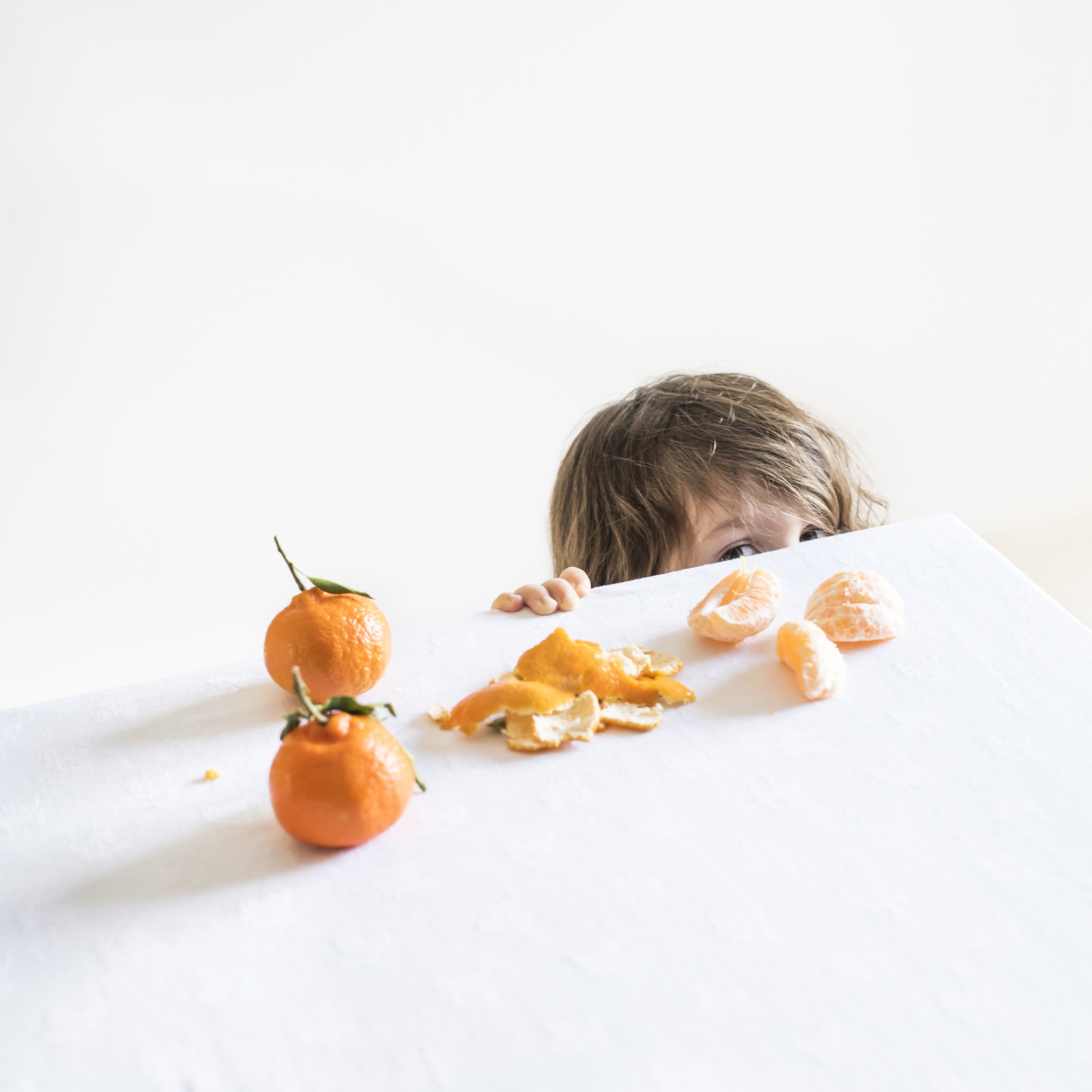
Every appetite ends as evidence. On a white table tipped up like a field of snow, the case is arranged from left to right: two clementines stacked whole, still wearing their green leaves; a heap of torn peel; the naked segments, split and waiting. Above the table’s edge rise a pair of eyes and four small fingertips. The suspect has come back to the scene.
The picture is disarming, which is exactly why it should be examined. Its whiteness is not innocence but staging: a blank page on which orange becomes the only fact. The stacked fruit is a child’s architecture, one sphere balanced on another with the seriousness children reserve for play. Photography has always adored childhood because childhood is the thing most visibly in the act of vanishing; the camera consoles us with possession. But these eyes refuse the arrangement. Half-hidden, level with the horizon of the table, they watch the watcher. The subject declines to be only a subject.
Harvey has made her life and her work in Rockport, Maine, and her books, The Blue Notebook among them, have turned the domestic day into a sensory vocabulary: fruit, fog, garden, child. Her photographs are widely exhibited and collected in American museums, which is to say the seduction has been institutionally confirmed. The archival pigment print gives this scene its particular temperature, whites kept warm rather than clinical, the orange dense as pigment in a jar. What remains is the aphorism revised: appetite ends as evidence, and evidence, printed, becomes appetite again.

Every appetite ends as evidence. On a white table tipped up like a field of snow, the case is arranged from left to right: two clementines stacked whole, still wearing their green leaves; a heap of torn peel; the naked segments, split and waiting. Above the table’s edge rise a pair of eyes and four small fingertips. The suspect has come back to the scene.
The picture is disarming, which is exactly why it should be examined. Its whiteness is not innocence but staging: a blank page on which orange becomes the only fact. The stacked fruit is a child’s architecture, one sphere balanced on another with the seriousness children reserve for play. Photography has always adored childhood because childhood is the thing most visibly in the act of vanishing; the camera consoles us with possession. But these eyes refuse the arrangement. Half-hidden, level with the horizon of the table, they watch the watcher. The subject declines to be only a subject.
Harvey has made her life and her work in Rockport, Maine, and her books, The Blue Notebook among them, have turned the domestic day into a sensory vocabulary: fruit, fog, garden, child. Her photographs are widely exhibited and collected in American museums, which is to say the seduction has been institutionally confirmed. The archival pigment print gives this scene its particular temperature, whites kept warm rather than clinical, the orange dense as pigment in a jar. What remains is the aphorism revised: appetite ends as evidence, and evidence, printed, becomes appetite again.