Txema Yeste
Spanish, b. 1972Needles, 2019-24
Gelatin silver print mounted on aluminium Dibond.
Image: 45 x 63 cm / 17 3/4 x 24 3/4 in / Paper: 60 x 77 cm / 23 5/8 x 30 1/4 in
Image: 78 x 110 cm / 30 3/4 x 43 1/4 in / Paper: 95 x 126 cm / 37 3/8 x 49 5/8 in
Image: 90 x 147 cm / 35 3/8 x 57 7/8 in / Paper: 106 x 162 cm / 41.0065 0.75 in
Hand-signed by the artist, titled, editioned, and dated in ink on a label affixed to the verso of the mount
Edition of 10 — Image: 45 x 63 cm / 17 3/4 x 24 3/4 in / Paper: 60 x 77 cm / 23 5/8 x 30 1/4 in
Edition of 5 — Image: 78 x 110 cm / 30 3/4 x 43 1/4 in / Paper: 95 x 126 cm / 37 3/8 x 49 5/8 in
Edition of 3 — Image: 90 x 147 cm / 35 3/8 x 57 7/8 in / Paper: 106 x 162 cm / 41.0065 0.75 in
© The Artist
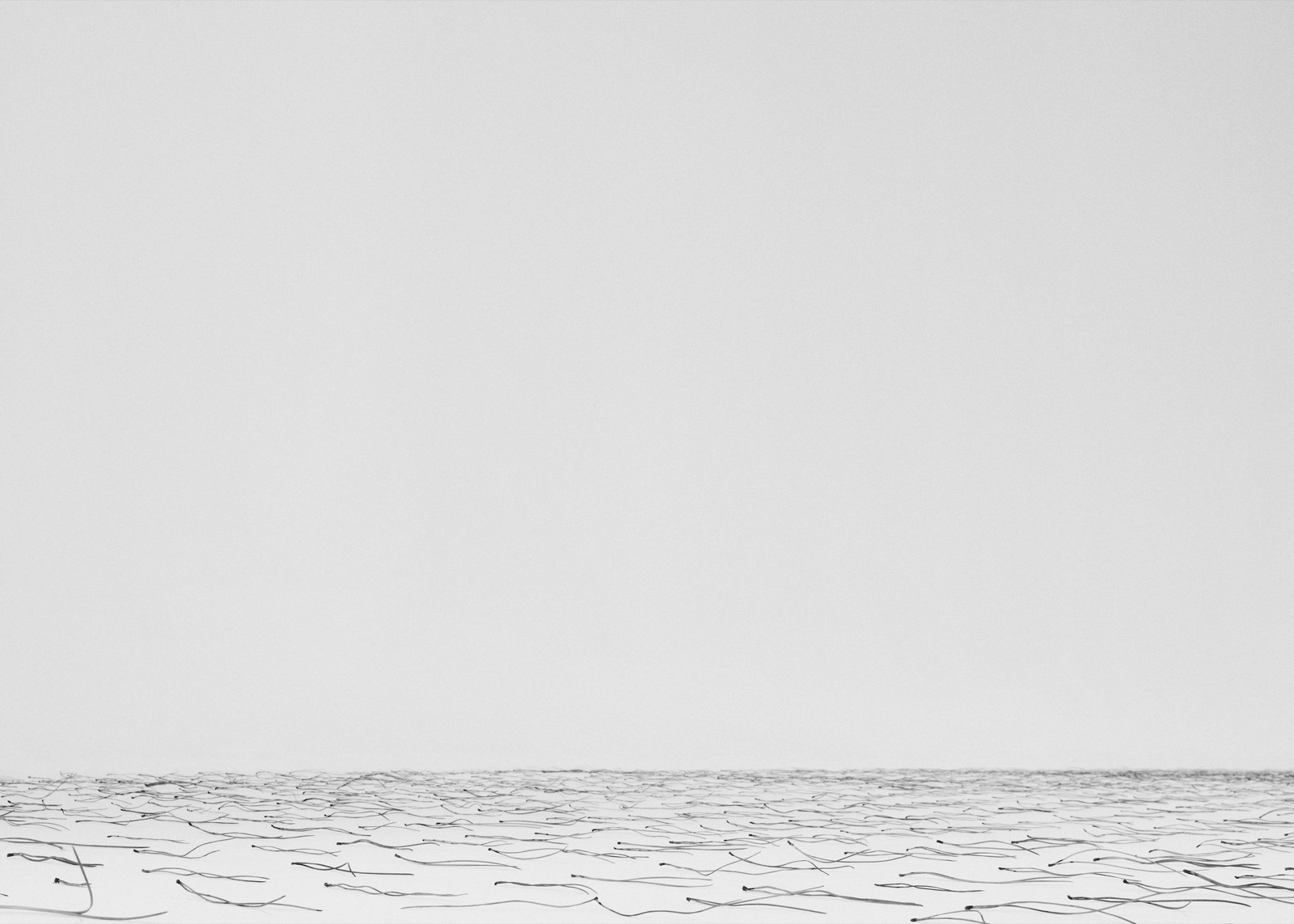
Photography is forever confusing the near with the far, and this picture makes a whole method of the confusion. What could be a scatter of dried stems dropped on a white table becomes, in the frame, an immense plain seen to the horizon: hundreds of dark needles lying every which way across a field of chalk-white, thinning as they recede into a soft grey band that reads exactly like a distant shore. Nothing here declares its true size.
Two-thirds of the frame is simply empty light, a pale sky over a paler ground, and the emptiness does real work: it starves the eye until every thin stroke of a stem counts. Some carry tiny dark heads, like spent matches or seed capsules, and their small marks accumulate into rhythm, almost script. There is a long history of pictures built from near-nothing, from horizon lines and blank fields, and this joins it without strain. The image asks whether a photograph needs a subject at all, or only a surface and a scattering of incident.
That a leading Spanish fashion photographer — Numéro, Harper’s Bazaar, Vogue behind him — should also make work this austere tells you something about the appetite behind the glossier images. As a gelatin silver print mounted on aluminium Dibond, the piece holds its enormous whites without a seam, the delicate greys of the stems floating on a surface that reads as solid and continuous as frost. At a distance it is a landscape; up close it dissolves back into marks. The picture keeps both readings alive and refuses to choose.