
Txema Yeste
Spanish, b. 1972Needles, 2019-24
Gelatin silver print mounted on aluminium Dibond.
Image: 45 x 63 cm / 17 3/4 x 24 3/4 in / Paper: 60 x 77 cm / 23 5/8 x 30 1/4 in
Image: 78 x 110 cm / 30 3/4 x 43 1/4 in / Paper: 95 x 126 cm / 37 3/8 x 49 5/8 in
Image: 90 x 147 cm / 35 3/8 x 57 7/8 in / Paper: 106 x 162 cm / 41.0065 0.75 in
Hand-signed by the artist, titled, editioned, and dated in ink on a label affixed to the verso of the mount
Edition of 10 — Image: 45 x 63 cm / 17 3/4 x 24 3/4 in / Paper: 60 x 77 cm / 23 5/8 x 30 1/4 in
Edition of 5 — Image: 78 x 110 cm / 30 3/4 x 43 1/4 in / Paper: 95 x 126 cm / 37 3/8 x 49 5/8 in
Edition of 3 — Image: 90 x 147 cm / 35 3/8 x 57 7/8 in / Paper: 106 x 162 cm / 41.0065 0.75 in
© The Artist
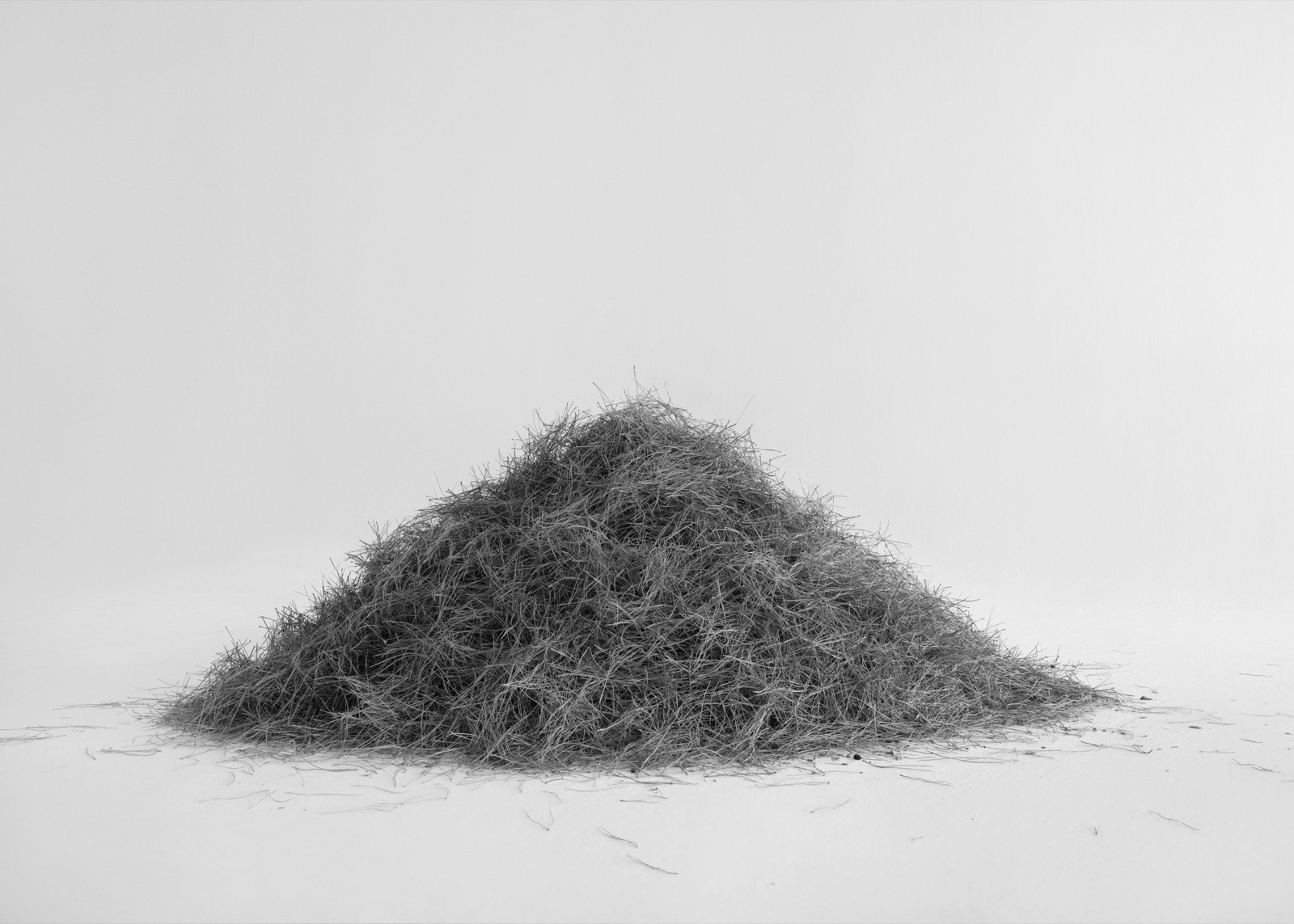
How many hours of gathering does a heap like this cost, and who was meant to see the arithmetic? Txema Yeste sets a low grey mound of pine needles in an empty studio, lit so evenly that the pile reads less as debris than as a proposition. Nothing frames it but the seamless pale floor and the strays that skid outward, thin dark filaments loosed from the mass. The heap is built with the deliberation of a set, yet it mimics something found, swept, discarded.
What holds the eye is the tension between control and collapse. The conical form rises toward a soft summit, almost a mountain in miniature, but its edges fray into loose needles, tiny black marks pricking the white ground. Yeste, schooled in the elemental theatre of fashion, treats these dry filaments as he might treat wind-blown cloth or sand: material to be composed, weighed, shadowed. The result refuses the studio’s usual glamour and keeps only its rigour, a still life stripped to texture and gravity.
Part of the Needles series, the image belongs to a strain of work in which Yeste turns from the body toward the raw stuff of the earth. He stands among the front rank of Spanish fashion photography, published across Numéro, Harper’s Bazaar and Vogue, yet here his eye narrows to a monochrome study of accumulation. Printed as gelatin silver and mounted on aluminium Dibond, the object holds a dense, unbroken tonal field, the grey pile resting on ground as pale as breath. It asks to be read slowly, the way a heap of small things becomes, at last, a form.