Bolted to a wall bracket, a boxy cathode television hangs in the corner, its screen burning a blank white rectangle into the teal gloom, cables spilling down the wall like a loosened vein. This is Between the Two, and the motel room it shows belongs to the great American vernacular of transient interiors — rooms rented by the night, furnished for nobody in particular, and remembered by no one who passes through.
The glowing screen is itself a kind of photograph: a lit rectangle in the dark, an image with no image, the precise emptiness Hido keeps circling. A dark veneered dresser anchors the left; two beds wear their tight white sheets at the right; a bright window blows out to nothing beyond. A single crumpled tissue lies on the green carpet, the one soft trace of an occupant, small and human and already discarded. Everything else has been wiped down, reset, made ready for the next stranger.
As an object the print insists on its own surface — archival pigment on aluminium Dibond, the cool cast pressed into a skin you could rap with a knuckle. Hido descends from a documentary lineage that found its poetry in cheap rooms and roadside signs, the overlooked furniture of ordinary American life, and he renews that inheritance by making a nondescript motel feel like a held breath, a place suspended in the very interval its title names.
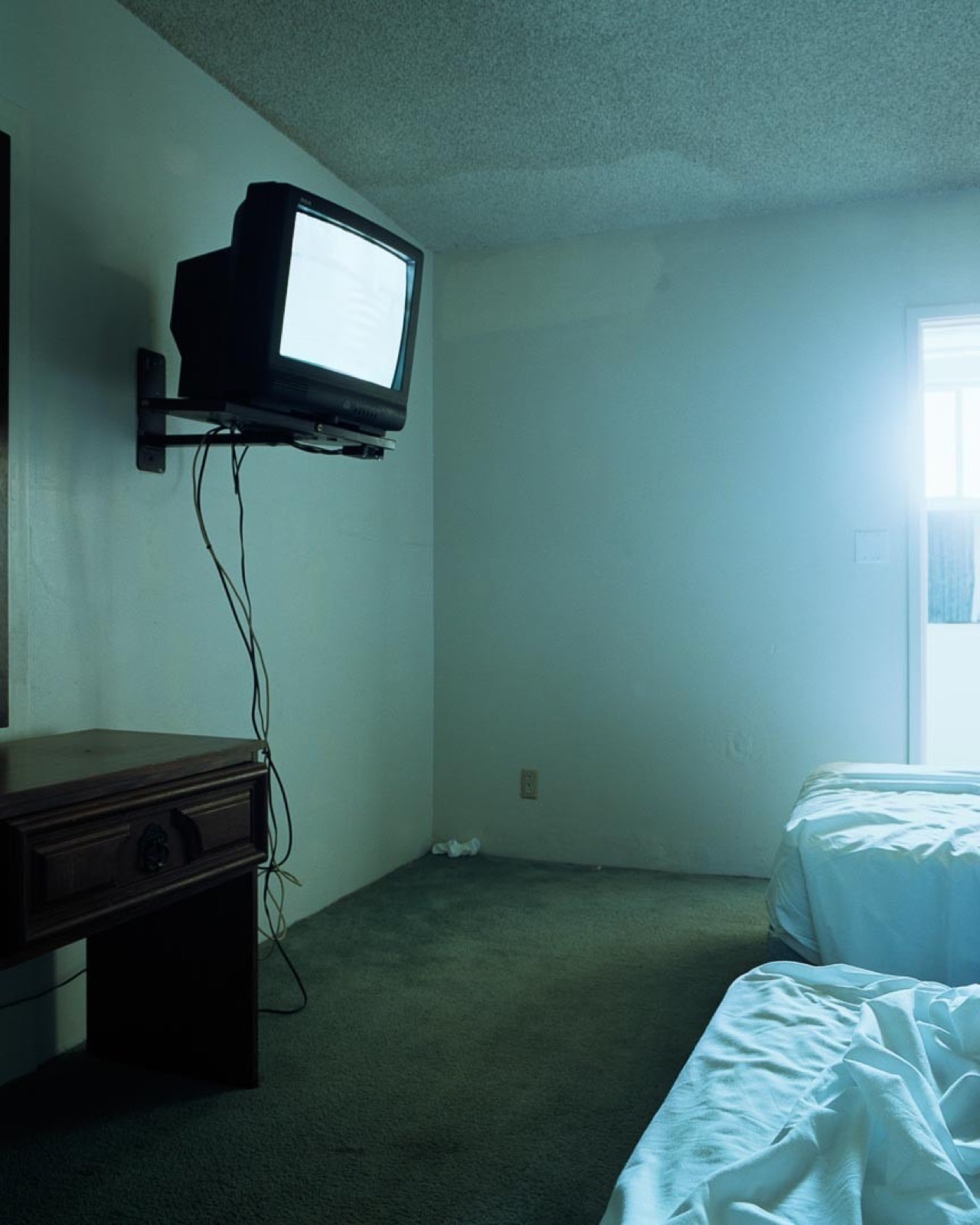

Bolted to a wall bracket, a boxy cathode television hangs in the corner, its screen burning a blank white rectangle into the teal gloom, cables spilling down the wall like a loosened vein. This is Between the Two, and the motel room it shows belongs to the great American vernacular of transient interiors — rooms rented by the night, furnished for nobody in particular, and remembered by no one who passes through.
The glowing screen is itself a kind of photograph: a lit rectangle in the dark, an image with no image, the precise emptiness Hido keeps circling. A dark veneered dresser anchors the left; two beds wear their tight white sheets at the right; a bright window blows out to nothing beyond. A single crumpled tissue lies on the green carpet, the one soft trace of an occupant, small and human and already discarded. Everything else has been wiped down, reset, made ready for the next stranger.
As an object the print insists on its own surface — archival pigment on aluminium Dibond, the cool cast pressed into a skin you could rap with a knuckle. Hido descends from a documentary lineage that found its poetry in cheap rooms and roadside signs, the overlooked furniture of ordinary American life, and he renews that inheritance by making a nondescript motel feel like a held breath, a place suspended in the very interval its title names.