Television, photography's restless younger sibling, appears here as nothing but light. Hido's exposure is long enough to erase the broadcast entirely: whatever the Magnavox was showing that night has been overwritten by photographic time, thirty frames a second dissolved into a single radiant blank. The medium that never stops moving is stilled by the one that does nothing else. What remains is a hearth — the television as the fire around which late-twentieth-century domestic life arranged itself, throwing its glow across gold shag carpet the way firelight once fell on stone floors.
Around the set, a small domestic archaeology. Motocross trophies stand guard on the cabinet and the shelf above, gilded riders frozen mid-victory; a ginger jar sits to one side; a VCR waits on the carpet beside its Memorex tapes, cables trailing to the wall socket. Nobody is in the room, and yet the room is full of somebody — their pride, their evenings, their habits of accumulation. Hido photographs interiors the way other photographers approach faces, and this one wears the slightly guarded expression of a house that did not know it was being looked at.
The picture's real subject may be duration itself. That white screen is not empty; it is over-full — every image broadcast during the exposure is in there somewhere, cancelled by its own abundance. And so a strange stillness settles: the trophies commemorate speed, the tapes promise replay, the television insists on now, and the photograph quietly outlasts them all. Light, here, is what time looks like when it stops moving.
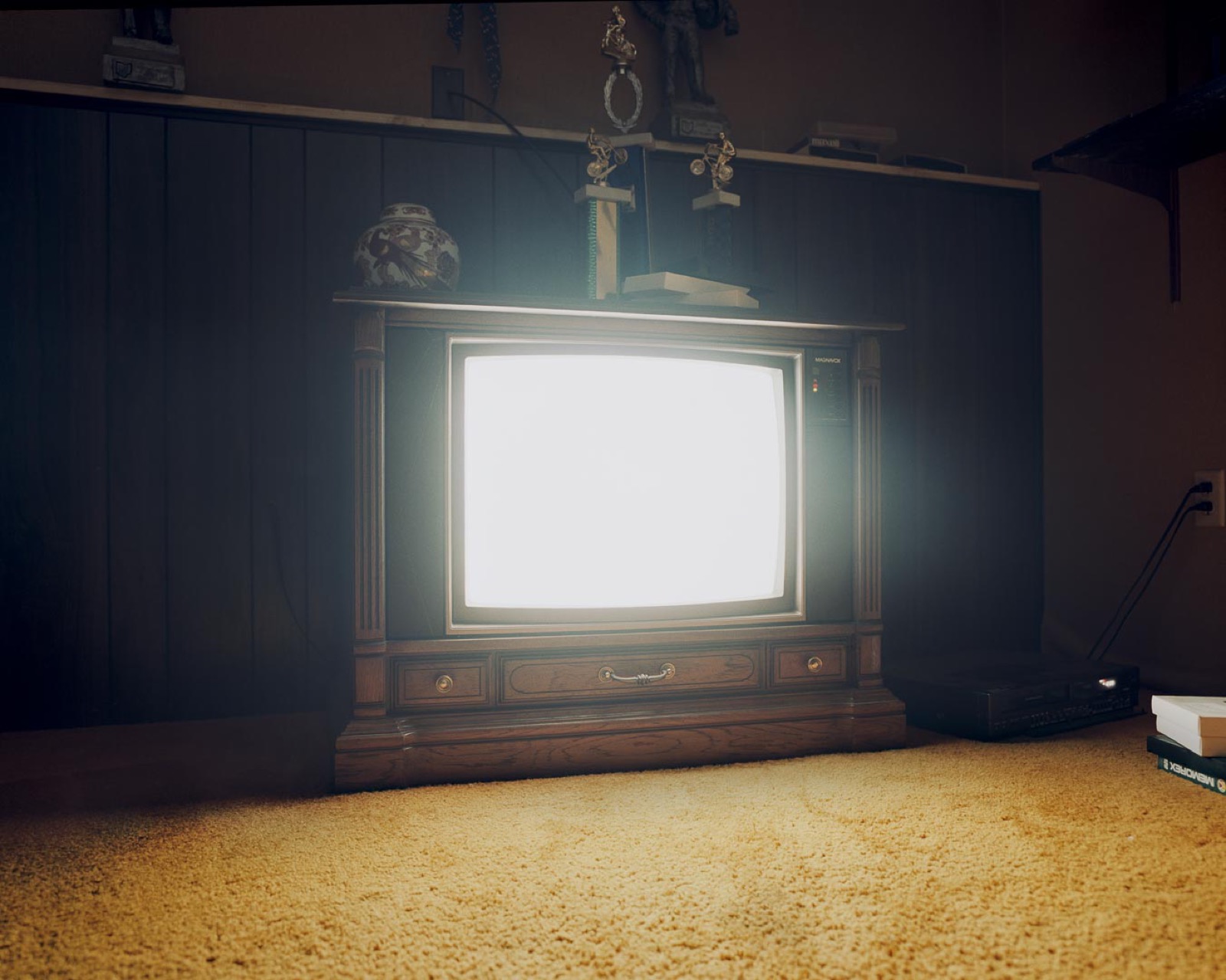

Television, photography's restless younger sibling, appears here as nothing but light. Hido's exposure is long enough to erase the broadcast entirely: whatever the Magnavox was showing that night has been overwritten by photographic time, thirty frames a second dissolved into a single radiant blank. The medium that never stops moving is stilled by the one that does nothing else. What remains is a hearth — the television as the fire around which late-twentieth-century domestic life arranged itself, throwing its glow across gold shag carpet the way firelight once fell on stone floors.
Around the set, a small domestic archaeology. Motocross trophies stand guard on the cabinet and the shelf above, gilded riders frozen mid-victory; a ginger jar sits to one side; a VCR waits on the carpet beside its Memorex tapes, cables trailing to the wall socket. Nobody is in the room, and yet the room is full of somebody — their pride, their evenings, their habits of accumulation. Hido photographs interiors the way other photographers approach faces, and this one wears the slightly guarded expression of a house that did not know it was being looked at.
The picture's real subject may be duration itself. That white screen is not empty; it is over-full — every image broadcast during the exposure is in there somewhere, cancelled by its own abundance. And so a strange stillness settles: the trophies commemorate speed, the tapes promise replay, the television insists on now, and the photograph quietly outlasts them all. Light, here, is what time looks like when it stops moving.