Hand-signed by the artist, with title, date, and edition number inscribed in ink on an archival label affixed to the reverse side of the mounted photograph.
A moment before, she must have crossed the dark half to stand here, and a moment after she will lift a hand or turn her head; for now she does neither. The photograph seizes the pause between two motions and makes it feel like a decision. She stands in full silhouette against a wall of scalloped white curtains, sheer festoons drawn up into repeating swags that glow with the light behind them. Her dress, sleeveless, seamed down the back, gives up all its detail to shadow.
The image is frankly, almost shamelessly beautiful, and part of its intelligence is to know this. Backlighting is among photography’s oldest flatteries: it dissolves a body into pure contour, spares us the face, converts a person into an emblem of longing. One suspects the seduction even while yielding to it. Yet the curtains complicate the transaction. Their obsessive gathered scallops, luminous but blank, offer no window, only more fabric. What she faces is not the world outside but a surface that gives back light without giving back sight.
Cig Harvey, working out of coastal Maine but here in a room in Russia, has long made pictures that press domestic detail toward the pitch of a dream, gathered in books such as You an Orchestra a Bomb and collected by American museums. The archival pigment print earns its keep here, holding the near-black of the figure against the softly graded whites of the drapery without losing either. To keep it is to keep the question the picture withholds: whether the woman is waiting to be let out, or content to be kept in.
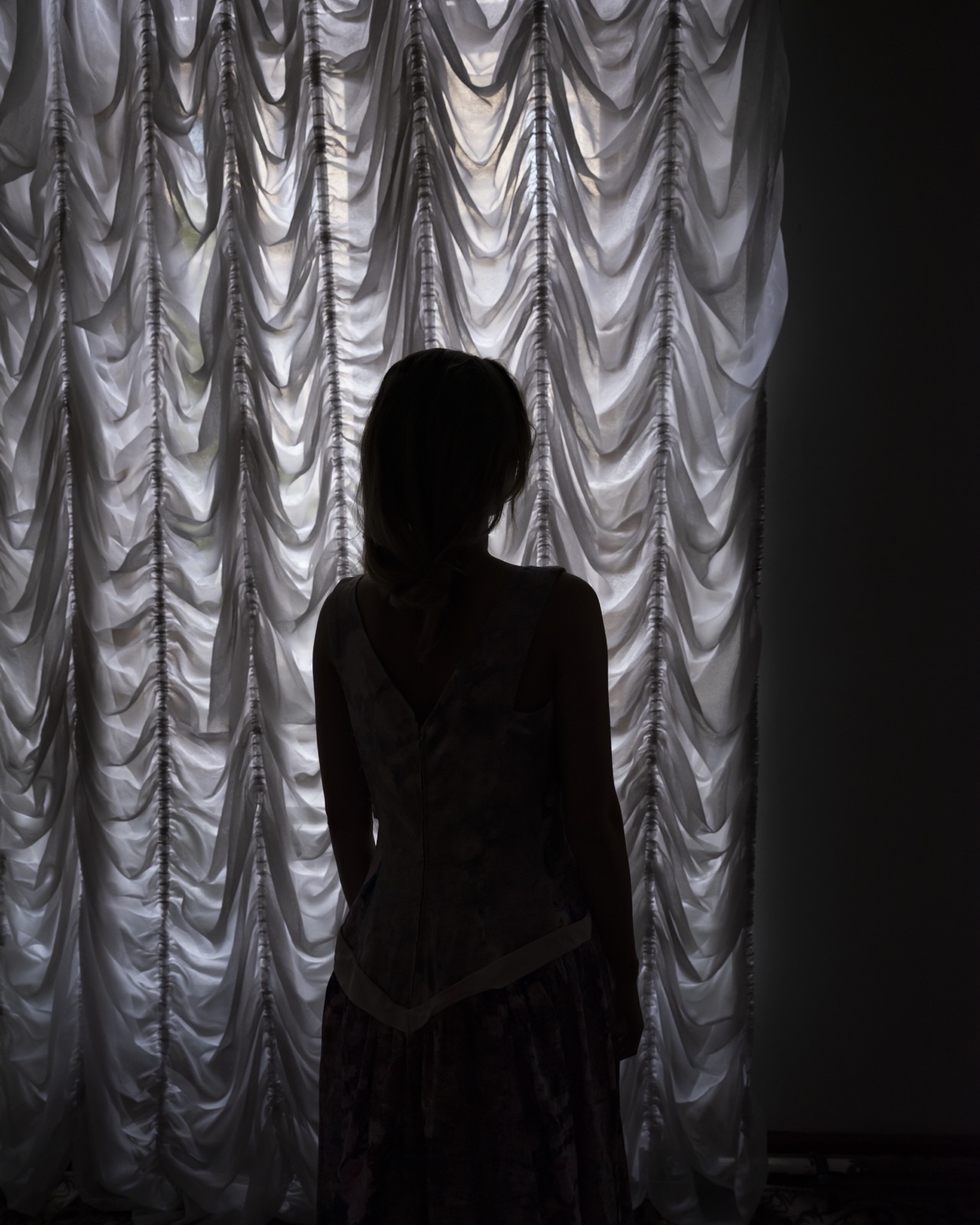

A moment before, she must have crossed the dark half to stand here, and a moment after she will lift a hand or turn her head; for now she does neither. The photograph seizes the pause between two motions and makes it feel like a decision. She stands in full silhouette against a wall of scalloped white curtains, sheer festoons drawn up into repeating swags that glow with the light behind them. Her dress, sleeveless, seamed down the back, gives up all its detail to shadow.
The image is frankly, almost shamelessly beautiful, and part of its intelligence is to know this. Backlighting is among photography’s oldest flatteries: it dissolves a body into pure contour, spares us the face, converts a person into an emblem of longing. One suspects the seduction even while yielding to it. Yet the curtains complicate the transaction. Their obsessive gathered scallops, luminous but blank, offer no window, only more fabric. What she faces is not the world outside but a surface that gives back light without giving back sight.
Cig Harvey, working out of coastal Maine but here in a room in Russia, has long made pictures that press domestic detail toward the pitch of a dream, gathered in books such as You an Orchestra a Bomb and collected by American museums. The archival pigment print earns its keep here, holding the near-black of the figure against the softly graded whites of the drapery without losing either. To keep it is to keep the question the picture withholds: whether the woman is waiting to be let out, or content to be kept in.