Hand-signed by the artist, with title, date, and edition number inscribed in ink on an archival label affixed to the reverse side of the mounted photograph.
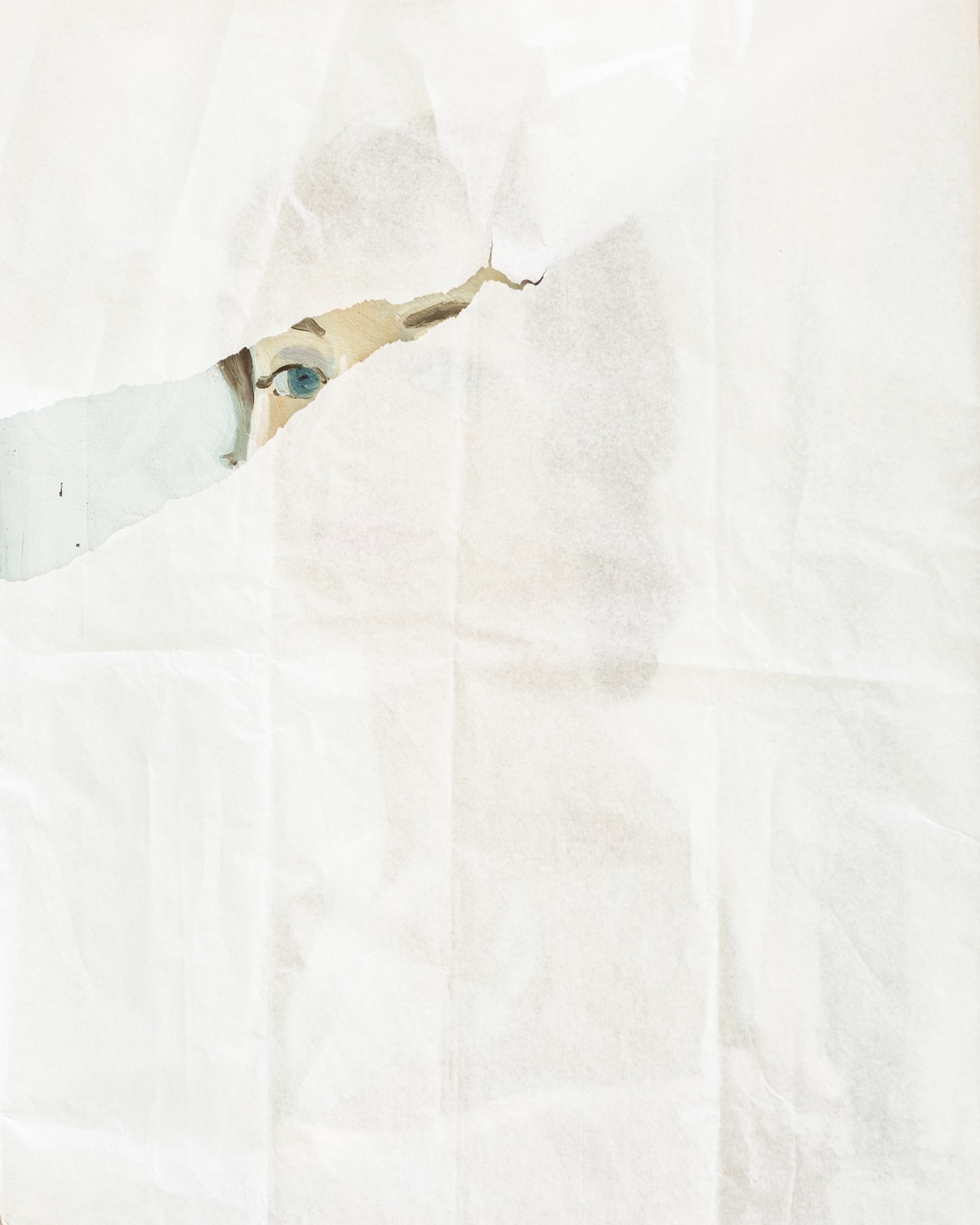
The oldest story painters tell is the contest of Zeuxis and Parrhasius, won by the man who painted a curtain so convincing his rival tried to draw it back. Cig Harvey has staged a version of that ancient trick with a camera. A crumpled sheet of translucent white tissue lies over a painted portrait, hiding it, and only a diagonal tear near the top lets anything through: a single blue eye, in visible oil strokes, looking out from a wedge of pale skin.
What the photograph delivers is an image of an image of a person, folded twice over. Beneath the paper a ghost of the head still registers, a soft grey oval pressing up through the creases, present as a shadow but denied as a face. This is photography’s condition, the medium that can render a surface perfectly and still withhold the thing itself. The one eye that escapes looks painted, not photographic, its iris a chip of blue-green set in a brushed lid, so even the fragment we are given belongs to another art.
Harvey, who works on the Maine coast, is best known for saturated color and sensory abundance, the gardens and fruit of books such as You an Orchestra a Bomb, and this pale, withholding picture shows the reserve on the other side of that lushness. The archival pigment print is exact about texture, holding the fibrous grain of the tissue and the ridge of each fold against the smooth oil beneath. Titled a portrait, it lets a single eye stand for the whole hidden face, proof of presence and a refusal in the same gesture.
The oldest story painters tell is the contest of Zeuxis and Parrhasius, won by the man who painted a curtain so convincing his rival tried to draw it back. Cig Harvey has staged a version of that ancient trick with a camera. A crumpled sheet of translucent white tissue lies over a painted portrait, hiding it, and only a diagonal tear near the top lets anything through: a single blue eye, in visible oil strokes, looking out from a wedge of pale skin.
What the photograph delivers is an image of an image of a person, folded twice over. Beneath the paper a ghost of the head still registers, a soft grey oval pressing up through the creases, present as a shadow but denied as a face. This is photography’s condition, the medium that can render a surface perfectly and still withhold the thing itself. The one eye that escapes looks painted, not photographic, its iris a chip of blue-green set in a brushed lid, so even the fragment we are given belongs to another art.
Harvey, who works on the Maine coast, is best known for saturated color and sensory abundance, the gardens and fruit of books such as You an Orchestra a Bomb, and this pale, withholding picture shows the reserve on the other side of that lushness. The archival pigment print is exact about texture, holding the fibrous grain of the tissue and the ridge of each fold against the smooth oil beneath. Titled a portrait, it lets a single eye stand for the whole hidden face, proof of presence and a refusal in the same gesture.