Hand-signed by the artist, with title, date, and edition number inscribed in ink on an archival label affixed to the reverse side of the mounted photograph.
Brown bamboo leaves and white daisies, printed across a rumpled cotton shirt, anchor the picture in the ordinary before the wind undoes it. A girl sits inside a car, and everything soft has been set streaming: her dark hair lifts off her shoulders and pours to one side in tangled ropes, catching a warm afternoon light. She has pressed one hand flat over her eyes and nose, so the single still thing is the gesture of not-looking. Outside the open window the green world blurs past.
A photograph cannot record wind; it can only record what wind does. Here that is enough. The camera has stopped the hair mid-flight, frozen the disorder into a permanent tumble, and in doing so performs the small violence photography works on motion, converting a passing sensation into a possessable thing. Yet the child’s covered face resists the exchange. She will not be looked at while she is feeling, and the picture, generous for once, lets her keep the interior weather to herself. What we get is the surface of a sensation, not its center.
The child is Scout, and Harvey has photographed her family for years, turning a mother’s attention into one of the durable subjects of American photography, gathered in books such as You an Orchestra a Bomb and held in museum collections. The archival pigment print keeps the warmth intact, the tropical cottons and the sunlit brown of the hair holding their color against the car’s shadowed interior. It is a portrait of an element more than a person, which is perhaps the only honest way to photograph a feeling.
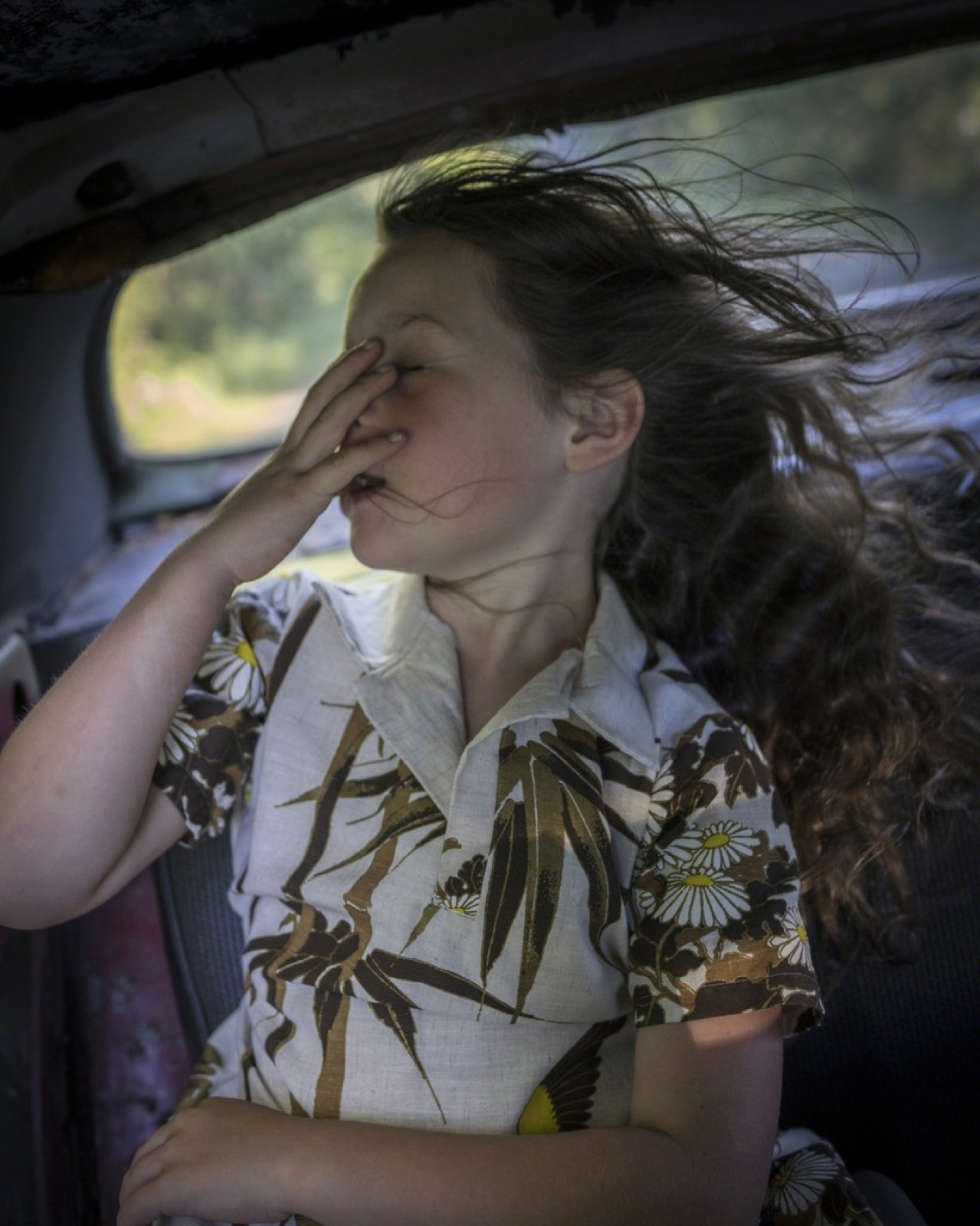

Brown bamboo leaves and white daisies, printed across a rumpled cotton shirt, anchor the picture in the ordinary before the wind undoes it. A girl sits inside a car, and everything soft has been set streaming: her dark hair lifts off her shoulders and pours to one side in tangled ropes, catching a warm afternoon light. She has pressed one hand flat over her eyes and nose, so the single still thing is the gesture of not-looking. Outside the open window the green world blurs past.
A photograph cannot record wind; it can only record what wind does. Here that is enough. The camera has stopped the hair mid-flight, frozen the disorder into a permanent tumble, and in doing so performs the small violence photography works on motion, converting a passing sensation into a possessable thing. Yet the child’s covered face resists the exchange. She will not be looked at while she is feeling, and the picture, generous for once, lets her keep the interior weather to herself. What we get is the surface of a sensation, not its center.
The child is Scout, and Harvey has photographed her family for years, turning a mother’s attention into one of the durable subjects of American photography, gathered in books such as You an Orchestra a Bomb and held in museum collections. The archival pigment print keeps the warmth intact, the tropical cottons and the sunlit brown of the hair holding their color against the car’s shadowed interior. It is a portrait of an element more than a person, which is perhaps the only honest way to photograph a feeling.