Hand-signed by the artist, with title, date, and edition number inscribed in ink on an archival label affixed to the reverse side of the mounted photograph.
Snow is the weather that photographs itself, each flake a tiny lens of falling light, and here it comes down thick enough to dissolve the world into grades of white. A road runs away into the storm between rows of bare trees, and out of the murk two headlights burn, the only warm certainty in a landscape busy erasing its own edges. Weather is the true subject, not a backdrop for the figure but the medium she is nearly lost inside, the way an image can be lost in its own grain.
A woman stands at the right, her back to us in a high-collared white coat that all but surrenders to the snow around it. Only her brown hair holds out, lifted and tangled by the wind, a knot of the organic in a field gone abstract. She has turned her head just far enough that her face stays hidden, so we watch her watching the car come on. The picture is almost monochrome, a study in how little tonal information a scene can keep and still remain a place.
Cig Harvey works from this coast in Maine, and her books, among them The Blue Notebook and Blue Violet, have made her weather and her people into a body of art held in American museum collections. Snow appeals to her for the same reason it appeals to any photographer alert to their materials: it turns the visible world into something that behaves like emulsion. As an archival pigment print the image can hold that near-white without emptying out, keeping the flakes discrete and the headlights precise against the storm.
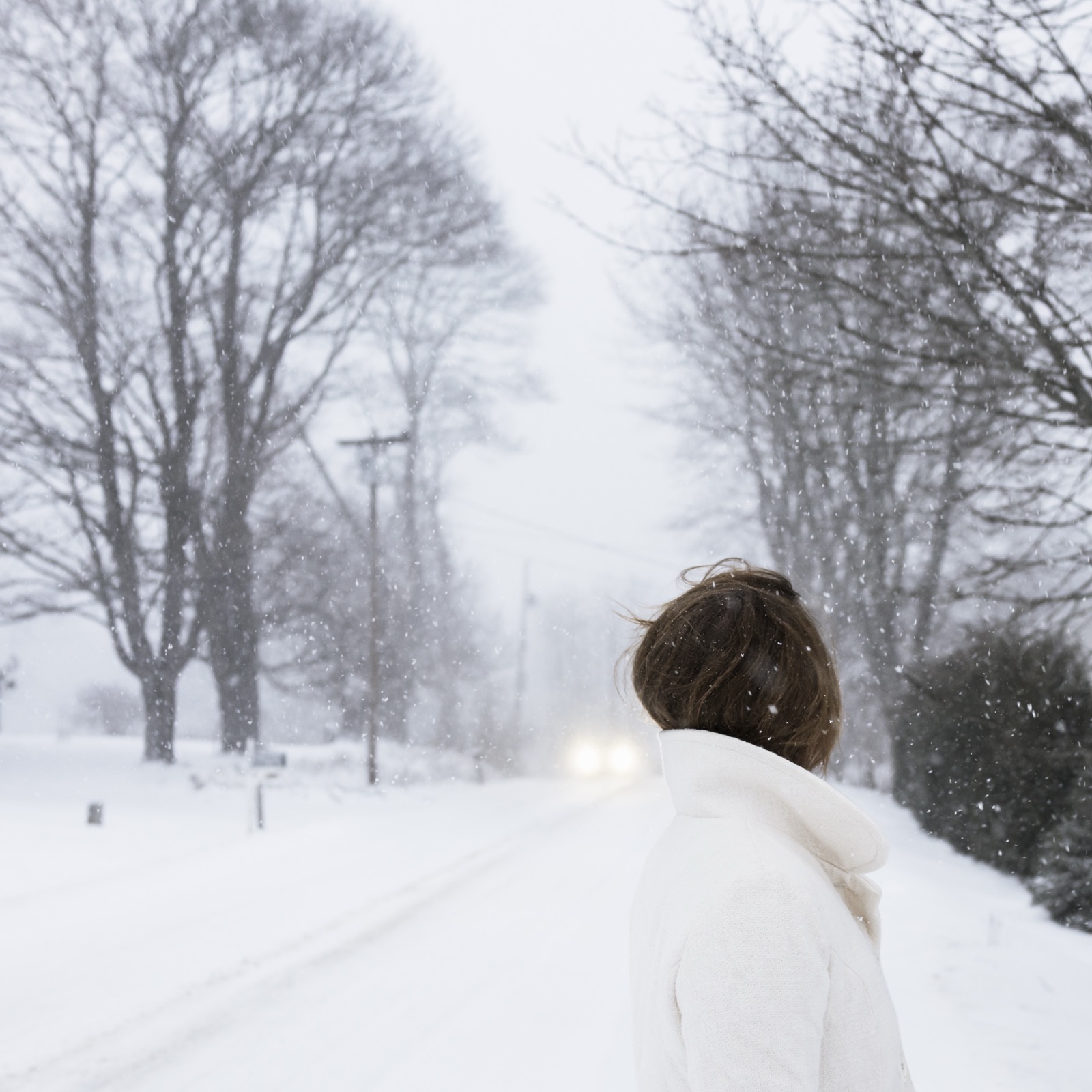

Snow is the weather that photographs itself, each flake a tiny lens of falling light, and here it comes down thick enough to dissolve the world into grades of white. A road runs away into the storm between rows of bare trees, and out of the murk two headlights burn, the only warm certainty in a landscape busy erasing its own edges. Weather is the true subject, not a backdrop for the figure but the medium she is nearly lost inside, the way an image can be lost in its own grain.
A woman stands at the right, her back to us in a high-collared white coat that all but surrenders to the snow around it. Only her brown hair holds out, lifted and tangled by the wind, a knot of the organic in a field gone abstract. She has turned her head just far enough that her face stays hidden, so we watch her watching the car come on. The picture is almost monochrome, a study in how little tonal information a scene can keep and still remain a place.
Cig Harvey works from this coast in Maine, and her books, among them The Blue Notebook and Blue Violet, have made her weather and her people into a body of art held in American museum collections. Snow appeals to her for the same reason it appeals to any photographer alert to their materials: it turns the visible world into something that behaves like emulsion. As an archival pigment print the image can hold that near-white without emptying out, keeping the flakes discrete and the headlights precise against the storm.