Hand-signed by the artist, with title, date, and edition number inscribed in ink on an archival label affixed to the reverse side of the mounted photograph.
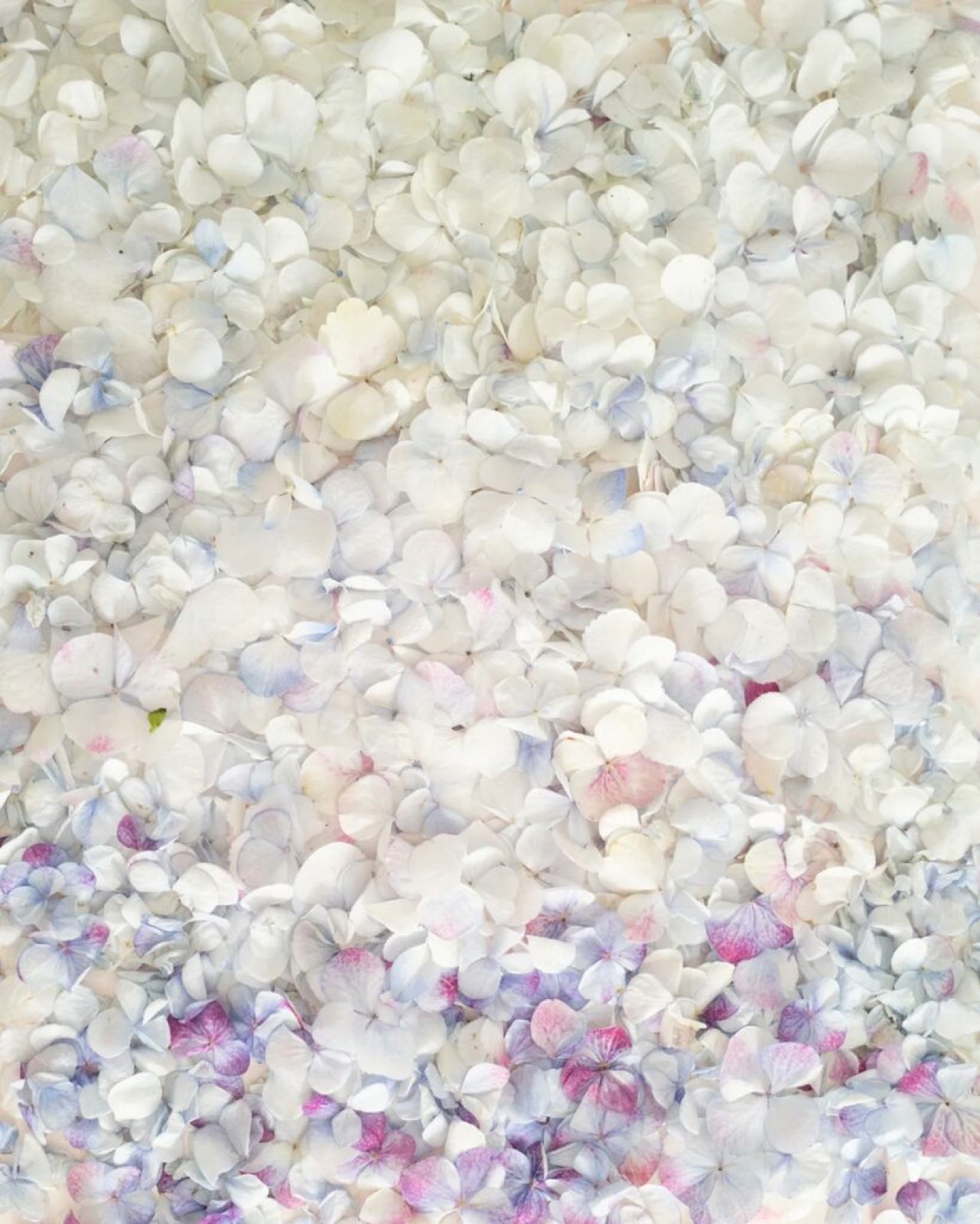
Someone has strewn the hydrangea petals across the whole surface and stepped back, and the picture catches the strewing as if it were still underway. There is no horizon, no near or far, only a bed of overlapping petals filling the frame edge to edge. The color does something photographs rarely admit to: it drains from a bruised magenta and lavender at the bottom up through cornflower blue to an almost paperwhite top, an ombré the flowers themselves would never manage without a human hand arranging them.
This is a picture about the flatness photography is always accused of, turned into a virtue. Denied depth, the eye reads it as pattern, then as field, then as weather. Look closer and the individual petals reassert themselves: a magenta star burning at one center, a single fleck of green stranded near the left, the faint veins mapping each translucent blade. Harvey lets the medium hover between document and abstraction, so that we are never quite sure whether we are seeing flowers or the idea of a color.
British-born and long resident on the coast of Maine, Harvey has built book after book on exactly this sensory register, from The Blue Notebook to You an Orchestra a Bomb, and shows widely in American museums. The work is an archival pigment print, whose smooth, continuous tonal transitions are precisely what a subject this dependent on gradient requires; a coarser process would break the ombré into steps. It is a photograph that behaves like a monochrome and smells, somehow, like a garden.
Someone has strewn the hydrangea petals across the whole surface and stepped back, and the picture catches the strewing as if it were still underway. There is no horizon, no near or far, only a bed of overlapping petals filling the frame edge to edge. The color does something photographs rarely admit to: it drains from a bruised magenta and lavender at the bottom up through cornflower blue to an almost paperwhite top, an ombré the flowers themselves would never manage without a human hand arranging them.
This is a picture about the flatness photography is always accused of, turned into a virtue. Denied depth, the eye reads it as pattern, then as field, then as weather. Look closer and the individual petals reassert themselves: a magenta star burning at one center, a single fleck of green stranded near the left, the faint veins mapping each translucent blade. Harvey lets the medium hover between document and abstraction, so that we are never quite sure whether we are seeing flowers or the idea of a color.
British-born and long resident on the coast of Maine, Harvey has built book after book on exactly this sensory register, from The Blue Notebook to You an Orchestra a Bomb, and shows widely in American museums. The work is an archival pigment print, whose smooth, continuous tonal transitions are precisely what a subject this dependent on gradient requires; a coarser process would break the ombré into steps. It is a photograph that behaves like a monochrome and smells, somehow, like a garden.