Hand-signed by the artist, with title, date, and edition number inscribed in ink on an archival label affixed to the reverse side of the mounted photograph.
A garden does not sleep; it only stops being looked at. Here it is caught after dark, mid-breath, and what I cannot let go of is the single pale rib that rises near the top — one bleached stem standing upright among the crumpled kale like a nerve, the one vertical thing in a picture that otherwise pours downward.
The rest is leaf and water. Curled, frilled, savoyed leaves heaped on themselves in a green so deep it is almost the colour of the night that swallows their edges, and over every surface the droplets — hundreds of them, each holding its small grain of borrowed light. I want to call them dew, but the word is too gentle; they bead and cling and refuse to fall, and it is their refusal that catches and holds me. The studium is plain enough: a vegetable bed photographed in the dark, the patient horticulture of a Maine island. But that suspended water is the detail that snags. It is the picture insisting that something is happening at an hour when we assume nothing is.
Cig Harvey has built her work on exactly this — the saturated, almost edible colour of the ordinary world pushed to the edge of the symbolic, the garden and the kitchen table made into a private cosmology across books such as You an Orchard, You an Animal. What is rare in this frame is its restraint: she withholds the glut of colour she is known for and gives us instead a near-monochrome darkness where green has to be searched for. The light is so scant, so evenly hoarded among the leaves, that one feels the long exposure, the camera gathering what the eye cannot. To look is to be made patient. The garden was awake the whole time; we simply had to be shown the water to believe it.
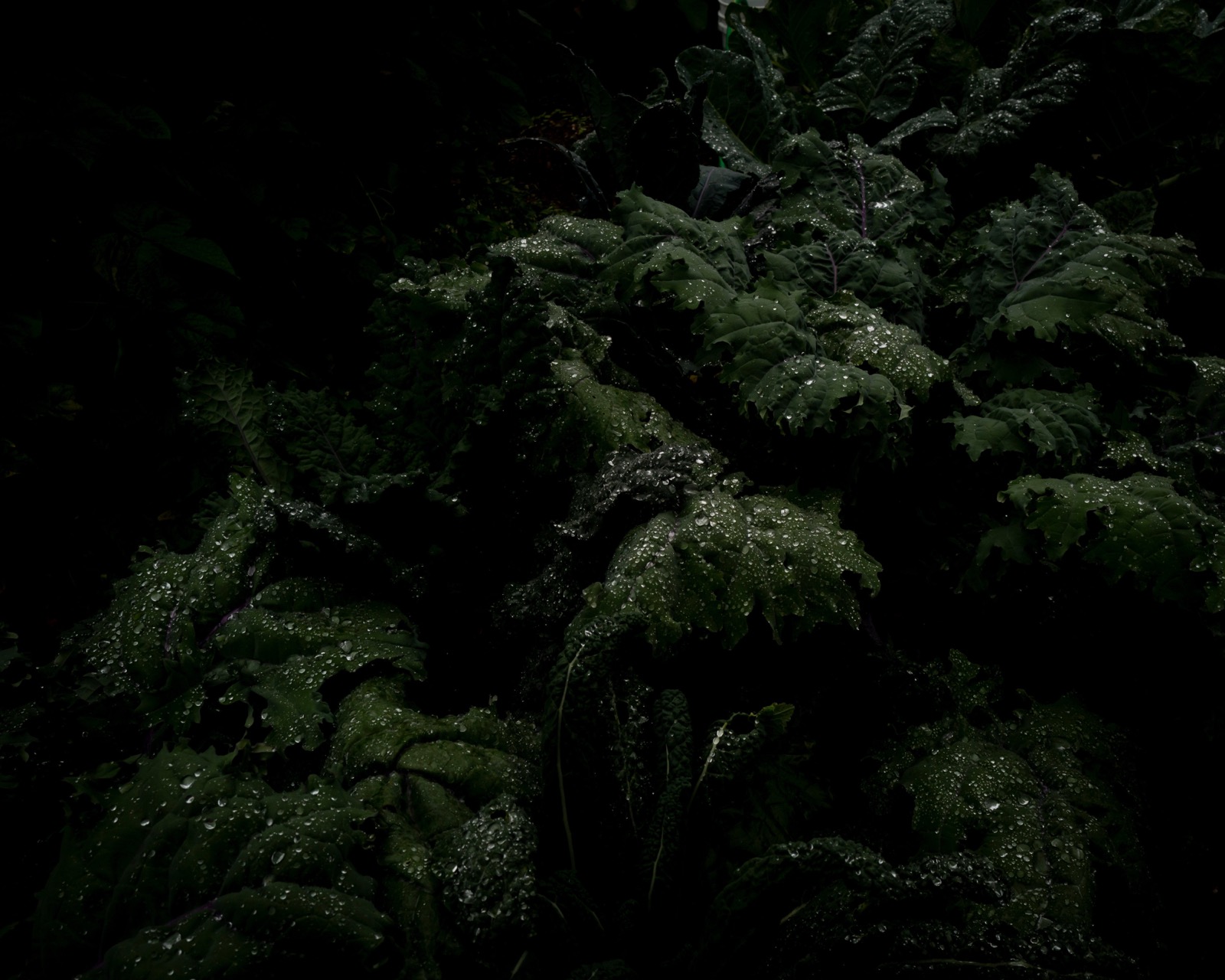

A garden does not sleep; it only stops being looked at. Here it is caught after dark, mid-breath, and what I cannot let go of is the single pale rib that rises near the top — one bleached stem standing upright among the crumpled kale like a nerve, the one vertical thing in a picture that otherwise pours downward.
The rest is leaf and water. Curled, frilled, savoyed leaves heaped on themselves in a green so deep it is almost the colour of the night that swallows their edges, and over every surface the droplets — hundreds of them, each holding its small grain of borrowed light. I want to call them dew, but the word is too gentle; they bead and cling and refuse to fall, and it is their refusal that catches and holds me. The studium is plain enough: a vegetable bed photographed in the dark, the patient horticulture of a Maine island. But that suspended water is the detail that snags. It is the picture insisting that something is happening at an hour when we assume nothing is.
Cig Harvey has built her work on exactly this — the saturated, almost edible colour of the ordinary world pushed to the edge of the symbolic, the garden and the kitchen table made into a private cosmology across books such as You an Orchard, You an Animal. What is rare in this frame is its restraint: she withholds the glut of colour she is known for and gives us instead a near-monochrome darkness where green has to be searched for. The light is so scant, so evenly hoarded among the leaves, that one feels the long exposure, the camera gathering what the eye cannot. To look is to be made patient. The garden was awake the whole time; we simply had to be shown the water to believe it.