The color arrives first and stays: a deep, forested green so saturated it reads almost black at the edges, a thousand overlapping leaves pressed into a single tonal field. Across three panels the green barely varies, and that evenness is the point. Only in the middle does the wall of foliage part enough to admit two small figures, two Weimaraners in pale cream clothing, a girl’s smocked pinafore and a boy’s shirt and suspenders, standing close and dwarfed by the thicket that surrounds them on every side.
The triptych is doing quiet work. By flanking the children with two panels of nothing but leaves, the picture makes the forest the true subject and the fairy tale a rumor inside it. Photography has always been good at this, at letting a background swallow its ostensible subject, at turning abundance into unease. The dogs look off in slightly different directions, alert, their pale coats and paler costumes the only warm notes in all that cold chlorophyll. They are already lost, and the composition has lost them for us on purpose.
Since the 1970s the artist has staged his Weimaraners inside borrowed stories, but here the deadpan gives way almost entirely to atmosphere. As a pigment print the greens hold their depth without going muddy, the shadowed leaves separating into countless fine gradations that a lesser process would clot. The result behaves less like a joke than like a landscape with a secret in its center. Enter the woods, the picture says, and see how small the story becomes against the green.
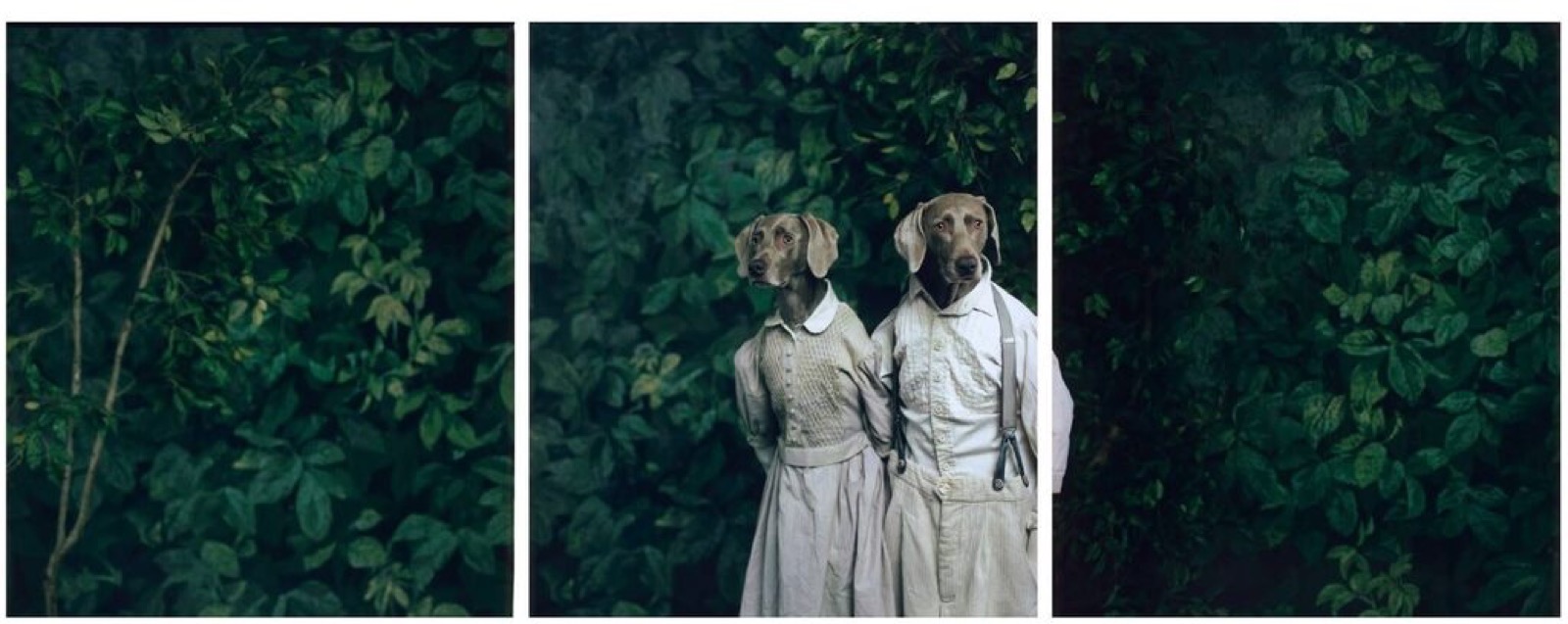
The color arrives first and stays: a deep, forested green so saturated it reads almost black at the edges, a thousand overlapping leaves pressed into a single tonal field. Across three panels the green barely varies, and that evenness is the point. Only in the middle does the wall of foliage part enough to admit two small figures, two Weimaraners in pale cream clothing, a girl’s smocked pinafore and a boy’s shirt and suspenders, standing close and dwarfed by the thicket that surrounds them on every side.
The triptych is doing quiet work. By flanking the children with two panels of nothing but leaves, the picture makes the forest the true subject and the fairy tale a rumor inside it. Photography has always been good at this, at letting a background swallow its ostensible subject, at turning abundance into unease. The dogs look off in slightly different directions, alert, their pale coats and paler costumes the only warm notes in all that cold chlorophyll. They are already lost, and the composition has lost them for us on purpose.
Since the 1970s the artist has staged his Weimaraners inside borrowed stories, but here the deadpan gives way almost entirely to atmosphere. As a pigment print the greens hold their depth without going muddy, the shadowed leaves separating into countless fine gradations that a lesser process would clot. The result behaves less like a joke than like a landscape with a secret in its center. Enter the woods, the picture says, and see how small the story becomes against the green.