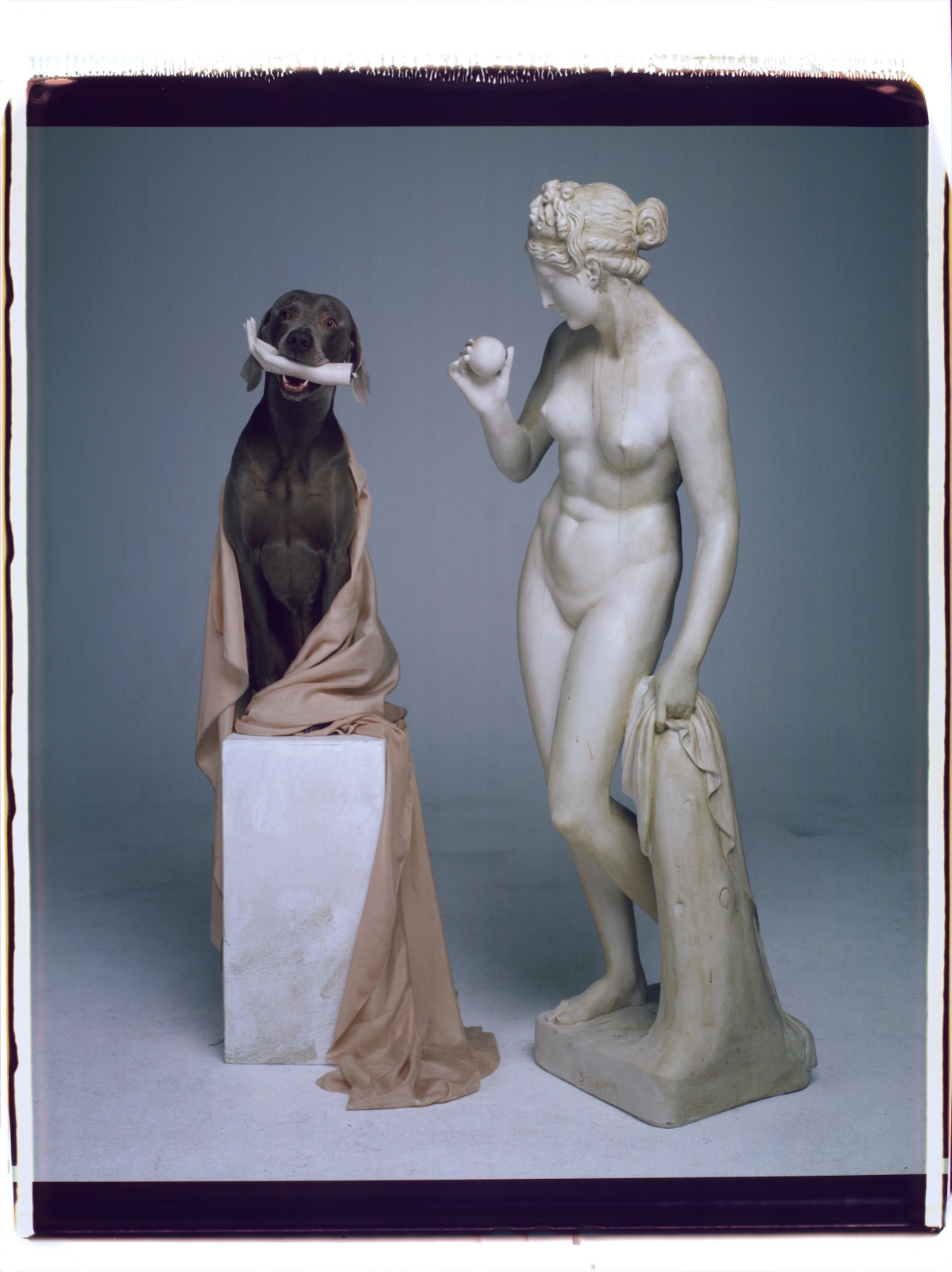
Who threw the hand? A gray dog sits wrapped in blush satin on a white plinth, gripping a plaster hand crosswise in its mouth with the settled pride of a retriever who has done exactly what was asked. Beside it a cast Venus considers the apple in her raised fingers and declines to notice that somewhere a statue has been relieved of a wrist. The joke is announced quietly, then left alone.
The picture’s intelligence is in its organization. Two verticals of nearly equal height share an even gray-blue field, and the plinth is the crucial decision: it promotes the dog to statuary. Under cool, shadowless studio light the Weimaraner’s coat takes a pewter sheen scarcely different from plaster, so that the living figure and the cast one trade properties; she has the more relaxed stance, it the more anxious eye. The satin does what drapery has done since antiquity, conferring gravity on whatever it touches, and the dog accepts the honor. Fetch has been elevated to allegory without a single strained gesture.
Wegman has worked this vein of deadpan since the 1970s, but the 24×20 Polaroid gave the comedy its gravity: a camera the size of a wardrobe, exposures made at life scale, and no negative behind the print. This is a unique color Polaroid, one object and no other, its dark upper border and fringe of chemistry recording the minute of its own development. The medium that certified family snapshots here certifies a myth: the goddess keeps her apple, and the dog, mounted like a bronze, keeps what it caught.
Who threw the hand? A gray dog sits wrapped in blush satin on a white plinth, gripping a plaster hand crosswise in its mouth with the settled pride of a retriever who has done exactly what was asked. Beside it a cast Venus considers the apple in her raised fingers and declines to notice that somewhere a statue has been relieved of a wrist. The joke is announced quietly, then left alone.
The picture’s intelligence is in its organization. Two verticals of nearly equal height share an even gray-blue field, and the plinth is the crucial decision: it promotes the dog to statuary. Under cool, shadowless studio light the Weimaraner’s coat takes a pewter sheen scarcely different from plaster, so that the living figure and the cast one trade properties; she has the more relaxed stance, it the more anxious eye. The satin does what drapery has done since antiquity, conferring gravity on whatever it touches, and the dog accepts the honor. Fetch has been elevated to allegory without a single strained gesture.
Wegman has worked this vein of deadpan since the 1970s, but the 24×20 Polaroid gave the comedy its gravity: a camera the size of a wardrobe, exposures made at life scale, and no negative behind the print. This is a unique color Polaroid, one object and no other, its dark upper border and fringe of chemistry recording the minute of its own development. The medium that certified family snapshots here certifies a myth: the goddess keeps her apple, and the dog, mounted like a bronze, keeps what it caught.