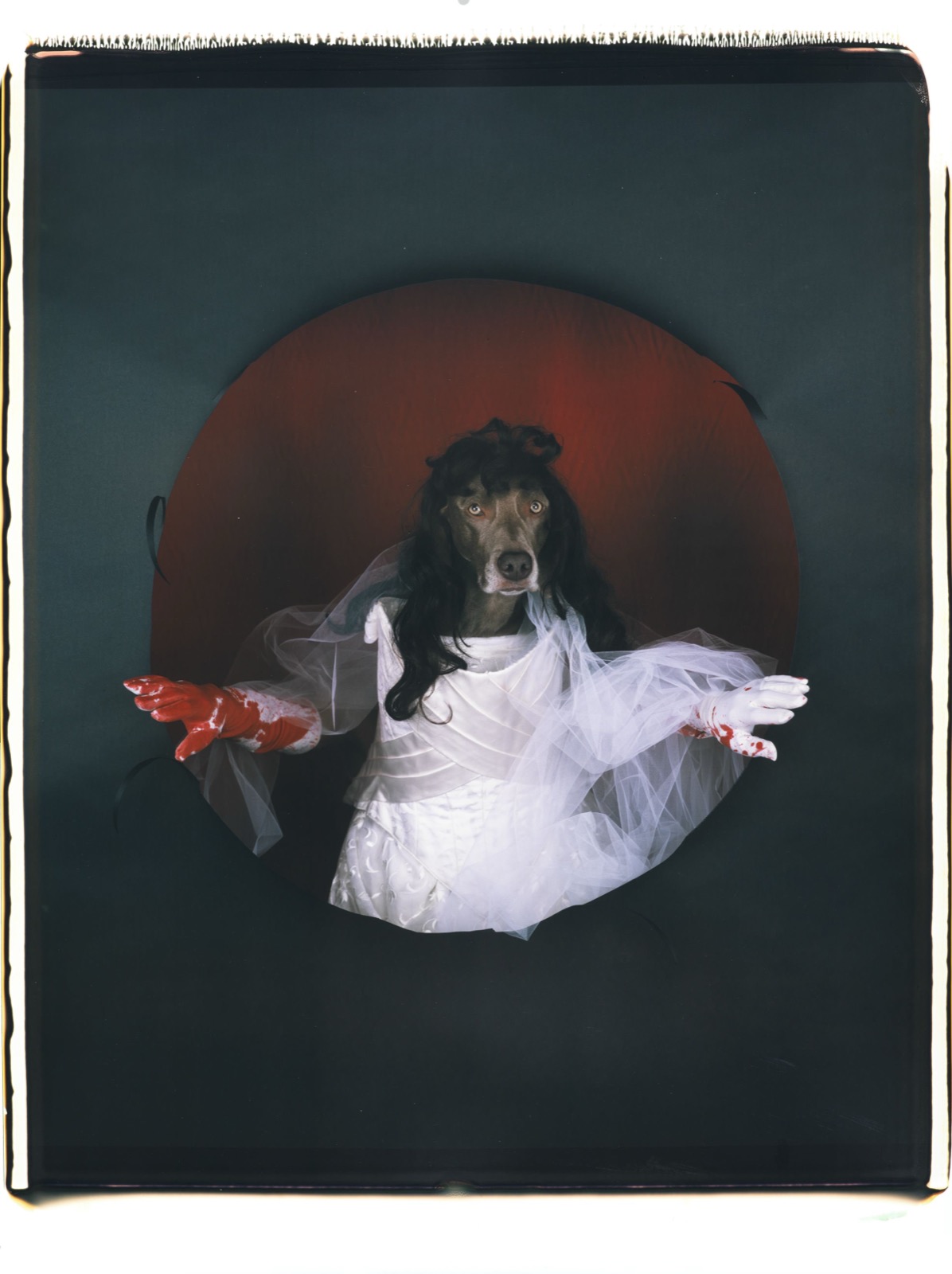
It's the paws that get you. Not the veil, not the black wig sliding off the dome of that long Weimaraner skull, not even the bridal satin — but the two red latex hands, splayed open at the end of the dog's actual forelegs, dripping like she's just come from somewhere unspeakable. Which, if you know your Donizetti, she has. This is the mad scene. Lucia has done the deed, and here she is presenting the evidence to a house she can't see, hands turned outward in that helpless what-have-I-done gesture, except the hands aren't hands and the singer is a dog and the whole thing is happening inside a torn hole in the dark that glows red like a furnace door left ajar.
I keep coming back to the eyes. Everything around them is pure costume — the wig is absurd, the tulle is a joke, the gloved paws are frankly grotesque — and then there are these two amber eyes looking straight out, completely level, not playing along and not refusing either. That's the trick Wegman has always pulled and never explained: the more ridiculous the get-up, the more dignified the animal underneath it. Sorrow leaks through the farce. You laugh, and then you don't.
It exists at all because of a machine the size of a wardrobe — Polaroid's 20x24 camera, which spat out one unrepeatable positive per exposure, no negative, no second chance, no retouching. So the lighting and the dog and the blood-paws all had to land in one breath. By 2007 the film was already vanishing, which makes the lush red and that velvet black feel like an aria sung knowing it's the last performance. Wegman's opera dogs began with a Met commission decades back; this is the same gag grown darker, and rarer.
It's the paws that get you. Not the veil, not the black wig sliding off the dome of that long Weimaraner skull, not even the bridal satin — but the two red latex hands, splayed open at the end of the dog's actual forelegs, dripping like she's just come from somewhere unspeakable. Which, if you know your Donizetti, she has. This is the mad scene. Lucia has done the deed, and here she is presenting the evidence to a house she can't see, hands turned outward in that helpless what-have-I-done gesture, except the hands aren't hands and the singer is a dog and the whole thing is happening inside a torn hole in the dark that glows red like a furnace door left ajar.
I keep coming back to the eyes. Everything around them is pure costume — the wig is absurd, the tulle is a joke, the gloved paws are frankly grotesque — and then there are these two amber eyes looking straight out, completely level, not playing along and not refusing either. That's the trick Wegman has always pulled and never explained: the more ridiculous the get-up, the more dignified the animal underneath it. Sorrow leaks through the farce. You laugh, and then you don't.
It exists at all because of a machine the size of a wardrobe — Polaroid's 20x24 camera, which spat out one unrepeatable positive per exposure, no negative, no second chance, no retouching. So the lighting and the dog and the blood-paws all had to land in one breath. By 2007 the film was already vanishing, which makes the lush red and that velvet black feel like an aria sung knowing it's the last performance. Wegman's opera dogs began with a Met commission decades back; this is the same gag grown darker, and rarer.